

Before the experiments begin, put your school’s science culture under a microscope.
A healthy school culture is vital to creating positive teaching and learning relationships among students and teachers. A healthy school culture can allow a new curriculum to flourish; an unhealthy one can drive the most promising new teacher out of the profession. All administrative leadership programs address school culture and how to support a healthy one. School leaders must understand school culture in order to ensure organizational effectiveness (Kruse & Louis, 2009).
But, what if we focus on how school culture applies to specific subjects and disciplines, say in mathematics, literature, or science? We would likely find different subcultures for some specific disciplines — and that may well represent a significant distinction. We propose that the culture of a discipline within the school is as important to successful teaching and learning as the overall school culture is for supporting organizational effectiveness.
For example, one of us recently attended her daughter’s graduation ceremony at an urban elementary school.
Teachers described the attributes of students who would be moving from primary to upper elementary school. Teachers recognized many students as “good readers” or “mathematicians.” Teachers hailed one child as a “go-to tech guy who could do anything on the iPad” and recognized three girls as “artists.” But out of 100 3rd graders, teachers called only one child a scientist and only one an inventor. By listening to the teachers, an essence of the school culture became clear: These children did not experience a culture of science teaching and learning in this school. The teachers did not identify with science as a discipline.
At this school, a specialist teaches science lessons to all 400 students on a rotating schedule, which means students rarely have scientific experiences in school.
School science leadership
The three of us have been designing and teaching a leadership academy for school-based teams of teachers and principals for seven years. The Academy for Leadership in Science Instruction was sponsored by the Merck Institute for Science Education, a branch of the pharmaceutical concern. The academy’s goals were to help school leadership teams develop and support effective science instruction in their schools. The teams were made up of education professionals from kindergarten through high school; they participated in the academy for three consecutive years, experienced 21 days of face-to-face academy curriculum, and conducted inquiries with their school-based colleagues as part of their leadership in their schools. Four cohorts completed the academy, comprising 337 participants from 62 schools in seven school districts.
Curriculum for this leadership experience included not only sessions on science instruction and new conceptions of science as described in the Framework for K-12 Science Education (National Research Council, 2012) and the Next Generation Science Standards (National Research Council, 2013) but also sessions on understanding and evaluating local school culture. We introduced the concept of culture with a broad and robust description:
The school culture is the complex pattern of norms, attitudes, beliefs, behaviors, values, ceremonies, traditions, and myths that are deeply ingrained in the very core of the organization. The culture is the historically transmitted pattern of meaning that wields astonishing power in shaping what people think and how they act (Barth, 2006, p. 160).
We discussed with the participants how their leadership team would learn to assess their working environment and professional relationships to develop an inquiry community of professional learners at their schools. These processes included developing a vision of effective science instruction with colleagues, developing and practicing a communication mindset, finding entry points for school-based inquiries, and engaging in inquiries that would move them toward effective science instruction for all students in their schools. Learning to notice, identify, and analyze their own school culture was an essential step in these teams’ leadership development.

We asked academy participants to read about school culture and discuss features of their school culture. We created an evidence-based inventory of the dimensions of school culture to help the teams take apart the larger idea of culture and look at specific elements of how people live and communicate values in their schools (see Figure 1). By using these dimensions of school culture, we intended that the teams would become better observers of their own living cultures and learn to “. . . take a fresh inventory of . . . habituated practice so encrusted in our schools’ cultures and to categorize them” (Barth, 2006, p. 164).
We also wanted the analysis to help the teams identify healthy parts of their school cultures as well as the “nondiscussables” (Barth, 2006) that they live with every day. Immediately, we were surprised by how many teachers on these leadership teams had never been exposed to the concept of living and teaching within a school culture. Principals knew about school culture and its powerful influence on teaching practices and professional collaboration. They could offer textbook definitions and speak to the importance of acknowledging that school cultures exist and that leaders need to know how to build and shape healthy school cultures. For teachers, however, naming and understanding their school culture was a revelation. The school culture inventory became a powerful avenue into conversations among teachers and the principals about teaching and learning in their schools.
Learning to notice, identify, and analyze their own school culture was an essential step in these teams’ leadership development.
These initial conversations about school culture helped teams identify cultural elements of their work that give shape to their daily experience in school: how curriculum is governed, how teachers interact informally in ways not governed by the school, how students engage in their coursework and identify with the academic disciplines, how the physical space of the building speaks to its inhabitants about what is important and what is valued. We next took a deeper dive with these school leadership teams to examine not just the abstract school culture writ large but the specifics of their school science teaching and learning culture.
What is a science teaching and learning culture?
Fundamentally, we asked these school leadership teams to examine how their school culture supports all students in learning science. We shifted the lens from a whole school culture view to a very specific focus on how students experience science in each school. For example, if visitors walked through the school:
- What impression about science teaching and learning would they take away?
- What would students say about science if someone stopped and interviewed them?
- Would all students be able to talk about science or only certain groups?
- What would they observe in the classrooms and public spaces that showed them the value placed on science in the school?
- What would parents say about science in this school?
- Do teachers other than science teachers know about the science rituals of the school: annual field trips, guest presenters, science fairs? How do they know about them?
We asked the teams 12 questions to guide their conversations and leadership planning. (See Figure 2, p. 46.) The initial activity was to identify what a school’s science teaching and learning culture would look and sound like if it were healthy, i.e., supportive of teaching science as described in the current reform literature (Banilower et al., 2008; Duschl, Schweingruber, & Shouse, 2007; National Research Council, 2012, 2013; Michaels, Shouse, & Schweingruber, 2008). The criteria for science culture health is that it must be based on science practices, focused on conceptual development, and built on the values of equity and access for all children. During the academy, the teams participated in core sessions focused on developing a vision of effective science instruction and included modeled instruction to help them see this vision in action. We also illustrated ideas of practitioner-led inquiry (Hubbard & Power, 1999), professional learning communities (Garmston & Wellman, 1999), and practical leadership (Sato, 2005).
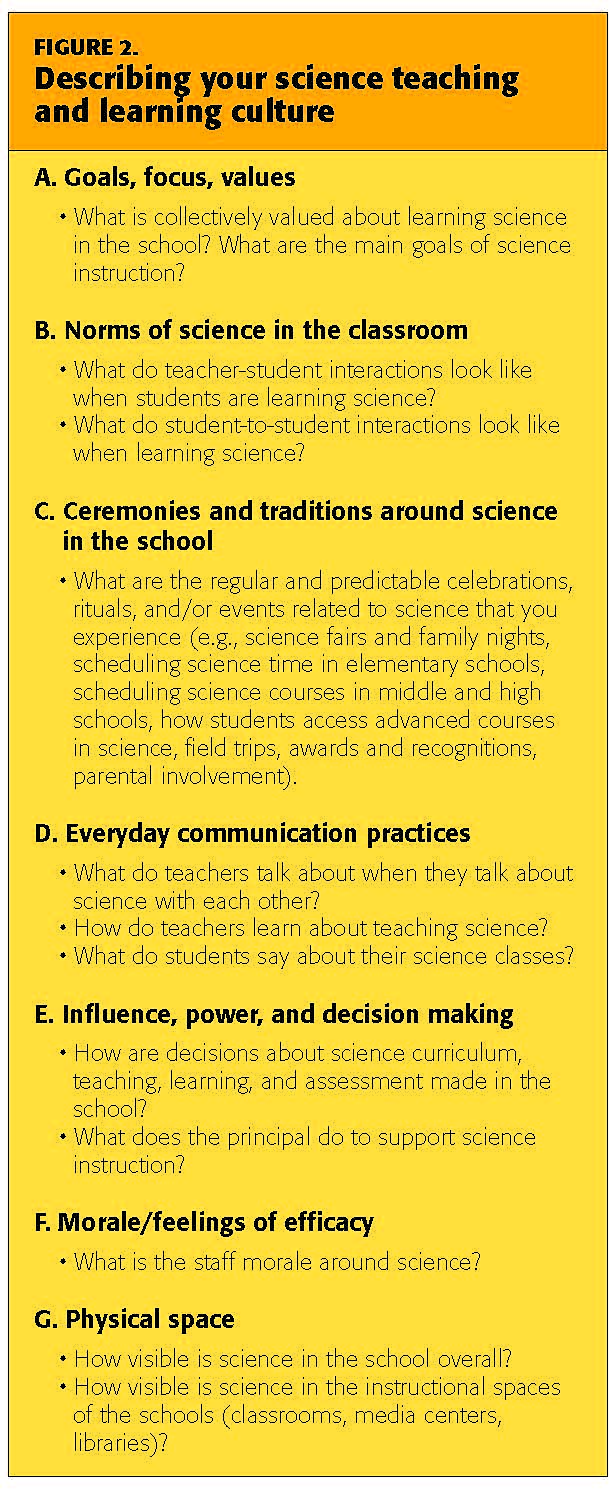
We then asked the teams to describe their own science teaching and learning culture. Ultimately, the teams conducted a gap analysis, noting how their school’s culture compared to a healthy science teaching and learning culture. This gap analysis gave the teams concrete starting points for focusing their engagement with their school colleagues in school-based inquiries and professional conversations about moving their school toward a healthy science teaching and learning culture.
For elementary school teams, the conversations almost immediately turned to not having time to teach science when teachers were under pressure to ensure better test scores in reading, writing, and mathematics. Even though schools maintained requirements for the amount of science instruction students should get each week, state and local accountability systems gave preference to other subject areas. Most of these districts had been through multimillion-dollar reforms in the 1990s that created science material resource centers. Now, teachers said well-intentioned teachers were returning unopened state-of-the-art curriculum kits to the district resource centers because they needed to focus on increasing their students’ reading and math skills.
Skipping time
Academy facilitators worked hard to get teams to talk about more than limited instructional time. When that happened, they realized how little they talked about science with other teachers; science was something each teacher did on his or her own, not a collective activity. Teachers tended to follow the science curriculum kit rotation schedule and not question how the kit curriculum fit into the other subject areas. Most school teams had teachers from multiple grade levels and when the conversations turned to which grade level taught which kit, for the first time teachers began to see a vertical articulation in how science concepts were structured across grade levels. Science might be present in many of these elementary schools, but these conversations left an impression that the schools did not have cultures that support students taking on a scientist identity or support teachers in feeling like science is part of the fabric of their school curriculum.
Conversations with secondary teachers first focused on students being unprepared for doing science and not having a work ethic to complete homework and turn in their work on time. Academy staff drew team members into conversations about science instruction and how students are encouraged (or not) to identify as scientists while learning science. Teachers complained about teaching in isolation and making up science instruction on their own. They also told stories about dominant teaching personalities within departments who created environments that did not support collaboration. Secondary teachers said class time is too short for laboratory work, leaving teachers to balance content coverage with engaging in scientific investigations. The norms of science interactions and the staff morale around science portrayed in these discussions evoked a sense of science teaching and learning cultures that were isolated within individual classrooms, constructed as a set of fragmented activities, and treated as a school requirement rather than something for students to look forward to every day.
A healthy science culture
Although the school teams in the academy were urban, suburban, small, and large, the culture analysis gave all of them starting points for conversations with colleagues about how to teach science more effectively as a collective endeavor.
One team said engaging their school colleagues took time, but building on their knowledge of school culture and their vision of what an effective science teaching and learning culture could look like, they were able to find some success. Said one academy participant:
I remember coming into the academy and feeling very overwhelmed. I couldn’t see how I would be able to bring these visions and practices back to my school knowing the toxic attitude of most of my colleagues. In the beginning, we hit road bumps, but we kept going. Our team began to get stronger as we experienced the activities and discussions at the academy. We began to see that we had to advocate better if we were to make any change. We also took suggestions on how to approach our “vision” with our principal and colleagues. At first, we didn’t see as many of our peers engage with us as we had hoped, but, as we kept planning events and professional development activities, we noticed more of our teachers wanting to help out. They started to join our PLC and engage in planning school events.
Another school team member commented on the collective responsibility for teaching science well within the school, not only relying on the individual classroom teacher to be successful on his or her own:
It takes a village to raise a child. Nurturing students to become productive members of a society is a collective effort. The entire school community where the student belongs is responsible for achieving this goal. Someone has to be the advocate for the students so science can be well taught. That advocate is me, and I must do it. But we are all in this together and have to work that way.
A school’s science teaching and learning culture is a micro-culture embedded in the overall school. As a practice, the culture of science is a way to manifest all that we hope students will engage in, identify with, and carry with them as future scientists — a mindset that is one of trying to figure out how things work, a knowledge base that helps one springboard into new areas of exploration, and a disposition to stay with an investigation through failure and success in the spirit of learning something new about the world every day. Ultimately, student scientists must learn science in a culture that emits the values, attitudes, and beliefs related to the science we want them to culturally live and breathe. A healthy science teaching and learning culture should surround students like water surrounds a fish that knows no other form of living.
References
Banilower, E., Cohen, K., Pasley, J., & Weiss, I. (2008). Effective science instruction: What does research tell us? Portsmouth, NH: RMC Research Corp., Center on Instruction.
Barth, R.S. (2006). Culture in question. In The Jossey-Bass Reader on Educational Leadership (2nd ed.), pp. 159-168. San Francisco, CA: Jossey-Bass.
Duschl, R.A., Schweingruber, H.A., & Shouse, A.W. (Eds.). (2007). Taking science to school: Learning and teaching science in grades K-8. Washington, DC: National Academy Press.
Garmston, R.J. & Wellman, B.M. (1999). The adaptive school: A sourcebook for developing collaborative groups. Norwood, MA: Christopher-Gordon.
Hubbard, R.S. & Power, B.M. (1999). Living the questions: A guide for teacher researchers. York, ME: Stenhouse.
Kruse, S.D. & Louis, K.S. (2009). Building strong school cultures. Thousand Oaks, CA: Corwin.
Michaels, S., Shouse, A.W., & Schweingruber, H.A. (2008). Ready, set, SCIENCE!: Putting research to work in K-8 science classrooms. Washington, DC: National Academies Press.
National Research Council. (2012). A framework for K-12 science education: Practices, crosscutting concepts, and core ideas. Washington, DC: National Academies Press.
National Research Council. (2013). Next Generation Science Standards: For states, by states. Washington, DC: The National Academies Press. www.nextgenscience.org
Sato, M. (2005). Practical leadership: Conceptualizing the everyday leadership work of teachers. The New Educator, 1 (1), 55-71.
Citation: Sato, M., Bartiromo, M., & Elko, S. (2016). Investigating your school’s science teaching and learning culture. Phi Delta Kappan, 97 (6), 42-47.
ABOUT THE AUTHORS

Margo Bartiromo
MARGO BARTIROMO is director of education programs at the Merck Institute for Science Education, Rahway, N.J.
Mistilino Sato
MISTILINO SATO is an associate professor and Campbell Chair for Innovation in Teacher Development at the University of Minnesota-Twin Cities, Minneapolis, Minn.
Susan Elko
SUSAN ELKO is former manager of education programs for the Merck Institute and a consultant to the Academy for Leadership in Science Instruction.