A conversation with Sham Bevel
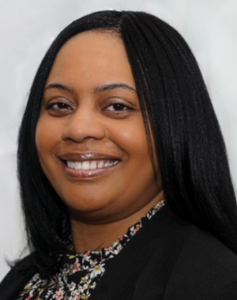
Sham Bevel
Sham Bevel wanted to be a dentist ever since the 5th grade. She graduated college with a degree in biology and took her dental entrance exam. But when a friend suggested she apply for a teaching job in Norfolk, Virginia, her career path turned in another direction. As Bevel says, “everything happens for a reason.”
At Norfolk Public Schools, Bevel taught middle school biology; she was a department chair and then a science instructional coach. Currently, she is the principal of Bayside Sixth Grade Campus in the Virginia Beach City Schools.
Bevel is one of three 2024 National Principal of the Year finalists. The award from the National Association of Secondary School Principals recognizes outstanding secondary school principals’ exemplary contributions to their schools, staff, students, and the profession.
A Title I school, Bayside Sixth Grade Campus has an enrollment of 317 students. The student population is 60% Black, and more than 70% of students are eligible for free or reduced-price meals. In her role, Bevel has integrated comprehensive literacy skills across subjects and diversified her math team’s teaching strategies, leading to dramatic improvements in Bayside’s state exam scores.
Those improvements led to the school receiving a 2023 National ESEA Distinguished School award, which recognizes positive educational advances and the outstanding academic achievement of students in Title I schools. Schools that earn this award have a poverty rate of at least 35%; demonstrate high academic achievement, including high academic growth; and meet or exceed state-determined accountability criteria.
Bevel said she “cried like a baby” when she heard the school had been awarded. “I felt so overwhelmingly proud of the work that we did, because I knew that that meant that we had been consistent, and our outcomes were unexpected,” she said. “Even without the award, I would have been proud, but the award was like the cherry on ice cream.”
Phi Delta Kappan spoke with Bevel about her path to becoming a principal, how principals keep their schools aligned and focused on their goals, and the importance of modeling expectations.
PHI DELTA KAPPAN: How did you become an educator?
BEVEL: When I was a little girl, I used to change my space into a classroom. I had the students represented by little pieces of paper, and my mother would have to come behind me and pick up the paper. So, it was something I thought about as a young child. When I was in college, it really wasn’t my goal. I was a biology major, and I thought I was going to be a dentist. But my best friend’s major was education. She would keep asking me, “Have you thought about being a teacher? You should do it.”
I wound up applying at Norfolk Public Schools, got an interview, and met my amazing first principal. I had a degree in science, but I didn’t have an education background. He took a chance on me, and it was the best change that I ever made. It was so rewarding for me, so exciting, because every day was different. I found that kids gave me a different kind of life, a different kind of purpose. I started and never stopped.
KAPPAN: What was your career path to the principal’s position?
BEVEL: I was a teacher, a department chair, and then a science instructional coach all in Norfolk Public Schools. When I became a department chair, I had great leaders who would bring up the possibility of me going into administration, and I’d say, “No, I don’t want to do that. I just want to be a teacher.” But my principal and my science coordinator would bring up different things and hint at the possibility. When I came to Virginia Beach, I started as an instructional specialist, and that was when it just really clicked for me. I really liked the leadership aspect of being an administrator because as a specialist, I was able to work with so many different teachers and principals. I realized that this work had a bigger impact than what I was doing just in my classroom. I figured out that I can have an influence over more students and more adults. I don’t know if I would have thought about being an administrator if I didn’t have leaders who put it in my head. Even when I was getting my leadership degree, I wasn’t quite sure that I was going to be a principal. But I knew that I did want to continue in leadership and education.
KAPPAN: You started in Virginia Beach as a central office administrator?
BEVEL: I was a science instructional specialist in the central office. After one year, I realized that I missed seeing the kids every day. I was visiting different buildings just about every day, but I didn’t know the kids’ names. It was such an eerie feeling sitting in a class and not knowing names or faces. I love data analysis, and I love curriculum planning, but I didn’t love not knowing names and faces and stories of the students. I decided to apply to be an assistant principal. I got into Virginia Beach’s program called LEAD for Aspiring Administrators. I applied for an assistant principal’s job, and within a week, I was interviewed. I was offered an administrative assistant position, which is like an assistant principal internship, so they can see if you can actually do the job. After a year, I was promoted to assistant principal at Great Neck Middle School.
My principal was an amazing leader. He sat me down from the very beginning and asked me, “What are your goals? Tell me what is it that I can support or help you do?” I said, “I just want to be an assistant principal.” He said, “You have to be thinking about the next step.” I was happy being an assistant principal. When the opportunity came to interview for this school, it was specific to this school. It was presented to me, and I said, “No, I’m going to stay as an assistant principal.” So many people called me and said, “You’d be perfect for that school.” I said, “I don’t think I’m ready to be a principal.” Then I spoke to another principal, and she told me, “You’ll never feel ready. You’ll always feel like you can learn something else.” It was that statement that made me apply. I never expected to get the interview, and then I didn’t expect to get the offer.
KAPPAN: Tell me about your school.
BEVEL: I have a cozy little school. It’s amazing. People say when you walk in our school it just feels different. We’ve worked hard to make sure that it has a family feel. When you’re here, you feel welcomed. Right now, I have about 317 little 11- and 12-year-olds running around. I have 17 core teachers, but altogether I have a staff of about 75, and we work closely together. It’s a small school, but because it’s a small school with high needs, we double and triple what we normally would do, because we don’t want the kids to ever feel like they’re missing anything. We are a Title I population. The kids have challenges in their communities, and those challenges sometimes end up in school. We came up with a mentor program. Almost every staff person in this building has seven to 10 student mentees. The school is built on making connections with kids, so they have a sense of belonging in a school. And that really has been the secret to our success, making sure we get to know our kids. Our school is built on building relationships. We do it with each other and we do it with our kids.
Our students come from a 4th- and 5th-grade elementary school. They come here for just 6th grade, and we’re the only 6th-grade school campus in Virginia Beach. And then they go to the 7th- and 8th-grade campus, and then they all go to a four-year high school. That’s part of the reason why we make relationships and belonging a big component of what we do here, because we don’t want them to feel disconnected. The good thing is they get to transition together. So quite often they know each other, but this is their first year where we have a few different schools that come together. We try to be very patient, understanding, and supportive of that change. And that’s why we spend so much time building relationships.
My teachers are phenomenal with that understanding. I’ve read a lot about how principals have to spend a lot of time teaching teachers about the needs of the community. I don’t. My teachers get it. They are so patient and understanding and supportive of our kids. When I get new teachers, they jump right in because it’s modeled for them by the administration, the staff, and the teachers. It takes a special kind of person to work at our school because you only have one year to make such a big difference.
KAPPAN: We know that principals have a huge impact on the success of the school and students, second only to teachers.
BEVEL: That impact has to do with our vision, our setting clear expectations, and our monitoring to make sure that things actually happen. The accountability piece is important. At the beginning of the year, I’ll talk about our focus areas, and then we’ll have an instructional leadership team meeting where we discuss how these things are going to happen and our plan for continuous improvement. These are all the steps that we plan to take to meet our goals. We all agree that this is what we’re going to do and how we’re going to do it. We talk about whether we need to add or to take away from that plan. Then I can align my leaders to make sure that’s happening within their departments. But if the principal doesn’t circle back and work directly with the leaders and get into the classrooms to make sure it looks the way it was envisioned, the whole plan falls apart. You must hold everyone accountable for the plan that you put forward at the beginning of the year. My staff cannot submit a request for resources, materials, programs, or events without making sure it’s perfectly aligned with our plan. I might say, “This sounds like it’s a lot of fun, but how does this support our vision and what we’re trying to do?” Principals make sure that alignment happens because sometimes staff members don’t see the full picture. It’s important that the principal makes sure that everyone sees that full picture and how everything works together.
This year, we did an alignment exercise so everyone could see all our different documents: our graduate profile strategic framework, our plan for continuous improvement, and our mission and vision. We talked about how this works here at our school and why we do what we do. We make sure that staff knows the purpose and the goal that directs alignment.
The principal models expectations. For example, if somebody walks in the front door, I’ll say, “How are you doing?” I might have to keep moving, but I’m modeling that when you see someone at the door, you welcome them. No matter how I feel inside, I try my best to smile and make a joke because we all are dealing with so much. It’s important that we show our kids our best so that they can do the same thing, because they carry a lot as well.
KAPPAN: How do you balance the two parts of your job: being the instructional leader and the management person?
BEVEL: Being an instructional leader is the easier part of my day. Most of my educational career has been on the instructional side. The monitoring of the classrooms, making sure we get professional development on the latest instructional strategies, giving feedback — that’s the easy part. It’s probably the part that I most enjoy because that’s where the learning happens.
I can plan for the expected parts of management. For budgeting and finance, I meet with my bookkeeper first thing in the morning or at the end of the day. I can plan drills, I can plan programs, and I can make those things happen by scheduling them. But unexpected things make you stop in your tracks, and you have to figure out who to call. Who can help us? Being in the central office my first year helped me to make a lot of great connections. But the instructional side is the fun side. The management is not so fun. And you don’t always learn that before becoming a principal. A lot of the management pieces you learn on the job at the time it happens.
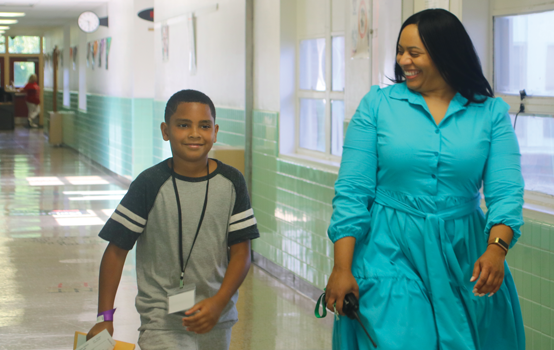
Photo courtesy of Sham Bevel
KAPPAN: How did serving as assistant principal prepare you for your job now?
BEVEL: Oh, my goodness, it was helpful. When I became a principal, my assistant principal was getting ready to go on maternity leave. I only had my dean, who typically deals with discipline. She hurt her ankle and had to be on leave. I had to do my job, and I had to pick up the assistant principal’s job. This was during the pandemic. I was able to do that because I had performed those same duties. It wasn’t new for me. I had already done it. It was a lot, but I was able to do it. If I didn’t have that experience, I don’t know what I would have done. Sometimes the central office can send a substitute administrator, but many times the substitute can’t do a lot of functions like special education and individualized education program (IEP) meetings.
I don’t think learning about the management and administrative pieces are as important as learning how to work with parents and deal with children. I think learning that skill is so important before becoming a principal. You can learn how to do all those other things. But really understanding how to deal with your community, how to build partnerships, and how to network for your school — those are things that you learn as an assistant principal that really help you in your principalship.
KAPPAN: You were a Black science teacher. Girls, especially Black girls, are underrepresented in the sciences. How do you think having you as a teacher impacted your students?
BEVEL: I do think that it makes an impact when they see you. I know this because of the emails that I get from former students. One Black former student just emailed me to let me know that she’s teaching science herself. I have another Black student who let me know that she graduated with a major in biology. She said she decided to major in biology when we dissected fetal pigs in 8th grade.
I try to make sure my students are exposed to STEM activities: Lego robotics, water robotics, STEM fairs, computer programing. I’m always looking for those opportunities because it’s about exposure. It’s not that Black girls can’t do, it’s that they’re not always exposed to it. But when they’re exposed to it, you find out how many of them love it and want to explore more.
Although we’re talking about science, I had a student last year, who when I introduced myself to her, she said, “I’ve never had a Black principal,” and I thought, I never did, either.
Being a Black woman, I can have a conversation with my students about my experience when I was their age. I can have those open conversations with them and their parents because we share the same culture. I don’t always think about being a Black principal, but I have to think about it because I’m visible. The kids see me, and I represent something. I always talk to them about representation, and I have to remember that it’s the same for me.
KAPPAN: What’s next for you?
BEVEL: I’m not really thinking about not being a principal, because I love what I do. Some days I could just scream. But I have so many more days that just make me laugh and put me in a good place. You know, I walk in the building with a million things on my mind. I have to do this after this. I have to email this person. Then I’ll just chill with the kids. I’ll think, “Oh, this is good.” They keep me young. Who doesn’t want a job where you can stay young?
This article appears in the December 2023/January 2024 issue of Kappan, Vol. 105, No. 4, p. 42-45.

ABOUT THE AUTHOR

Kathleen Vail
Kathleen Vail is editor-in-chief of Kappan magazine.
Visit their website at: https://pdkintl.org/