Cartoonish stories about a looming wave of conservative school board takeovers show that journalists need to guard against ‘catastrophizing’ the news — and to call out colleagues who fall prey to the habit.
By Alexander Russo
A week after the midterms, there’s something approaching a consensus that Republican candidates and conservative causes didn’t do nearly as well as expected.
And there’s nearly the same unanimity that “red wave” political coverage —over-reliant on polls, conventional wisdom, and speculation — was misleading and ultimately inaccurate.
What about education?
Alas, it was much the same.
National education stories kept hammering away at a frightening narrative that didn’t pan out, misleading readers and diverting attention from more pressing issues.
National education stories kept hammering away at a frightening narrative that didn’t pan out, misleading readers and diverting attention from more pressing issues.
In the weeks and months leading up to the midterms, there were just way too many credulous stories about Chris Rufo, Moms for Liberty, and extreme outrage of all stripes and flavors.
A sampling:

Above: Republicans want to win school boards. They’re winning in white counties by running on race. (USA Today)
“Already, some of these candidates have won big, taking over school boards in majority-white pockets of the country, buoyed by national money and big-name endorsements.”
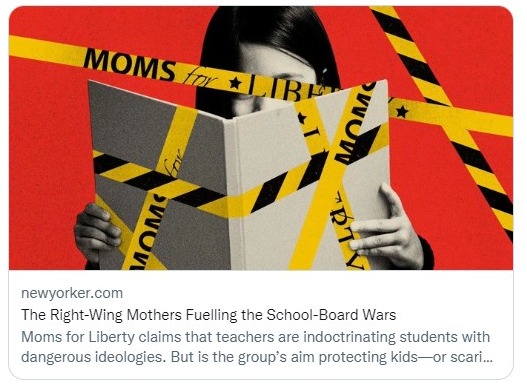
Above: The Right-Wing Mothers Fuelling the School-Board Wars (New Yorker)
“Moms for Liberty registered with the I.R.S. as the kind of social-welfare nonprofit that can accept unlimited dark money…The leaders had deep G.O.P. connections… A national phalanx of interconnected organizations…supported the suite of talking points about C.R.T.”
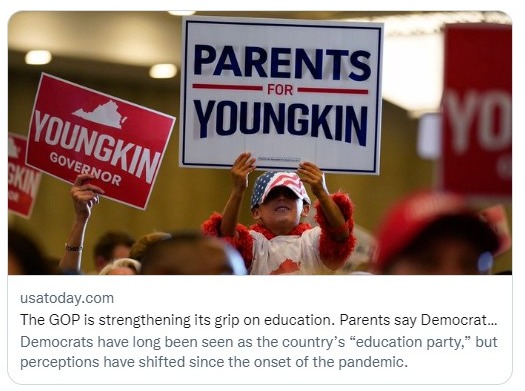
Above: The GOP is strengthening its grip on education. Parents say Democrats are to blame. (USA Today)
“The tide continues to turn in the GOP’s favor as Democrats struggle to mobilize and appeal to voters. And the implications could be vast, including greater privatization of public education, less federal involvement in schools and more restrictions on what students read and learn.”
Many others took the same approach.
However narrowly written and context-free they might be, these were by and large factually accurate stories about real events.
Many journalists would argue that these stories needed to be written.
But these stories didn’t need to be written so broadly or simplistically.
They didn’t need to imply that what was happening one or two (or 200) places was going to happen to a broad swath of the nation’s 13,000 school districts.
They didn’t need to suggest widespread culture-, curriculum-, and school-board “wars” all going in favor of the most conservative candidates.
They didn’t need to suggest widespread culture-, curriculum-, and school-board- “wars” all going in favor of the most conservative candidates.
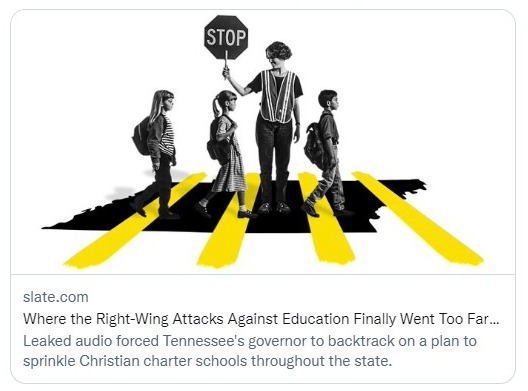
Above: Where the right-wing attacks against education finally went too far… for Republicans (Slate)
By comparison, only few outlets depicted the limited success of these efforts, the setbacks they had experienced, or countervailing efforts being implemented by other groups.
A late-July Slate piece reported how “the right-wing assault on public education has seemed nearly unstoppable over the past few years. But in Tennessee, the governor has discovered a limit.”
A July 25th oped in The Hill described how, “in places like Georgia, Montana, New Hampshire and New York, voters have rejected culture warriors running for school board, often doing so by wide margins.
A HuffPost told the story of a Boise student who won a school board seat running against a far-right candidate.
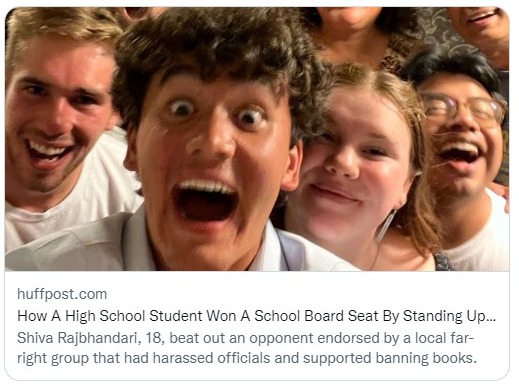
Above: Who could forget this image?
These aren’t the only examples.
A pre-midterm piece in Vox took a look at how school-related campaign advocacy had risen and fallen.
“Schools and CRT are so last year,” quipped an early November Slate story.
There were clues everywhere. But most stories just told readers to run for the hills.
There were clues everywhere. But most stories just told readers to run for the hills.
Few of these stories look very good in the aftermath of last week’s midterms.
Ron DeSantis won re-election in Florida along with nearly all of the school board candidates he backed. The Texas state school board took an increasingly conservative direction.
However, Democratic governors held on in Michigan, Wisconsin, Illinois, New York, and Colorado.
A slew of ballot referenda supporting additional spending on public education passed in states like Arizona and California. Preliminary analysis from Ballotpedia found that 361 school board winners in the general election were pretty evenly divided among those who opposed or supported COVID, race, and sex/gender issues — or didn’t have a strong or clear position.
The resulting coverage was, not surprisingly, reluctant.
The Wall Street Journal would only go so far as to admit that the results were “mixed.”
NBC News tucked the news that Republican candidates had done poorly in Texas suburbs into a much larger roundup.
The New Yorker suggested that conservative candidates and causes had done surprisingly well.
Only a few outlets like the Washington Post acknowledged that the midterm results “called into question the power of culture war education politics.”

Above: School culture war campaigns fall flat in some tight races (Washington Post)
Few education journalists want to talk about midterms coverage.
Everyone’s exhausted, frustrated, just trying to make it to the holidays, or think that looking back at pre-midterm coverage is a cheap shot.
But listen: I’m not asking journalists to be able to predict the future.
I’m not arguing that education-related coverage was worse than political news.
And I’m not asking them not to write about what’s happening.
I’m simply asking journalists to reflect on this persistent pattern of over-simplification and fear-mongering, to push back against thoughtless education coverage they might be asked to write — and to call it out loudly and persistently when they see others acting as what journalist Amanda Ripley calls “conflict entrepreneurs.”
Otherwise, readers will continue to be poorly informed about what people want and are most concerned about — and how they vote.
Previously from The Grade
The lamentable rise of ‘conflict’ journalism
People are fighting. Is that news?
‘Squid Game’ school board coverage isn’t helping
The culture war is the easy, less important story
Controversy-mongering coverage of social and emotional learning — and how to fix it.
Accuracy question plagues midterm 2018 education coverage
ABOUT THE AUTHOR

Alexander Russo
Alexander Russo is founder and editor of The Grade, an award-winning effort to help improve media coverage of education issues. He’s also a Spencer Education Journalism Fellowship winner and a book author. You can reach him at @alexanderrusso.
Visit their website at: https://the-grade.org/