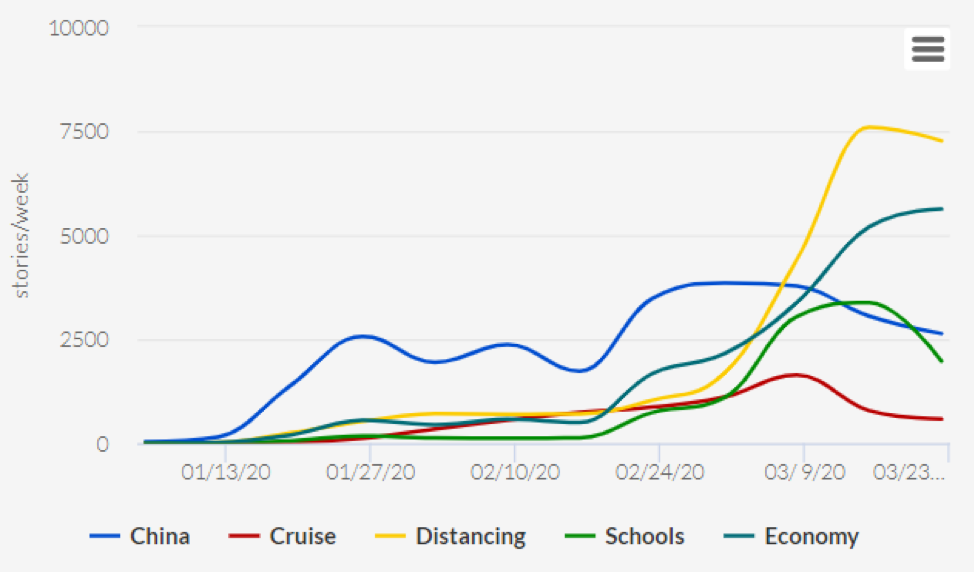
After a slow start, mainstream education-related COVID-19 coverage surged in the first half of the month, then fell sharply last week.
Over the past few weeks, the amount of school-related COVID-19 coverage produced by mainstream news outlets has seemed massive.
But a preliminary examination of the coverage using MIT Media Cloud tracking tool suggests that the amount of mainstream coverage (bright green line) grew only recently, relative to other related storylines, and peaked over a week ago.
Despite the profound impact that school closures have had on all communities, coverage of COVID-19 and schools was slow to gain attention and has been quick to decline — despite the fact that schools are still closed and remote learning solutions are still very much a work in progress.
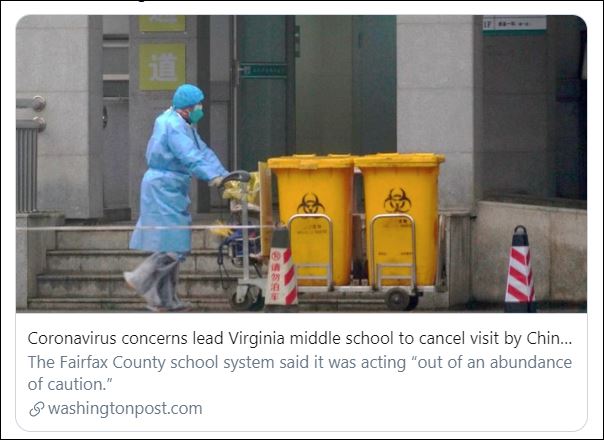
The first mainstream education-related COVID-19 story that we’ve been able to find was this early January Washington Post story about a canceled student exchange program (above).
After that, there was no immediate surge in the number of stories written about the virus and its relations to schools.
The number of stories about the connection between schools and the virus took several weeks to grow, relative to other terms.
The amount of mainstream coverage surged steeply in the first two weeks of March and fell off dramatically after that.
On Friday, March 27, there were 300 stories with the word “schools” — the lowest weekday number since March 6 (187) and less than half of the 765 stories that appeared just two weeks earlier.
In fact, stories featuring “schools” had the largest percentage decline (42%) among our five search terms, decreasing to 1,970 for the week.
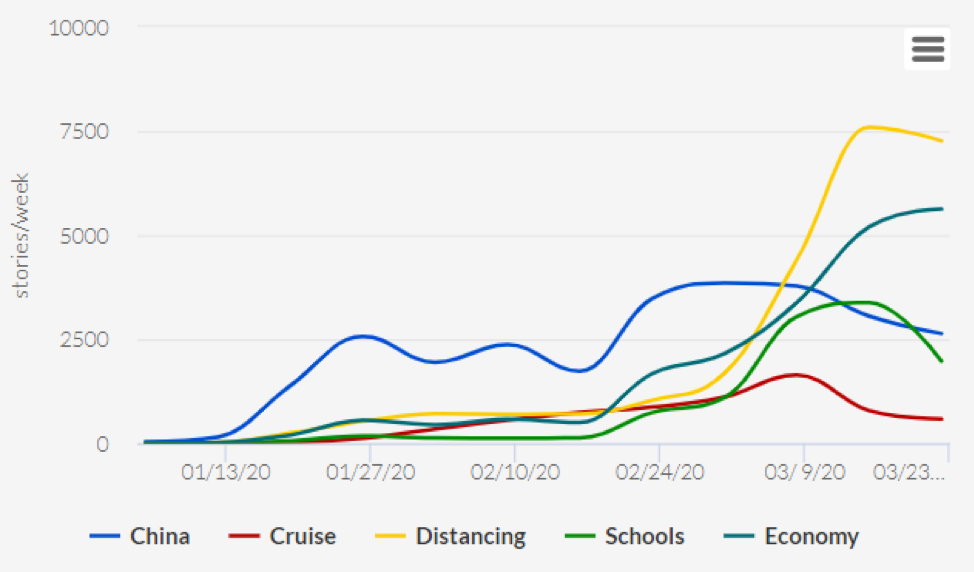
ABOVE: The bright green line represents the number of mainstream news stories featuring the impact of COVID-19 on schools in the first three months of 2020.
There are several possible explanations for the dropoff, including a turn towards the passage of the federal rescue package in DC, a chaotic and fluid news environment in which it was difficult to determine what new angles to pursue, and exhaustion from education journalists, many of whom are doing triple duty as parents, reporters, and at-home education supervisors.
In addition, there are not nearly as many mainstream education reporters working at traditional news outlets as there have been in the past. And this analysis does not include trade outlets, whose coverage patterns are likely much different.
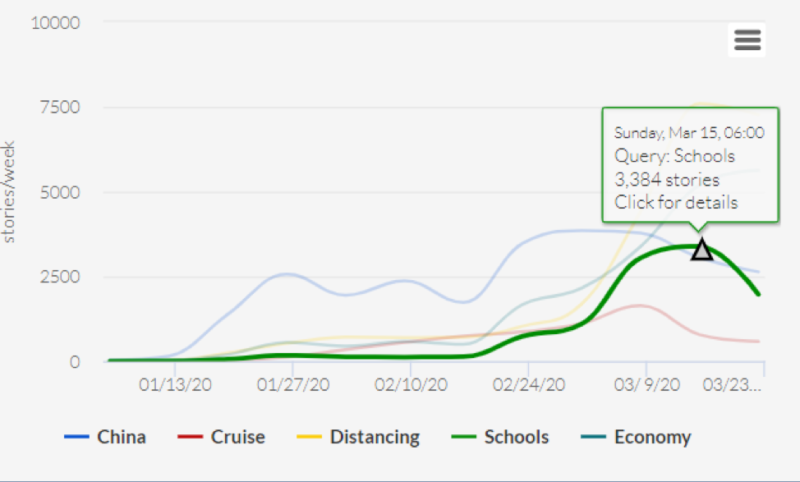
ABOVE: Mainstream coverage of the COVID-19 crisis and schools peaked the week of March 15th, then fell off sharply.
To obtain these results, we used the web site Media Cloud to conduct searches of top U.S. newspapers and digital native sources of 2018, based on research from the Pew Research Center, published in August 2019.
We used Media Cloud’s search functions to look for stories that contained the words “coronavirus” or “COVID-19” or “COVID19” along with other terms.
We conducted the searches for stories from Sunday, Jan. 5, 2020, through Saturday, March 28, 2020. (Take a look for yourself. Registration is required.)
These searches are but a small glimpse into news media coverage of COVID-19. Media Cloud is but one way to search media coverage, and the searches we conducted could have been constructed in many different ways, with different search terms, news sources, and date ranges.
ABOUT THE AUTHOR

The Grade
Launched in 2015, The Grade is a journalist-run effort to encourage high-quality coverage of K-12 education issues.