In this week’s newsletter: Students’ mental health struggles. School shooting hoaxes. The third anniversary of COVID school shutdowns. A Ukrainian student’s chaotic experience in a U.S. school. How to improve New England education coverage. Investigating serial school predators. The Washington Post education team expands. Journalism awards season kicks off.
STRUGGLING STUDENTS
The big story of the week
The big education story of the week is struggling students, who are reporting (and exhibiting) all kinds of distress at alarming levels. In New Jersey, a student who experienced bullying took her own life. A 5th grader stabbed a classmate in an after-school fight. The depth and breadth of the challenge are enormous.
This comes just a week after the CDC’s disquieting new report showing high levels of sadness among teenage girls in particular. “It all adds up to generational trauma that can’t be captured by any epidemiological curve,” writes Bryan Walsh in The ‘other’ long COVID, a powerful new overview in Vox.
While young people were largely spared the worst direct effects of COVID — making up just 0.3% of deaths — they may be among those most affected by the pandemic interruption, according to Walsh. Their academic, social, and emotional lives were interrupted for a lengthy period of time, and many experienced enormous amounts of fear, anger, and loss. The pandemic — and the measures the U.S. took to fight it — “will have long-lasting effects on them that we are only beginning to reckon with.”
For more about student mental health struggles and how educators are trying to help: NPR, K-12 Dive, Chalkbeat Newark, Washington Post.
Other big stories of the week:
SCHOOL SHOOTING HOAXES: Several schools in Colorado were placed on lockdown after police received calls reporting bombs or active shooters that turned out to be hoaxes (NewsBreak Denver, Denver Post). It’s part of a growing trend in schools called “swatting” — prank calls to law enforcement about false, but serious, threats. The prank also swept Oregon (KLCC). Last week it was Massachusetts (Boston Globe, CBS Boston, MassLive).
CHILDCARE SHORTAGES: Several stories this week spotlighted the fragility of U.S. childcare and after-school care systems. In Colorado, a bizarre child abuse case in which the alleged perpetrator is a 5-year-old has shut down a child care center — to the dismay of parents who are now scrambling (Colorado Sun). Rachel Cohen reported on the mess that is America’s after-school care system (Vox). And on top of shortages for necessities like formula and children’s medication, parents — particularly those who are low income — are also dealing with a shortage of childcare workers (The 19th).
NEWPORT NEWS SHOOTING: Still reeling from the recent shooting of a teacher by a 6-year-old, Virginia’s Richneck Elementary faced another threat this week. A fifth grade student sent text messages to classmates threatening to “pop some bullets” (Daily Press, Washington Post). Schools in the district have plans to install new metal detectors and hire more security officers by mid-March (Daily Press).

FROM WAR INTO CHAOS
The best education journalism of the week
The best education story of the week is Jill Tucker’s She fled the war in Ukraine but failed to find a safe haven in S.F. middle school in the San Francisco Chronicle (above).
The story describes a 13-year-old Ukrainian student named Yana who arrived in San Francisco in January and began school without much knowledge of the school system or English-speaking abilities. She joins a middle school full of students with their own struggles, witnesses student outbursts, experiences bullying, and eventually requests a transfer out of the school. “She had escaped war, but not bullying and bad behavior by classmates,” Tucker writes.
While stories about post-pandemic school challenges and the tensions between prevention and discipline have become commonplace, Tucker’s story provides vivid details and big-picture analysis. (The school’s “security action plan” response is wild.)
On the first anniversary of the war in Ukraine — and as the third anniversary of the pandemic school shutdown approaches — it’s well worth your time to read.
For more about Ukrainian students, check out Education in a war zone: a year in a Ukrainian school (Tes magazine).
BONUS
Chronic absenteeism climbs to record numbers in NYC schools (NY Daily News)
Public schools rely on paraprofessionals but pay meager wages (Boston Globe)
9-year-old Juanito and his mom join thousands of migrants arriving in Chicago (WBEZ Chicago)
Teachers Union’s big spending on Brandon Johnson for mayor draws criticism (Chicago Tribune)
CT ‘Parents Bill of Rights’ gets broad support in public hearing (CT Mirror)
Enrollment season compels conversation about educational equity (Washington Informer)
Meet the Black moms mobilizing parents in schools (Politico)
IMPROVING NEW ENGLAND SCHOOLS COVERAGE
What we’ve been up to at The Grade
This week’s new column is Colleen Connolly’s reported analysis of New England’s education coverage.
“There are a lot of talented education journalists in New England,” writes Connolly, who’s been tracking regional news for more than two years for The Grade. “But the immediacy and accountability coverage of education one can see in other parts of the country is too often missing.” Also missing: A sense of urgency and regular collaboration.
“You could argue that this same phenomenon plagues education reporting in lots of places that feel very assured their schools are above average,” tweeted The 74’s Beth Hawkins.
📌 Follow-up: Last week, I urged journalists to reconsider school shooting coverage. This week, a group of Philadelphia researchers are urging journalists to reconsider everyday gun violence coverage. Something’s gotta change. 📌
REPLICATING SCHOOL TURNAROUND IN CO
Coverage of promising school innovations & signs of progress
💡 Despite the system working against her, a Tacoma mom managed to get her special needs son into a school where he would grow rather than languish (Seattle Times/ProPublica). See the Times and ProPublica’s other reporting on this topic.
💡 State officials in Colorado are using successful school turnaround cases out of the city of Greeley to inform transformation efforts at other struggling schools (Chalkbeat Colorado). For a different perspective, read about how one district has resisted state-mandated reorganization.
💡 Schools in Kansas City, Kan., cut student homelessness in half using a model that other districts in the state are now replicating (KCUR).
💡 From home visits in Connecticut to expanded pre-K in Hawaii, states across the country are responding to pandemic-related student disengagement and distress with a variety of measures, some of which have already posted encouraging results (The 74).

PEOPLE, AWARDS
Who’s going where and doing what
Above, from left to right: The Washington Post’s Hannah Natanson, Karina Elwood, and Nicole Asbury are making moves on the ed team.
🔥 Career moves: The Washington Post announced new roles for some of their education team, including a new national beat assignment covering school culture wars for Hannah Natanson, a new gig covering Virginia schools, and a permanent assignment for Nicole Asbury covering Maryland schools. Also: former freelancer Lisa Rowan is taking a job at Cardinal (Virginia) News, where she’ll be the only full-time education reporter in the state west of Richmond — which is most of the state. Follow her here.
🔥 Awards: The George Polk award winners for education goes to New York Times investigative reporter Brian Rosenthal and Metro ed reporter Eliza Shapiro for their investigation into the failings of New York’s Hasidic schools. The duo are also finalists for the Goldsmith prize. It’s Rosenthal’s third Polk award in six years — including a previous award for his 2016 reporting on special education denials in Texas for the Houston Chronicle. “At its best, investigative journalism is about exposing when powerful forces are failing vulnerable people — and, unfortunately, that is often the case in schools,” he wrote to us in an email, noting that he began his career as a beat reporter covering public schools in Seattle. “The stakes of education are so high; it affects our children, our communities, our future.”
🔥 Prowling for predators: Predatory teachers too frequently find their way back into classrooms, as this week’s horrifying stories in Voice of San Diego and the SF Standard remind us. Complicit school systems and lax state laws are often to blame. So it’s great to know that Insider’s Matt Drange — who wrote a memorable piece about the predatory journalism teacher at his alma mater — is investigating the problem nationally. If the FOIA he got back from Fall River, Mass., schools is any indication, some school districts have a lot to hide.
🔥 Appearances: The Wall Street Journal’s Tawnell Hobbs was on This Morning with Gordon Deal talking about how TikTok is a venue for child sexual exploitation. The Washington Post’s John Woodrow Cox was featured on a Post video where journalists who’ve covered school shootings discuss the reporting moments that have stuck with them most. Freelancer Sarah Carr was on the SeeHearSpeak podcast talking about inequities in education. Chalkbeat’s Alex Zimmerman and The City’s Yoav Gonen were on WNYC to discuss New York City’s efforts to move away from its most widely used reading curriculum.
🔥 More awards: The American Association of Colleges for Teacher Education honored former Howard University ed school dean Leslie Fenwick with the Gloria J. Ladson-Billings Outstanding Book Award for her book “Jim Crow’s Pink Slip: The Untold Story of Black Principal and Teacher Leadership.” In November, Fenwick wrote for The Grade about the white media’s failure to tell the story of Black educators being displaced after Brown v. Board.
🔥 Job openings & scholarships: California’s EdSource is hiring an editor. See previous versions of the newsletter for jobs that may still be open. A scholarship for Virginia students who want to pursue a degree in journalism has been created in honor of Sierra Jenkins, the Virginian-Pilot education reporter who was killed in a shooting last year. The deadline to apply is March 1.
🔥 Layoffs: NPR joins CNN, The Washington Post, and other media outlets in announcing layoffs. No word yet on whether education reporters will be among the estimated 100 staffers who will be laid off.

APPEARANCES, EVENTS, & NEW RESOURCES
What’s happening and new research
Above: Vox has a big new package of education-related stories called Progress Report: America’s Schools, edited by former education reporter Libby Nelson and featuring work by Rachel Cohen, Matt Barnum, and others.
⏰ Podcasts, documentaries, etc: WNYC’s Notes from America podcast covered the battle over Black studies. WBUR’s On Point looked at how to improve teaching about slavery. The new documentary The Right to Read will be available for free online for a week beginning March 2 in celebration of National Reading Month — and in conjunction with a screening of the documentary at SXSW EDU. And Colorado Public Radio released their latest TedX video in their series of first-person high school perspectives, this one about self care.
⏰ Pandemic anniversary: Three years ago in January, a Virginia middle school canceled a visit from Chinese exchange students — the first reported instance of a school-related COVID event that I know of. Three years ago this Monday is the anniversary of what’s said to be the first high school in the nation to shut down due to COVID concerns. By the end of March, nearly every school in the nation had been shuttered. Some would say that they still haven’t returned to normal.
⏰ Journalism resources: From The Fix, read about five manageable ways to introduce solutions journalism to your newsroom. For Poynter, reporter Valerie Vande Panne offers tips for non-Natives covering Indigenous communities. The Palm Beach Post’s Kati Kokal shared an interesting map showing the states that track menstrual history: “From one data viz nerd to the next, this map is awesome.”
⏰ Media criticism: AEI published an analysis and critique of the media’s “slanted coverage” of Biden’s student loan forgiveness plan. “A surprising number of news accounts seemed more intent on helping borrowers take advantage of Biden’s proposal than helping readers assess its legality or merits,” the authors wrote. On The Daily Show, comedian Sarah Silverman took aim at the anger- and fear-generating mainstream media.
⏰ Reader mistrust: According to a new report featured in Nieman Lab, many Americans “feel distrust on an emotional level, believing news organizations intend to mislead them and are indifferent to the social and political impact of their reporting.” Hate to say it, but they’re not wrong.
THE KICKER
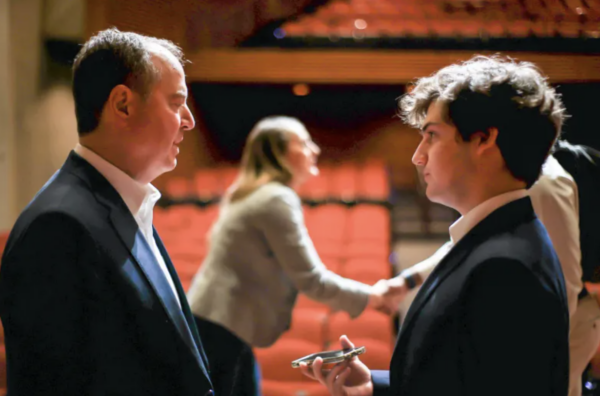
Big congrats to Polk award winner Theo Baker (above right) of the Stanford Daily, who won for his investigation into the university president’s shoddy research. It was the first time an independent student-run newspaper has won the prize.
That’s all, folks. Thanks for reading!
Reply to this email to send us questions, comments or tips. Know someone else who should be reading Best of the Week? Send them this link to sign up.
Using Feedly or FlipBoard or any other kind of news reader? You can subscribe to The Grade’s “feed” by plugging in this web address: http://www.kappanonline.org/category/the-grade/feed/.
Read more about The Grade here. You can read all the back issues of The Grade’s newsletter, Best of the Week, here.
By Alexander Russo with additional writing from Colleen Connolly.
ABOUT THE AUTHORS

The Grade
Launched in 2015, The Grade is a journalist-run effort to encourage high-quality coverage of K-12 education issues.
Alexander Russo
Alexander Russo is founder and editor of The Grade, an award-winning effort to help improve media coverage of education issues. He’s also a Spencer Education Journalism Fellowship winner and a book author. You can reach him at @alexanderrusso.
Visit their website at: https://the-grade.org/