0
(0)
In this week’s newsletter: Schools grapple with addressing student mental health needs. NPR’s Anya Kamenetz describes how education reporters’ pandemic coverage ‘could have been a lot louder’ (then announced her departure). And the Miami Herald’s Sommer Brugal asked the Washington Post to credit her paper’s coverage — and succeeded.

MENTAL HEALTH IN SCHOOLS
The big story of the week, according to us:
The big story of the week is schools’ responses to students’ mental health needs, which are becoming one of the major education stories of the pandemic. In reaction to reports of behavior problems, absenteeism, and other indications of student distress, schools are trying to provide increased mental health supports including hiring more counselors or launching new prevention programs — even as some parents and educators question whether schools are the appropriate entity to provide these supports:

🔊 Schools Are Tackling Mental Health This Summer (WSJ)
🔊 New Alabama school counselor role ‘important’ for improving schools, student mental health (AL.com)
🔊 How one rural SC school district is tackling the in-school therapist shortage (Post and Courier)
🔊 This Fresno school opened safe space for students 12 years ago. Now the idea is spreading (Fresno Bee)
🔊 After Uvalde shooting, Texas leaders will spend more than $100 million on school safety, mental health (KHOU Houston)
🔊 As Mental Health Crisis Rages, Michigan Schools Work to Boost Kids’ Connection (The 74)
🔊 New Ken Burns PBS documentary offers raw look at the youth mental health crisis (LA School Report)
🔊 Mental health: Is that a job for schools? (Christian Science Monitor)
🔊 The Deep Divide Over School Mental Health Services (Have You Heard)

Two other big stories this week: A new report from the California Department of Ed shows that nearly 20% of classes in the state are taught by teachers without proper credentials or qualifications (KQEDEdSourceLA TimesSan Diego Union-TribuneMercury News). And: Following a tumultuous year during which the district narrowly avoided state receivership, Boston Public Schools has a new superintendent (Boston GlobeWBURBoston HeraldGBHCommonwealth magazine). See “resources” for national data on teacher qualifications and district mental health spending.

RAPID GENTRIFICATION & VARIED DISRUPTIONS
The best education journalism of the week, according to us:
🏆 BEST: The best story of the week is “Gentrification on steroids” squeezes out Latino students, raising fears of Denver school closures by the Denver Post’s Jessica Seaman. Seaman looks into a report showing declining enrollment in Denver and finds that it’s not just the pandemic that contributed to the decline. Gentrification is another factor. And its effects are being felt most by Latino students. Here’s how it works: In 2012, Latino students made up 58% of the district’s population. Last year, the number was down to 52%. The number of white students rose by five percentage points. Due to Denver’s school choice, students don’t have to attend their neighborhood schools, so when richer and whiter families move into lower income neighborhoods, the neighborhood school may lose enrollment and the school may eventually close. “What are we going to do when there’s no more people of color living in Denver?” asks one education advocate quoted in the story. Housing and education are two issues that so often go hand-in-hand, but I don’t usually see stories that spell it out so well.

See also the New York Times’ story about the decline of middle-class neighborhoods, which makes school districts even more likely to reinforce inequality

🏆 RUNNER-UP: This week’s runner-up is Pandemic effect: More fights and class disruptions, new data show by Chalkbeat’s Kalyn Belsha. Despite the headline and past coverage suggesting widespread increases in student behavior problems, Belsha’s deep dive into data on classroom disruption shows a high degree of nuance. Just 1 in 3 school leaders saw increases in student fights compared to before the pandemic, according to federal data Belsha reports. And several districts including Dallas, Houston, and New York City reported decreases. Belsha also includes valuable insights from educators. One assistant superintendent in Kentucky acknowledges the stress and trauma that kids went through in the pandemic and empathized with their efforts to adjust back to being in the classroom. A Bronx teacher attributes some of the acting out to kids’ embarrassment at being behind in their work — and worries more about attendance than misbehavior. Student behavior and classroom safety are critically important issues, but we need nuanced coverage like this to avoid exaggerating the problem for readers and policymakers.

BONUS STORIES:
🏆 The Education of Glenn Youngkin (Time)
🏆 School Board Candidates Who Criticized Hiring of a Black Educator Lose Their Elections (ProPublica)
🏆 Frustrated law enforcement officials say Boston schools leaving them in the dark (Boston Globe)
🏆 High school almost didn’t happen for this Philly teen. Now the Honduran immigrant is going to college. (Philly Inquirer)
🏆 Native American Kids’ Schools Are Crumbling And Unsafe. Congress Won’t Fix Them. (HuffPost)
🏆 How a small, Michigan college is helping DeSantis reshape education in Florida (Miami Herald)
🏆 Texas town’s frequent book bans prompt residents to file a civil rights lawsuit (Houston Chronicle)
🏆 Celebrated all-boys charter school in Chicago cited by CPS for ‘dismal’ financial management (WBEZ Chicago)

*Note: Since there was no newsletter last week, some of these stories go back all the way to June 24.

Share
Tweet
Forward
‘WE COULD HAVE BEEN A  LOT LOUDER’
New commentary from The Grade
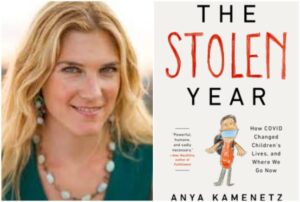
Above: Former NPR education correspondent Anya Kamenetz and her forthcoming book. 

On Wednesday, we published a profile of NPR education correspondent Anya Kamenetz featuring her critical assessment of the education beat’s pandemic coverage. Then on Thursday, she announced on Twitter that she was leaving NPR.

Congrats to Kamenetz on her big move, and thanks for the coverage and the candor. We need more journalists producing strong coverage and talking publicly about what education journalism needs to do better.

Even now, says Kamenetz, the full extent of the damage that was done by prolonged districtwide school closures “doesn’t get told.”

Follow me at @alexanderrusso for thought-provoking commentary on education journalism all day, every day.
PEOPLE, JOBS, AWARDS
Who’s doing what, going where
Above: This week’s job movers include (clockwise from top left) EWA’s Kim Clark, WHYY’s Avi Wolfman-Arent, The Post and Courier’s Devna Bose, and Chalkbeat Newark’s Jessie Gómez.

🔥 Job moves: In other job moves, WHYY’s Avi Wolfman-Arent has moved full-time from education reporter to host of the Philadelphia public radio station. Devna Bose has left the Charlotte Observer for The Post and Courier’s education lab, where she’ll be covering the Charleston County school district. Chalkbeat Newark has hired Jessie Gómez, who comes from NorthJersey.com. EWA deputy director Kim Clark is stepping away from the organization, which is going through a leadership change.🔥 Rescued: Emily Hanford says her team’s education work will continue as part of MPR News after the media company shut down APM Reports, the organization that had previously housed her efforts. Hanford has done some of the best work on literacy — which we’ve highlighted before — and we hope that’ll continue in the new set-up.

🔥 Awards & belated congrats: Colorado Public Radio’s Jenny Brundin won a Public Media Journalists Association award for her series on the child care workforce. The CT Mirror’s Ginny Monk won an Arkansas SPJ award for her previous reporting at the Arkansas Democrat-Gazette on deaths by child abuse in the state. Congrats to both!

🔥 Books: Former Boston Globe Great Divide editor and current O’Brien fellow Sarah Carr is working on a book “following a diverse set of families as they attempt to help their children become literate.” InsideSchools founding editor Clara Hemphill has a new book coming next year about why school segregation is so persistent even in racially integrated neighborhoods. Journalist Mosi Secret’s book “Teaching Them: The 1960s Experiment to Desegregate the Boarding Schools of the South” will come out in 2023 with Little, Brown.

🔥 The Miami Herald’s Sommer Brugal called out the Washington Post for mining her story about religious views in teacher training without proper attribution — and it worked. “Hey @washingtonpost, please consider attributing who first reported this story, especially if you’re going to quote one of the 3 teachers in the original piece.”

EVENTS, REPORTS
Appearances, podcasts, & new resources. 
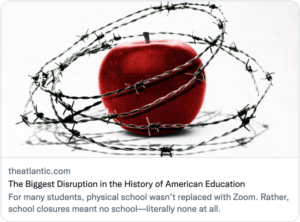
Above: ICYMI, The Atlantic published a devastating story describing how for many kids remote learning meant no learning

⏰ Appearances: The 74’s Mark Keierleber was on MIT Technology Review’s podcast In Machines We Trust talking about student surveillance technology. The Atlantic’s Adam Harris was on the Higher Voltage podcast talking about his book “The State Must Provide” about inequality in higher education. Freelancer and author Linda K. Wertheimer was featured on an episode of World Channel’s Stories From the Stage telling a personal story about her Jewish identity. Last week, she also wrote for us about what reporters should know about religion in schools. Former NPR education correspondent Anya Kamenetz is scheduled to appear at the NASSP summit next week.

⏰ Podcasts & documentaries: WHYY’s Schooled podcast has an episode out on how a proposed book ban in the Central York School District gained national attention — and met defeat. Vice News has a new documentary on an alleged sexual assault coverup in Charlotte schools. And check out the new documentary about the scandal at Louisiana private school TM Landry.

⏰ Resources: According to a Future Ed report, 31% of school districts in blue states are planning to spend money on SEL. According to NCTQ, state teacher qualification reports vary widely. An EdChoice report breaks down how teachers spend their time, with almost three quarters spending less than five hours each week working outside the regular school day. Results from a Gallup poll show that confidence in schools is down four percentage points since just last year. (Confidence in newspaper journalism is also down five percentage points.)


THE KICKER

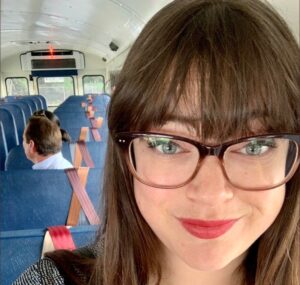
Riding on a bus today for work!,” tweeted Naples Daily News’ Nikki Ross, working on a story about driver shortages and longer bus routes.
That’s all, folks. Thanks for reading!

Reply to this email to send us questions, comments or tips. Know someone else who should be reading Best of the Week? Send them this link to sign up.

Using Feedly or FlipBoard or any other kind of news reader? You can subscribe to The Grade’s “feed” by plugging in this web address: http://www.kappanonline.org/category/the-grade/feed/.

Read more about The Grade here. You can read all the back issues of The Grade’s newsletter, Best of the Week, here.

By Alexander Russo with additional writing from Colleen Connolly.

ABOUT THE AUTHOR

default profile picture

The Grade

Launched in 2015, The Grade is a journalist-run effort to encourage high-quality coverage of K-12 education issues.

How useful was this post?

Click on a star to rate it!

Average rating 0 / 5. Vote count: 0

No votes so far! Be the first to rate this post.