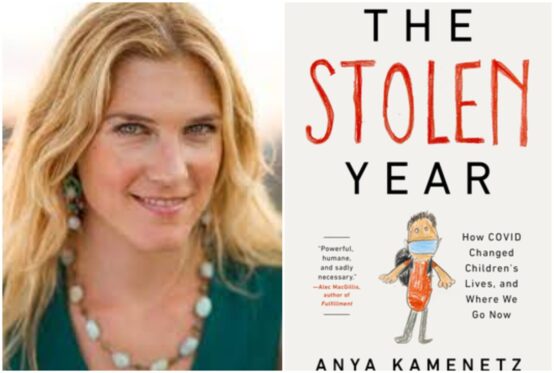
Pandemic education coverage failed to capture the losses vulnerable kids and working-class families were experiencing, says NPR’s K-12 education correspondent.
By Alexander Russo
I have often been disappointed during the past two years tracking education beat coverage of schools’ pandemic responses.
However, there have been a small number of education reporters doing invaluable work. Chief among them has been NPR’s Anya Kamenetz.
Among national education reporters working for mainstream outlets, Kamenetz’s efforts covering the pandemic are the strongest I’ve seen.
Her work has been independent and creative, regularly focused on kids and families, — and always cognizant of in-person school’s many functions beyond academics or potential COVID transmission.
“I knew that we didn’t have a scientific consensus” around the need for school closings, she told me recently. “We needed social science expertise, not just medical expertise, to decide what was best.”
Kamenetz also stands out among most education journalists for being willing to reflect and comment publicly about media coverage — hers and others’.
In a recent phone interview, she described herself as having been “too timid” about taking risks involved in field reporting on vulnerable kids most adversely affected by forced homeschooling.
Most of all, she says that she and other education reporters didn’t “talk loudly enough and in enough detail” about the harms to kids that would likely result from blanket school shutdowns that were often prolonged.
“It was all easy to predict, so we could have been a lot louder.”
“We could have been a lot louder.” – Anya Kamenetz
It’s no secret that I’m an admirer of Kamenetz’s work, which was featured in last year’s roundup of best education journalists and a review of EWA award finalist hits and misses in which I noted that her work deserved recognition.
However, I’m not alone in admiring her efforts. Kamenetz just won the AERA prize for excellence in journalism about education research.
“I think what stands out about Anya’s pandemic reporting is that she’s exploring the questions that families really want answers to,” author and Brookings fellow Jordan Shapiro told me in an email.
She’s not the archetypal longform narrative audio storyteller we might associate with NPR along the lines of This American Life contributor Chana Joffe-Walt or WBEZ Chicago’s Linda Lutton.
I wouldn’t call her a stylist, really, though she does use words during interviews that I have to look up later.
But she’s not a no-narrative wonk, either, despite her comfort with academic research studies.
And she’s certainly not a middle-of-the-road, cover-what-everyone-else-is-covering kind of beat reporter.
“She is constantly challenging the conventional wisdom of education reporting,” emailed NPR education editor Steve Drummond, who also praises her “passion for finding, and including, the voices of the people affected by the policies we write about.”
“She’s exploring the questions that families really want answers to.” – Jordan Shapiro
From the start, her pandemic coverage often differed from that of other national education reporters.
For example, her June 2020 story What Parents Can Learn From Child Care Centers That Stayed Open During Lockdowns was among the first — and only — national education stories about schools and centers created to serve the kids of essential workers in NYC and other places.
Her September 2020 story ‘Learning Hubs’ Offer Free Child Care And Learning — But Only For A Lucky Few was again among few stories I saw revealing that some kids were going to school, raising questions about the necessity of blanket shutdowns that many districts imposed.
In other hands, the results of taking a broad approach to the beat could be mushy and unfocused. But Kamenetz’s stories are sharp, timely, and memorable.
For example, see her stories about the irrelevance of education culture wars to most parents or the intersection between climate change and school construction.
And, while Kamenetz isn’t blind to the many challenges teachers have been experiencing during the pandemic, she doesn’t reflexively circle back to teachers’ or school districts’ perspectives the way so many others do.
Arguably more than any other national education reporter, Kamenetz has hammered home the disastrous effects of prolonged school shutdowns and blanket remote learning.
In the video introduction to her forthcoming book, The Stolen Year, Kamenetz notes that “the cost of closing our schools for so long” may have been well-intended but “has not yet been fully reckoned with.”
“If you look at schools only through the lens of how they may or may not spread diseases, you would make very different decisions.” – Anya Kamenetz
Asked to reflect on the last two years of COVID-related education coverage, Kamenetz noted that it was education reporters’ responsibility to make sure that COVID education stories didn’t solely report about schools on the basis of disease spread risks, as a health or science reporter might do.
“Because if you look at schools only through the lens of how they may or may not spread diseases, you would make very different decisions” than if you looked at them more holistically.
Generally speaking, however, education reporters didn’t meet the challenge of producing detailed, robust coverage of “the large numbers of children who were not attending school at all, the large numbers who were going hungry, and the ones who were potentially unsafe.”
A contributing factor was that many education reporters seemed to lack an independent series of community network relationships that would have let them report on kids suffering during remote instruction, independent of school district sources.
“Reporters need to have those really tight, on-the-ground connections with community groups to find these kids,” says Kamenetz. “And make sure that we know where they are before the next disaster happens.”
She found one main character in her book by calling homeless outreach coordinators at eight or nine school districts, another by reaching out to homeless services organizations. And yet, despite her efforts, she says she could have done better if she hadn’t been “too timid” about getting herself and her family sick:
“I wish I could have spent more time in schools, traveled around the country, and tried harder to find the kids who no one was finding,” she told me. “They were outside the Dollar Store, living in shelters, working in fast food restaurants.”
Even now, two years later, she says there’s not enough reporting on kids who haven’t returned to school full-time.
“We know a lot of kids are missing,” says Kamenetz. “But we can’t find them because the districts can’t find them. And so the story doesn’t get told.”
“We know a lot of kids are missing, but we can’t find them because the districts can’t find them. And so the story doesn’t get told.” – Anya Kamenetz
Kamenetz hasn’t become a lightning rod for her pandemic coverage like some others, but she has her critics.
She hasn’t been the school reopening hero that journalists David Leonhardt or Alec MacGillis or David Zweig have been.
Her stories don’t go far enough for the most ardent school reopening advocates, and her forthcoming book seems unlikely to satisfy them.
But she hasn’t been trying, either.
Instead, she’s done important and unusual work, along with taking care of two school-age daughters, writing a book, and even reporting from Ukraine.
Not many of us can claim the same.
Previous profiles from The Grade:
What makes the New York Times’ education reporter Erica Green so good?
How Bethany Barnes became a star education reporter
Why reading went under the radar for so long – & what Emily Hanford is aiming to do about it
Nikole Hannah-Jones, the Beyoncé of education journalism
How New Yorker writer Rachel Aviv tells education stories
ABOUT THE AUTHOR
Alexander Russo
Alexander Russo is founder and editor of The Grade, an award-winning effort to help improve media coverage of education issues. He’s also a Spencer Education Journalism Fellowship winner and a book author. You can reach him at @alexanderrusso.
Visit their website at: https://the-grade.org/