Despite a strong lineup of reporters, the Post’s education section is a mess. Here’s why we all should care — and three easy ways to sort out the confusion and imbalance of the current setup.
By Alexander Russo
For roughly a decade, the Washington Post’s education blog has been telling readers the same basic story about the evils of school reform efforts.
But repetitiveness is not the problem. Opinions are what blogs are all about, and this one, called the Answer Sheet, is quite popular among readers.
The real problem is that the Post has allowed the Answer Sheet to dominate its education section, blurring the lines between news and opinion writing, tainting reader perceptions of its reported news stories, and relying on journalistic practices that are less than ideal.
As it currently operates, the section is a mess unlike any I’ve seen anywhere else: confusing to readers, unfair to journalists and contributors, and nearly homogenous in the points of view it features.
Follow The Grade on Twitter and Facebook to learn more about how the media covers education.

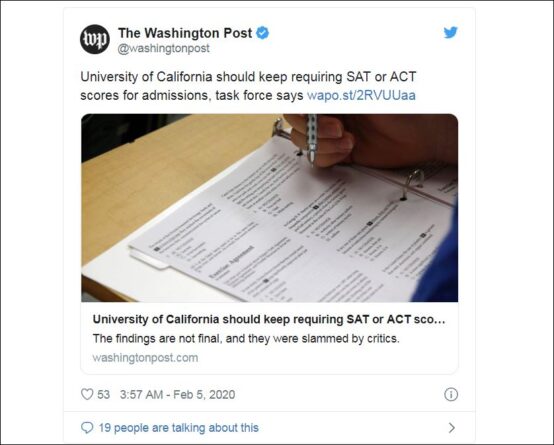
Above: The Post regularly calls on Valerie Strauss, usually an opinion writer, to write reported news stories like this one about SAT testing.
A close look at the education section at the Post reveals several problematic features and practices:
The section includes three tabs: Local Education, Jay Mathews, and Valerie Strauss. Mathews is a longtime columnist and book author. Valerie Strauss is the main author of the Answer Sheet.
However, there is no visible tab for national news or for higher education. And education-related opinion pieces published in other parts of the paper by columnists like George Will and guest writers like Conor Williams don’t appear in the education section.
Partly as a result, the mix of pieces within the section is often dominated by the opinion-heavy posts of the Answer Sheet. Most readers wouldn’t notice, however. Visually speaking, Answer Sheet pieces don’t look very much different than news stories.
Adding to the confusion, the Post has Strauss playing a number of different roles within the section. She writes her own opinion pieces. She produces reported education stories, some of which appear in the print version of the paper. She also introduces opinion pieces written by others, under her own byline, functioning as the de facto opinion editor for the education section of the paper.
In its weekly newsletter, The Grade takes a deeper look at education journalism. Sign up here.
As it currently operates, the section is a mess unlike any I’ve seen at any other major newspaper: confusing to readers, unfair to journalists and contributors, and nearly homogenous in the points of view it features.
Lack of differentiation between news and opinion. Multiple roles for a single journalist. Lack of sufficient credit given to outside contributors. Failure to include a broad range of viewpoints. The education section of one of the most prestigious news outlets in the nation is a confusing, journalistically questionable dumpster fire.
Thus far, at least, the Post doesn’t seem alarmed in the least.
Asked about these issues at an education journalism conference three years ago, Post editor Marty Baron told me he wasn’t concerned about potential reader confusion about Strauss’s multiple roles and emphasized how popular the Answer Sheet was with readers. An email to Strauss and the education editor about these issues was referred to the Post’s communications team.
However, in an era of reader mistrust and confusion, the Post’s behavior feeds a journalism-wide problem regarding media transparency and accountability that none of us involved in education journalism can afford to ignore.

Above: A recent example of an opinion piece published in the Post but not included in the education section, where diverse viewpoints are not typically featured.
The good news is that there are three easy ways the editors at the Post could fix these issues if they wanted to:
FIX #1: Limit Strauss to opinion writing or news coverage.
It is all but unheard of for a single journalist to function as both an opinion writer and a news reporter at the same time.
It’s confusing to readers who don’t know what they’re reading, and problematic for sources who know the writer’s biases.
Asking a single reporter to report news stories and produce opinion on the same topic is a recipe for disaster.
The Post should curtail this practice immediately.
FIX #2: Give the outside contributors their own bylines.
In today’s world, bylines not only signify authorship. They also are attached to pageviews, which are considered a measure of success, for better or worse.
For these reasons, it’s highly unusual for a journalist who did not write a piece to receive the official byline for the publication of the piece.
But that’s exactly what happens within the Answer Sheet, where some pieces are introduced and bylined by Strauss even though they primarily feature a full-length column or commentary from someone else.
I’m not accusing anyone of being deceptive or stealing content. Contributors presumably pitch their ideas or are asked for permission ahead of time. They are credited in the body of the piece.
But the practice is sloppy and unfair to other journalists — especially when it involves using way more than a snippet and a link like an aggregator would do.
And it encourages Strauss to produce a large number of pieces, further unbalancing the section. The Answer Sheet has published a dozen new posts over the past two weeks. The blog produced even more new content in the first half of the month.
FIX #3: Move the Answer Sheet over to the opinion section (or move education-focused opinion pieces into the education section).
Opinion pieces run in news sections in many newspapers, but they’re clearly labeled in ways that make it clear they’re not straight news stories. That’s not what happens here, where opinion is not clearly labeled opinion (and news isn’t labeled news).
One solution would be to separate news coverage from the opinion writing, moving the Answer Sheet over to the opinion section.
Another would be to move education-related opinion pieces into the education section, so that readers could see the full range of opinion pieces that are being published by the Post.
At very least, the Post should add “Opinion:” to each relevant headline (and “News:” to news stories, too, while we’re at it).

Above: The Post’s Valerie Strauss, who serves as an education columnist, news reporter, and de facto opinions editor for the education section.
There are certainly other, arguably bigger problems at the Post when it comes to education. Two years ago, the Post missed a graduation rate scandal taking place in the DC public school system, due largely to frequent turnover among metro education reporters. And there have been a handful of troubling corrections and attribution failures recently.
But the issues within the education section are in ways more pernicious for having gone on so long.
In an era of reader mistrust and confusion, the Post’s behavior feeds a journalism-wide problem regarding media transparency and accountability that none of us involved in education journalism can afford to ignore.
I’m complicit, having agreed to have a handful of short blog posts published in the Answer Sheet several years ago. And I pretty much gave up on calling my concerns about the section after a 2015 piece about the issue of byline credits and a 2017 conversation with the Post’s Baron failed to generate any response.
But I’m hoping that education journalists and others at the paper will decide to care about these problems and consider making one or more of the fixes outlined above. And I’m hoping that education journalists who aren’t at the Post will let their feelings be known, publicly or otherwise.
I don’t want to see an end to the Answer Sheet. I admire the Herculean effort behind what Strauss has built over the past decade. And she was kind enough to let me interview her about her work way back in 2011. She seems like a nice person.
But we are all collectively responsible for improving the quality of education journalism, bringing transparency and accountability to the beat. And the current practices at the Post are an embarrassment to all of us.
RELATED COLUMNS
A bold, imperfect start for the Washington Post’s Laura Meckler
Favorite bylines, outlets, & education teams for spring 2019
The Washington Post’s confusing/unfair “Answer Sheet” byline system
How the Washington Post missed the DC schools graduation rate scandal so badly, for so long
Why reporters should help combat misleading opinion pieces
ABOUT THE AUTHOR

Alexander Russo
Alexander Russo is founder and editor of The Grade, an award-winning effort to help improve media coverage of education issues. He’s also a Spencer Education Journalism Fellowship winner and a book author. You can reach him at @alexanderrusso.
Visit their website at: https://the-grade.org/