Media outlets that fail to vet opinion pieces they publish create a Wild West experience for readers and undercut trust in reported news. Beat reporters and editors can’t afford to ignore the problem any longer.
By Alexander Russo
Maybe you, like me, are long past caring very much what Diane Ravitch has to say about education. Seeing how much less frequently she’s quoted in education stories these days, I get the sense that I’m not alone.
For that reason, I was more than a little bit surprised to see that TIME magazine published a particularly misleading op-ed from the former George H.W. Bush administration education official without seeming to have given it the editing and fact-checking it so badly needed.
However, you don’t have to care about Ravitch or TIME or opinion journalism to be concerned about what I’m calling “copy and paste” opinion pieces.
Copy and paste op-eds are minimally edited, generally absent thoughtful consideration of complexities, and sometimes factually inaccurate. They are unfortunately pretty common.
They create a Wild West experience for readers, who don’t know that what they’re reading is misleading. They erode trust in news stories that are carefully reported and edited for accuracy and fairness. Occasionally, they blow up in media outlets’ faces.
This kind of thing has to stop. The torrent of polarizing opinion pieces has grown too toxic. And it’s not enough to call for more and better editing by short-staffed opinion sections.
To address this scourge, education reporters and editors need to end the journalistic tradition that separates news and opinion journalism and begin to help police misleading and inaccurate opinion pieces.
Follow The Grade on Twitter and Facebook to learn more about how the media covers education.
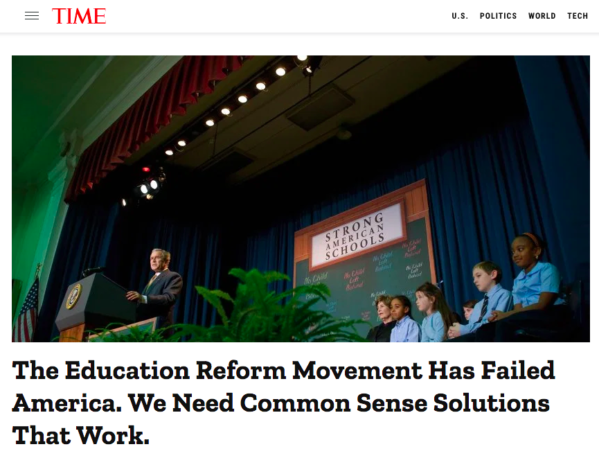
TIME magazine recently published this Diane Ravitch op-ed, which is misleading in several obvious ways.
There are lots of good reasons for news outlets to publish both news and opinion stories, which are often called op-eds and sometimes published under the label “ideas” or “perspectives.”
Done well, opinion writing complements news coverage, giving readers analysis and perspective that they may not otherwise get inside the confines of news writing. They help readers make sense of the many different “he-said, she-said” arguments, putting a bunch of confusing and contradictory information into perspective.
More recently, though, it seems like publications have come to count on op-eds — especially inflammatory, attention-grabbing ones — to enrage readers and raise page views.
Outlets sometimes fail to note prominently when a piece is opinion, confusing readers who think they’re reading a news story. Outlets too often let opinion writers get away with blatant self-promotion and cherry-picking the evidence to simplify their point. Sometimes, they let opinion writers share inaccurate information under their logo.
As a result, writers aren’t pressed to wrestle with contradictory facts, and readers aren’t forced to expand their thinking beyond their initial position. Nobody’s beliefs are challenged, not even a little bit. There’s little to no wrestling with hard and conflicting truths.
Ravitch’s TIME op-ed is a good example, presenting the Bush-era No Child Left Behind Act as a Republican-dominated initiative (which it wasn’t) and overstating the impact of the Obama-era Race to the Top initiative (under which few low-performing schools were closed).
However, readers don’t necessarily know the difference between an op-ed that may have been very lightly edited and a news story that’s gone through a heavy editing process is not immediately apparent from the outside. Readers pick something written by someone they like, published in an outlet they generally trust, and they get their beliefs affirmed.
Making matters worse, misleading opinion pieces published by reputable outlets discredit the work being done in other parts of the newsroom.
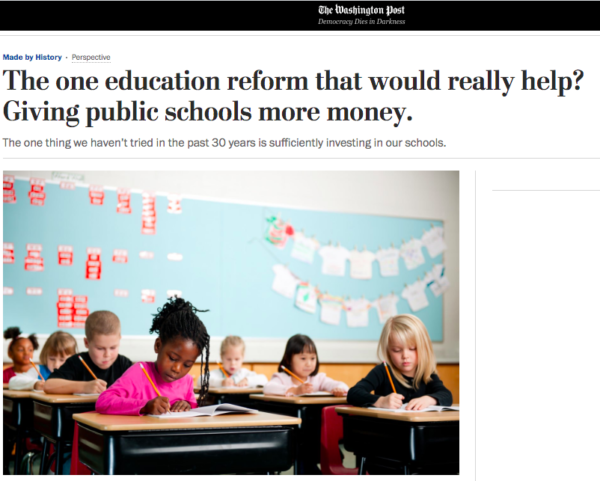
Occasionally, under-vetted op-eds blow up in everyone’s faces. In December, the Washington Post had to write a major correction for an op-ed in which the dean of the University of Virginia school of education made claims about school spending that turned out to be wrong.
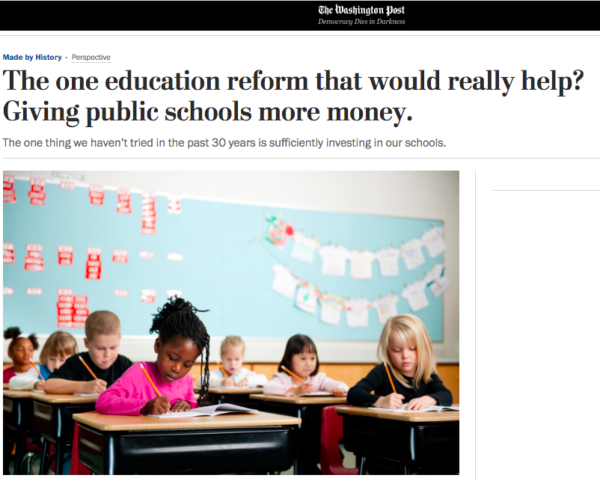
The Washington Post was forced to correct this oped by the education school dean at the University of Virginia.
Some outlets, like Chalkbeat, avoid traditional op-eds in favor of first-person essays centered on personal experiences. They are edited multiple times by two editors, according to managing editor for style and standards Emiliana Sandoval.
“We ask for sources, check claims, and will delete things that can’t be checked,” Sandoval wrote in an email to The Grade. “We link to information such as studies or statistics within the essays.”
Other outlets, such as the Hechinger Report, publish traditional op-eds but fact-check them before publication. “OpEds go through the same editing processes as our other work,” opinion editor Jennifer Shaw wrote in an email. This includes “the same copy editing and fact-checking process as all our content.”
Fact-checking and robust editing of opinion pieces are a good start. But there’s clearly more work to be done. In most cases, beleaguered opinion sections and understaffed fact-checking operations aren’t up to the task of monitoring the torrent of opinion.
To improve the quality of op-eds and protect the reputation of news teams, journalists are going to have to rethink the long-standing firewall between opinion and news sections, which allows news reporters to ignore opinion pieces.
“Journalism needs to be policing this stuff,” implored right-leaning policy wonk Andy Smarick after the Washington Post’s inaccurate op-ed was finally corrected. “We need journalism to be our reliable source.”
I’m told that TIME edits everything that it publishes, including fact-checking. Asked how much editing her piece received, Ravitch responded via email, “I don’t know.”
Each week, The Grade takes a deeper look at education journalism. Sign up for the free newsletter.
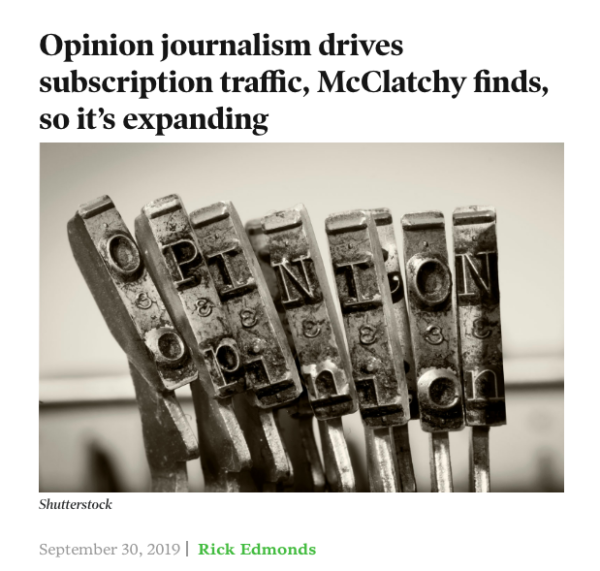
Poynter’s Rick Edmonds explained the media shift towards opinion in this recent piece.
Historically, education reporters and editors ignore opinion pieces, putting their heads in the sand rather than acknowledging that there’s a problem when these pieces appear under the same logo as their own work. In so doing, however, they are complicit in undercutting reader trust in fact-based journalism.
I’m no better, having spent most of the past five years begging off calls to write about problematic opinion writing.
I’m not suggesting that beat reporters write opinion pieces themselves or take public positions on controversial issues. But what I think could and should happen going forward is that education reporters and editors start weighing in on opinion journalism on topics they know well, helping to police the broader ecosystem.
In some situations, beat reporters could help out within their own newsrooms, as part of the prepublication editing process. In other situations, education journalists could flag misleading or inaccurate comments that they come across, privately or on social.
The understanding that we need to rethink journalistic practices around opinion writing is clear. Two years ago, HuffPost stopped publishing unpaid, thinly edited opinion pieces, once a dominant feature of the outlet. The New York Times recently announced that its standards department would expand its oversight to include the opinion section. For a time, The 74 regularly examined the facts behind education-focused opinion pieces published in other outlets.
We are drowning in thoughtless opinion pieces, which too often eclipse reported journalism and serve as a way for advocates and ideologues to distribute their ideas without scrutiny. The result is an increasingly polarized, walled-off readership, and an underinformed public.
Something’s got to change. News reporters (and media watchdogs like me) can’t ignore opinion writing any longer.
Related columns from The Grade:
Lessons from the media’s coverage of the 1996 Ebonics controversy
Transparency on fact-checking might shed light on controversial NYT op-ed (2015)
ABOUT THE AUTHOR

Alexander Russo
Alexander Russo is founder and editor of The Grade, an award-winning effort to help improve media coverage of education issues. He’s also a Spencer Education Journalism Fellowship winner and a book author. You can reach him at @alexanderrusso.
Visit their website at: https://the-grade.org/