A trio of ambitious stories reveals several strengths along with some nagging challenges.
By Joseph Williams
The Washington Post’s decision to hire Laura Meckler for the education team in 2018 was unconventional, to say the least.
A longtime political reporter for the Wall Street Journal, Meckler has impressive reporting chops — she’s covered several presidential campaigns and the White House — but her experience covering education policy was thin.
It took a while for Meckler to warm up in her new role, but she recently produced a trio of ambitious, long-form enterprise pieces on school desegregation and busing, arguably the most contentious issues in public education.
The first was a data-driven analysis of Colorado’s struggles to provide a quality, racially balanced education for African Americans, whites and Latinos. It deftly blended data and shoe-leather reporting, Meckler’s strong suit, and brought a fresh perspective to the topic. Her conclusions about whites and integration, supported by solid interviews, aren’t often seen in stories on education and race.
The second was a deconstruction of a liberal school district that not only accepted busing in the 1970s but kept at it for decades, boosting black and white student achievement, but with a hidden price. The district in question? Shaker Heights, Ohio, Meckler’s childhood hometown. The story’s intriguing premise — that even the affluent, liberal school district that educated Meckler can’t get integration and equity right — hit a few potholes that more experienced beat reporters might have avoided.
The third, and most recent, was a narrative account of a fledgling middle school integration effort in Brooklyn, New York. Though inconclusive, it is her most successful long-form education piece so far, another example of Meckler’s reporting prowess, her perspective, and apparent desire to change things up.
These three stories demonstrate both the potential benefits and liabilities of having a heavy-hitting journalist who is also an education-policy neophyte weigh in on race and education.
It is, of course, far too early to judge what Meckler’s seasoned talent will bring to the education beat over time. But these three stories — all linked by the theme that, six decades after Brown v. Board of Education, whites are still ambivalent about or resistant to integration — demonstrate both the potential benefits and liabilities of having a heavy-hitting journalist who is also an education-policy neophyte weigh in on race and education, fraught topics where veteran education reporters have learned to tread carefully. And the stories themselves have their own blind spots on race, another reminder that education journalism has diversity problems of its own.
Full disclosure: Meckler’s editor, Stephen Smith, and I worked together for several years at the Miami Herald and later at the Boston Globe. Also, Meckler, Smith and I are all former Nieman Journalism Fellows at Harvard University, although our fellowships took place in different years. Reached for comment, Smith and Meckler referred inquiries to the Post’s public relations department, which declined to comment. Several education journalists at the Post, the New York Times, and other news outlets also declined to comment on Meckler’s work.

Meckler announced her move from the Wall Street Journal to the Washington Post in June 2018.
A graduate of Washington University in St. Louis, Missouri, Meckler has covered the White House, three presidential campaigns (2008, 2012, and 2016, according to her LinkedIn profile), immigration, and health care policy. Her honors include a 1999 Livingston Award for her investigative reporting on the organ transplant industry.
Since landing at the Post, joining Moriah Balingit on the national K-12 front, Meckler has had an elevated profile: She’s represented the paper as a moderator or expert panelist at organizations like the Cato Institute, an influential conservative Washington think tank. She also had a prime-time, one-on-one session with former Florida governor and Republican presidential candidate Jeb Bush at the prestigious SXSW EDU education and ideas festival in Austin, Texas.
Meckler’s Post clip file for the first year after her arrival in mid-2018 was mostly filled with garden-variety policy pieces about Education Secretary Betsy DeVos and policy issues out of Washington. They included standard reports on the education secretary’s budget cuts, her abandonment of an Obama-era crackdown on for-profit colleges, and the Trump administration’s slashing of funds for the Special Olympics.
But Meckler’s past as a political journalist and her present beat collided this summer, when presidential candidates Joe Biden and Kamala Harris clashed over busing during the July Democratic debate, setting the stage for her marquee pieces on Colorado, Shaker Heights, and Brooklyn.
Follow The Grade on Twitter and Facebook to learn more about how the media covers education.
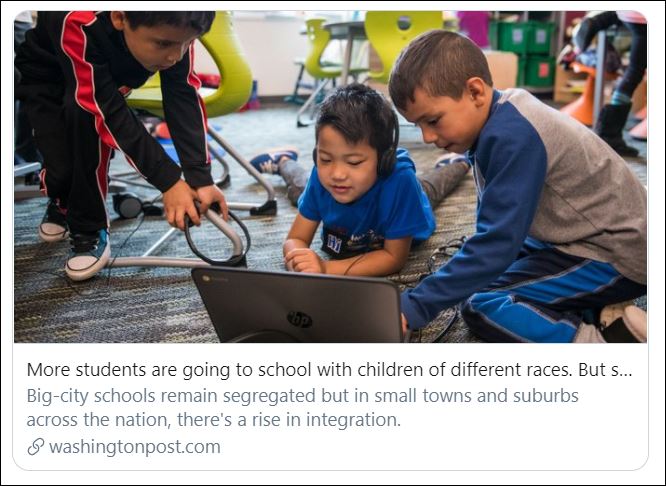
Her first major piece (above) focused on the increase in integration outside of big-city school districts: More students are attending schools with children of different races than ever before, a Post analysis has found.
In the first piece, Meckler and data journalist Kate Rabinowitz teamed up to examine a paradox: More children nationwide are attending school with students of other races, yet urban schools are highly segregated.
To tell that story, they chose a pair of Colorado school districts: Denver and Roaring Fork Valley, a booming suburb of Aspen, the tony ski resort town. In Denver, the district is heavily Latino and African American, while in Roaring Fork the predominantly white district is seeing an influx of Latino immigrants seeking jobs in the construction and hospitality industries.
When a federal court lifted Denver’s desegregation order in 1995, Meckler writes, segregation quickly took hold again, which all but guaranteed a district heavy on underperforming, majority-black schools. But whites in Roaring Forks, Meckler found, seemed far less resistant to integrating with Latino children than white Denverites had been about black-white integration and busing.
That leads Meckler to an obvious but seldom-spoken conclusion: For various reasons, white people are more accepting of Latino neighbors, who “have never been as segregated from whites as African Americans,” she writes. And when it comes to diversity, whites are comfortable “as long as they are still dominant.”
It’s an important perspective: Educational and societal equity and inclusion are high on the national agenda. Meckler brings in a range of detailed storytelling to amplify her points, including the gerrymandering that allows white parents to keep their children out of a mostly black school. She also tells about the stunting of Latinos’ political power in Roaring Forks by the implied threat of deportation of undocumented immigrants.
But in a story about inclusion, the voices of black and Latino parents and activists are sadly sparse. The people with the power — white people — are mainly telling the story.
Each week, The Grade takes a deeper look at education journalism. Sign up for the free newsletter.
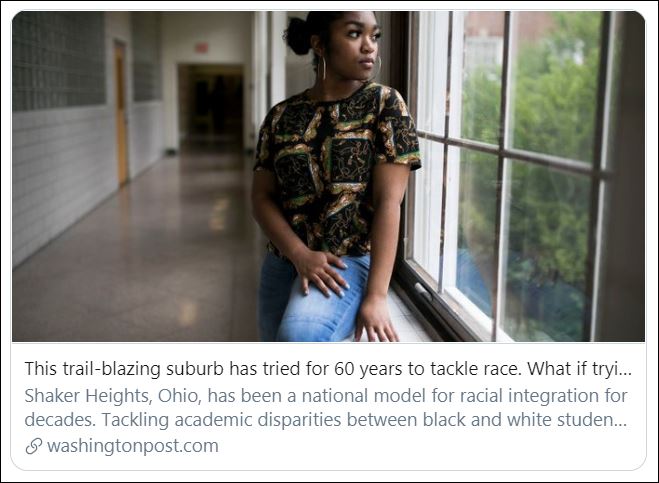
In her second big piece (above), Meckler focused on her hometown high school in Shaker Heights, Ohio: Shaker Heights has tried to tackle race for 60 years. What if trying isn’t enough?
In the Shaker Heights story, Meckler tackles another contradiction. A commitment to racial balance in Shaker Heights in the late 1950s has resulted in a consistently high number of black and white college-bound students in its schools, yet African-American students are starkly underrepresented in advanced classes that are important to elite college admission.
In a confrontation that serves as the emotional focus of the piece, a white teacher has recently been suspended for upbraiding an African-American student.
With that as background, Meckler folds in her own connection to the district, describing how it laid the foundation of her academic success and shaped her views on race. She literally goes home again, knocking on doors in her old neighborhood.
“As a white kid in an integrated school, I thought Shaker was a special place that had gone a long way toward figuring out race. But how true was that?” Meckler writes. “Returning as a reporter, and walking the hallways of my old schools, I set out to understand with fresh eyes a place I’ve known my entire life.”
But a piece with so much potential was frustratingly flawed, particularly given the more than 100 interviews that Meckler says she conducted.
Meckler doesn’t drill down into how or why a district with purportedly advanced views on race and education has walked past problems of privilege and inequity that education scholars and civil rights activists have pointed out for years. She brings in varying viewpoints, but no one is put on the spot or held accountable.
We hear a lot from Jodi Prodl, the white teacher who yelled at the black student, and whose case became a rallying cry for the teachers union. Having had her suspension reversed on appeal, Prodl says the punishment was unfair and hurtful and that she hasn’t decided if she wants to return to the classroom.
What we don’t know, however, is how many black teachers work alongside her — multiple studies show that teaching is an overwhelmingly white, female profession — and what they thought of the situation in Shaker Heights. Do the schools have the same discipline gap found in schools nationwide? Have other black Shaker Heights students had similar experiences?
Meckler herself admits that, as a student, she was unaware that African-American students had experiences so sharply different from hers. That’s a troubling admission from an education reporter; most of them know better these days.
“I was in AP classes, and sometimes I struggled, too… But I never considered that my classmates might think I didn’t belong there. … I realize now that was a form of white privilege in action — being in AP and knowing that no one questioned it.
Meckler’s honesty is appreciated, but her naivete about such matters is disturbing. That problem continues in her paragraph about Olivia McDowell, the student who was confronted by the teacher, whom Meckler sees as being much like her.
“She wasn’t pushed into AP courses as part of an affirmative action effort to diversify,” Meckler writes. “She has been taking advanced courses since middle school. In class, she raises her hand and has lots to say, just like I usually did. She thinks she might want to be a writer.”
The comparison felt a little cloying and patronizing; it would have been better not to assume a kinship with a student whose experiences have likely been so different.
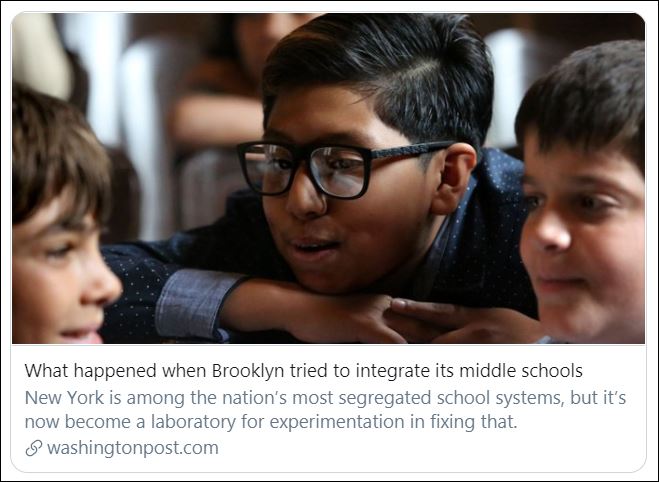
The most recent piece from Meckler (above) focuses on a fledgling integration plan among Brooklyn middle schools: How Brooklyn is trying to integrate its middle schools.
Ultimately, having an experienced reporter covering an unfamiliar beat cuts both ways, says Phillipe Copeland, a professor in the School of Social Work at Boston University and a specialist on race and public education.
“The freer the mind is, the better able it is to learn and help others do so,” Copeland said in a phone interview. “Orthodoxies of any kind tend to limit the mind. However, experience is also a form of learning. In fact, having more experience with an issue can be what contributes to a freer mind and less reliance on orthodoxies. So it could be both an advantage and a liability.”
Indeed, Meckler’s most recent piece, which follows a white girl sent to a middle school in a Latino neighborhood and a Latino boy sent to a white-dominated school, includes revealing depth and detail that are evidence of her skill as a reporter.
She clearly spent time with both families to get them to trust her and she didn’t pull punches when each child experienced moments of frustration in their new environments. One standout show-don’t-tell moment of reporting came near the end of the story, when Meckler describes how Angel, the Latino boy, was ostracized by a group of boys during lunchtime at his new school. By letting the facts do the talking, Meckler heightened the impact of a moment many reporters might have missed.
Although it was a fresh take on a new program, the story felt inconclusive and didn’t break a ton of new ground. We hear from white parents (and a few kids) who are opposed to New York’s integration plan, and we see the white family grappling with the decision. But the drama within the Latino family comes across as quieter: We aren’t at the kitchen table as Angel’s future is decided, and the stakes for him and his family aren’t defined as clearly.

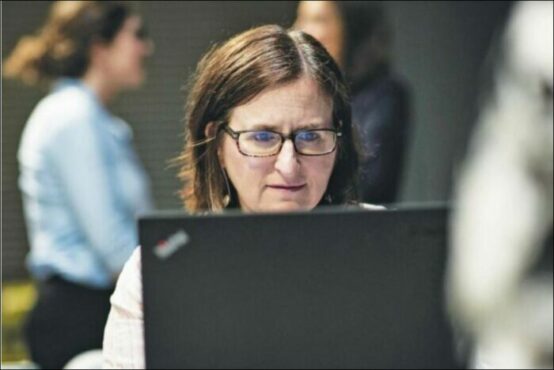
Washington Post national K-12 education reporter Laura Meckler, hard at work in an undated picture.
Meckler’s marquee stories indicate a desire to take risks, including blending her deeply personal narrative in a heavyweight enterprise story, and that’s to be applauded. Smith, her editor, is knowledgeable and experienced, and with Meckler’s skill set, there is great potential for her to be a force on the beat.
She needs to watch out for the subtle white saviorism that can be a minefield even for reporters steeped in education policy. But her extraordinary gift for on-the-scene reporting, set against her awareness of the larger context, could make her one of the most effective national reporters on the beat, once she has fully mastered the potential pitfalls.
In a way, perhaps she acknowledged her willingness to learn in a recent tweet:
“There are no easy answers,” she wrote. “But I came away proud of the fact that Shaker Heights is still trying, still working on a problem that many communities choose to ignore. They have a ways to go. Don’t we all?”
PREVIOUSLY FROM WILLIAMS:
Praise and a wish for more from ‘Raising Kings’
Why DeVos commencement coverage was so basic
RELATED COLUMNS FROM THE GRADE
New documentary highlights the need to deepen school integration coverage
Despite progress, racial diversity remains a big challenge for education newsrooms
“Feel-good” school story highlights concerns about racial blind spots
7 resources to help education journalists avoid racial blind spots
How the Washington Post missed the DC schools graduation rate scandal so badly, for so long
ABOUT THE AUTHOR

Joseph Williams
Joseph Williams is a longtime journalist who writes for US News & World Report covering the Supreme Court and for various other publications. He can be reached on Twitter at @jdub321.