In this week’s newsletter: School closures and layoffs slam districts across the country. Two years after the Uvalde shooting, a new documentary features a Robb Elementary parent who’s also a local journalist. A new investigation into the education of migrant students in Chicago reveals a widespread mismatch between affordable housing and schools prepared to serve newcomers. A parent featured in a recent education book shares what the experience was like — and what she would have done differently. Who will be the next Emily Hanford? And a new education book generates Taylor Swift-level crowds.
LOOMING CLOSURES & LAYOFFS
The big story of the week
The big education story of the week is the financial disaster that lays ahead for districts facing rising inflation, lower enrollment, and the looming end of the federal ESSER funds (The Atlantic, The 74).
Just this week, districts in New Jersey, Ohio, Michigan, and Connecticut announced layoffs (NJ.com, Ideastream, The Detroit News, Hartford Courant, CT Examiner). Other districts are taking even more drastic measures. Boston Public Schools scaled back its plan to close several schools, but it will still consolidate and close some (Boston Globe). Florida’s largest districts — and others in states like Colorado — face a similar fate (Tampa Bay Times, Colorado Sun).
Many programs that were created or bolstered in the pandemic, including mental health supports, are also on the chopping block (CT Examiner, New England Public Media). Only a few districts, such as Portland, Oregon, have found ways to stave off teacher layoffs for now (Oregonian).
School closings are a story that will challenge newsrooms to do their best work. As Tim Daly put it in a recent column for The Grade, “Closings are coming. Cover them well.” See also first-person essays from education journalists who have covered closings in Chicago and California’s Bay Area.
Also: On the two-year anniversary of the Uvalde school shooting, the new documentary “Print It Black” features a local journalist who lost her own daughter in the tragedy. The city — but not yet the state police or school district — have settled with the families (New York Times, Wall Street Journal, AP).
Check out daily links from @thegrade_ for more big education stories of the week.
MIGRANT POLICY MISMATCH
The best education journalism of the week
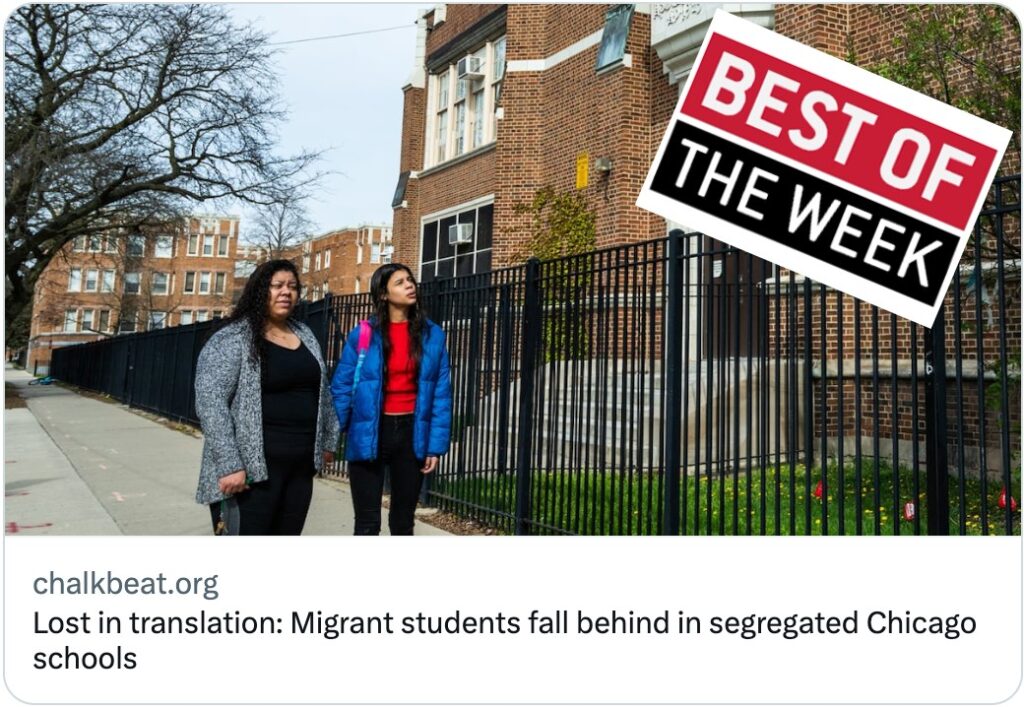
The best education journalism of the week is Lost in translation: Migrant kids struggle in segregated Chicago schools by Chalkbeat’s Reema Amin and Mina Bloom of Block Club Chicago.
It’s a smart collaboration between two small Chicago newsrooms — a muscular, deeply sourced narrative that delivers both heartbreaking personal stories and an unsparing, data-driven look at a school system that’s clearly overwhelmed.
The reporters looked at the schooling of dozens of migrant students, many from Central and South America, who are among nearly 9,000 migrant kids enrolled in Chicago Public Schools this spring — generating 40% increases in English learners at some schools.
Many migrant families have now moved from temporary shelters to find housing in neighborhoods favored by a state program that helps cover rent. However, these neighborhood schools often lack necessary bilingual staff and support services.
In one neighborhood, a first-grade teacher who hadn’t encountered English learners in 25 years now has nine. She doesn’t speak Spanish. Her school has exactly zero bilingual teachers. In another instance, a migrant family decides to keep their child at the school near their original shelter, despite a daily round-trip commute of three hours.
It’s a deeply satisfying, if harrowing, narrative. Kudos to Amin and Bloom for their use of FOIAs and more than 50 interviews with teachers, experts, and families — and to their publications for acknowledging the help of interpreters, who are not often given credit.
For more on how the two reporters decided to work together, check out Twitter threads from Amin and Bloom. For tips on covering migrant education — one of education journalism’s toughest topics — see The Grade’s recent roundup.
Other education stories we liked include how one New Jersey school district beat the odds against COVID learning loss (WNYC), why campus protests haven’t roiled Cal State Los Angeles (LA Times), Black families still lacking school options 70 years after Brown v. Board (AP), New York City migrant students pressured to transfer just before graduation (Chalkbeat New York), and how free school meals went mainstream (New York Times).

Above: Benjamin Herold’s book “Disillusioned” and Bethany Smith, a parent source who also wrote the book’s epilogue
DISILLUSIONED: A PARENT’S PERSPECTIVE
Our latest columns and commentary
Earlier this year when veteran education journalist Benjamin Herold published his book “Disillusioned.” we published a self-critical essay from Herold and commissioned a mixed review from former NPR education reporter Anya Kamenetz.
This week’s new edition is a reflection from Bethany Smith, one of the main parents featured in the book. In Disillusioned: A parent’s perspective, Smith describes what the experience was like for her, sharing her hopes and dreams for the book (and also writing the epilogue).
“My participation in ‘Disillusioned’ has not changed my life,” writes Smith. “But it sure does make my future much brighter. At the end of the day, this journalistic and literary world is a business. The next opportunity that comes my way, I would be more involved in the business.”
The Grade is dedicated to re-centering education journalism on parents and students.

Above: Who’s going to be the next Emily Hanfordis the question that the American Enterprise Institute’s Robert Pondiscio is asking in a new Education Next piece encouraging reporters to find classroom stories hiding in plain sight.
PEOPLE, JOBS, & EVENTS
Who’s going where and what’s happening
📰 Segments & appearances: WBUR’s “Here and Now” is on fire with education stories lately, producing four pieces in the last week and a half on the legacy of Brown v. Board of Education, school segregation (featuring Chalkbeat’s Erica Meltzer), chronic absenteeism (featuring Oregon Public Broadcasting’s Elizabeth Miller), and school board extremism. NPR also ran a segment on chronic absenteeism, along with stories on the rise in foreign teachers in Alaska and tuition-paying parents angry about campus crackdowns on student protesters. For WNYC, reporter Mary Ann Koruth of The Bergen Record explained how one New Jersey school district fought back against COVID learning loss. And for WBEZ Chicago’s “Reset,” Chalkbeat Chicago’s Reema Amin talked about the district’s plan to remove police officers from schools.
📰 Events: On June 6, Future Ed will host a webinar on rethinking gifted education. If you’re an IRE member, don’t miss their June 10 training on covering immigration. In case you missed it this week, AL.com Ed Lab reporter Trisha Powell Crain and Seattle Times politics reporter Daniel Beekmandiscussed the child care crisis with U.S. Senators Katie Britt and Patty Murray. And yesterday, The Education Trust and The School Superintendents Association held a virtual event about how Black women superintendents are overcoming systemic barriers, moderated by ABC’s Arthur Jones II.
📰 Impact: Last year, the Center for Public Integrity reported on Pennsylvania school districts that locked students out of school for weeks while investigating their families’ claims of homelessness. Now, a state bill has been introduced to stop the practice. After ProPublica featured a story two years ago about a high schooler who was ticketed by police in school for allegedly stealing AirPods, two civil rights attorneys took on her case that went all the way to a jury trial — and they won. And congrats to the one-year-old local outlet Brookline News, which celebrated its anniversary with a reflection on some of their best stories, including an investigation into school district payroll failure.
📰 Job openings & career moves: The Hechinger Report is hiring an investigative reporter. Open Campus has added a higher ed reporter at The Fort Worth Report with plans to add another one at Houston Landing this summer, bringing the total number of Open Campus newsrooms in Texas to four. Clara-Sophia Daly is the Miami Herald’s new education reporter, replacing Sommer Brugal who left a few months ago for Axios Miami. Former WAMU education reporter Jenny Abamu is back on the education beat and freelancing for Chalkbeat after a stint as a U.S. diplomat. And The 74 tells us they have a new chief development officer — Nicole Harris, who most recently served as vice president of development for chapter relations for After-School All-Stars.
THE KICKER

There were no reports of line-cutting, but folks who wanted a freshly signed copy of Mike Hixenbaugh’s new book “They Came for the Schools” had to stand in line for two hours at one recent event in Texas.