Welcome back! Hope everyone enjoyed their summer break as much as we did.
In this week’s newsletter: While kids are headed back into the classroom, in a growing number of schools their cell phones aren’t. There’s a surge in stories about attendance and present-day segregation academies. Former Seattle Times Ed Lab editor Katherine Long writes that solutions journalism is great, but it needs one more key ingredient: accountability. And one ed reporter makes the most of her summer with a climb to the top of Mount Fuji, leaving her feeling “a badass and a fool.”
CELL PHONE BAN-WAGON
The big story of the week
With more and more schools back in session, the big education story of the week — and likely one of the big stories of the year — is school cell phone restrictions.
Eight states have already enacted laws about cell phone use in K-12 schools, including outright bans in Florida, Indiana, Louisiana, and South Carolina (Ballotpedia, New York Times). Several others are inching closer to doing the same (Christian Science Monitor).
The Virginia Department of Education is recommending that districts ban cell phones “from bell to bell,” so students wouldn’t be able to use their phones between classes or during lunch (Washington Post, WVTF). The Connecticut Board of Education issued a similar recommendation (CT Mirror, New Haven Independent, Hartford Courant). With a push from Gov. Gavin Newsom, more and more California schools are following in LAUSD’s footsteps in banning phones (EdSource, San Francisco Chronicle). Other states, like Ohio, are mandating cell phone policies, but letting schools decide what that policy is. In Cleveland, it’s a ban (Axios Cleveland).
Of course, it’s one thing to enact a ban and another altogether to enforce it. Lots of schools are experimenting with Yondr pouches to lock phones away (CT Examiner, New Haven Independent, Fall River Herald News, New Bedford Light). Others are finding that some kids are still managing to use their phones during the day (CalMatters). Implementation timelines vary, and some districts still allow kids to use cell phones during passing times and lunch (SF Chronicle).
Other big education stories of the week include transportation problems — and innovative solutions — in getting kids to school, chronic absenteeism remaining a stubborn problem as the new year begins, and politics as Kamala Harris and Tim Walz headline the Democratic National Convention with education on the agenda. Check out @thegrade_ for daily headlines!
A DISTRICT-BY-DISTRICT LOOK AT CHRONIC ABSENTEEISM IN CT
The best education journalism of the week
The best education journalism of the week is “Connecticut has nearly 90,000 students ‘chronically absent’ from school. See how your district ranks” by the Hartford Courant’s Alison Cross.
Using new attendance data from the state, Cross finds that though the number of chronically absent K-12 students has declined for two years in a row, it remains 70% higher than five years earlier.
What at first might seem an underwhelming framing — absenteeism is dropping, but not fast enough — becomes an opportunity for Cross to look deeper at what districts are doing to further improve the situation. And she provides readers with a helpful look at the problem nationally, relying on reality checks from both Attendance Works and Georgetown University’s Future Ed think tank. All great context.
But what sets her report apart is a detailed, district-by-district breakdown that allows readers to see how their schools compare to those statewide. Cross provides a quick reference guide that helps them see exactly how last year’s district absentee rates stand in comparison to the highest rate in the 2021-22 school year as well as rates before the pandemic.
It’s not flashy, but it’s service journalism at its best. And it comes at a time when chronic absenteeism is still in the news: Last week, AP launched its latest package on chronic absenteeism, documenting how and why the problem has persisted.
Other education stories we liked this week: Segregation academies, past and present (AP, ProPublica), the youngest students’ post-pandemic setbacks (Chalkbeat), the search for overnight childcare in Akron (Akron Beacon Journal), and outsized test score gains in Oklahoma raising suspicions (The 74).
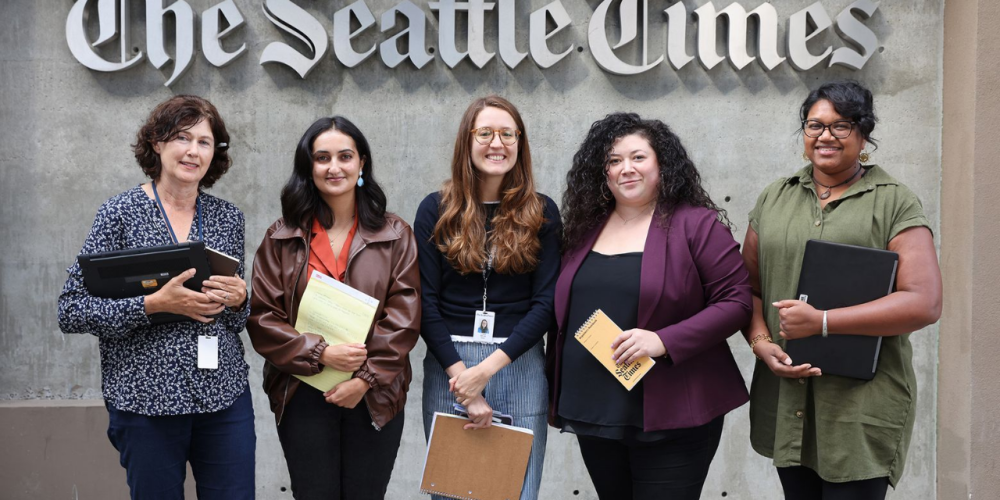
Above: Recently retired Seattle Times education editor Katherine Long (far left) with her team.
A KEY INGREDIENT FOR SOLUTIONS JOURNALISM: ACCOUNTABILITY
Our latest columns and commentary
In this week’s new column, just-retired Seattle Times Ed Lab editor Katherine Long reflects on her experiences with the solutions approach to schools coverage.
While generally admiring, Long believes those who take the solutions approach need to be sure to look back at their previous coverage and share with readers the updated findings — something that the Seattle Times Ed Lab has done.
And it’s not just solutions reporters who should do this kind of follow-up.
“I’ve come to believe that every education journalist should be examining past stories and writing about sustained success (or failures),” she writes. “It holds leaders to account… And it helps readers distinguish between tried-and-true methods and education fads.”
ICYMI: We kept publishing new pieces during the summer break, including ones on campus protest coverage, school board coverage, deepening reporting with community-based solutions, destigmatizing coverage of newcomer students, and lessons from the first year covering the Houston schools takeover.
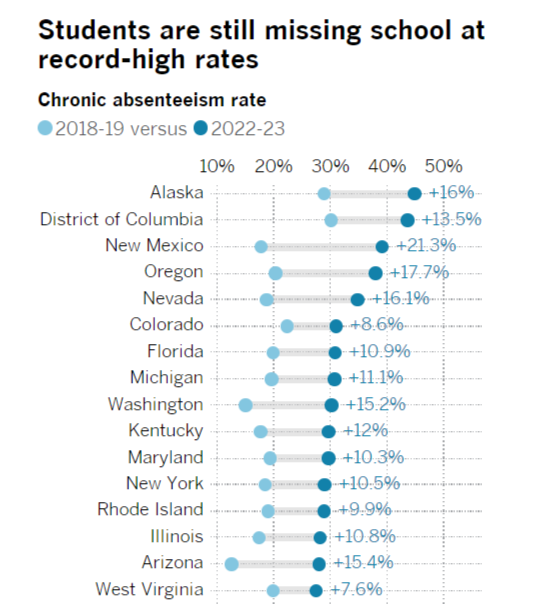
Above: While chronic absenteeism is down in some places, students are still missing school at record-high rates in many states. For more coverage, check out a thread on X from AP collaborations editor Alia Wong, following the outlet’s latest package on how and why chronic absenteeism has persisted for so long and where it’s still a big problem.
PEOPLE, JOBS, & EVENTS
Who’s going where and what’s happening
📰 Events: Don’t miss a webinar next week from the Reynolds Journalism Institute on how to create a community-centric and digital-first media organization, inspired by the Kansas City Defender. There should be great lessons for the ed beat there. The Texas Tribune Festival is happening Sept. 5-7 with a handful of education-related events. And in October, EWA is hosting a new two-day seminar on math coverage. In case you missed it, ProPublica had an event this week on understanding the intensifying political battle over school vouchers, featuring Alec MacGillis and other reporters.
📰 Books & podcasts: Chalkbeat New York bureau chief Amy Zimmer was on Ballotpedia’s “On the Ballot” podcast discussing New York City’s school cell phone policy. Former LA Times education reporter Sonali Kohli is giving out free donated copies of her book “Don’t Wait: Three Girls Who Fought for Change and Won” to students, youth activists, organizers, teachers, and libraries during her book tour this fall. Any other books or appearances? Let us know at @thegrade_ or thegrade2015@gmail.com.
📰 Awards: Three education-related stories won Edward R. Murrow Awards: “Inside the Uvalde Response” from Frontline PBS, ProPublica, and the Texas Tribune; NBC News’ podcast “Grapevine”; and a student entry about changes coming to Seattle Public Schools’ sex education classes. A piece in The Markup about digital book banning in K-12 schools won an Online Journalism Award, and the Idaho Statesman and ProPublica were named finalists for their investigation about schools in disrepair.
📰 Resources: As part of the Solutions Journalism Network’s HEAL Project, Mother Jones reporter and past Grade contributorJulia Métraux published a reporting guide on how young disabled and chronically ill people use online communities. For EWA, education journalist Melinda D. Anderson shared tips on reporting on Black girls in school. Denise-Marie Ordway of The Journalist’s Resource wrote about six tips for covering school vaccination requirements, vaccine exemptions, and undervaccination. And be sure to check out The 74’s 10 charts that explain how schools have grown less violent since Covid — counter to the usual narrative we hear.
📰 Career moves: Lauren Booker is the newest member of the Boston Globe’s Great Divide team, according to the homepage. She was previously a digital editor for the Globe’s Money, Power, Inequality team. And in case you missed it while we were off, longtime North Carolina education journalist Ann Doss Helms is retiring. See a reflection here about what she’s seen change in education coverage over the last 22 years.
THE KICKER

What’d you do this summer? Hard to compete with San Francisco Chronicle ed reporter Jill Tucker’s harrowing summer break climb of Mount Fuji, which left her feeling like both “a badass and a fool.”