Rural superintendents weigh in on the challenges their districts face.
Any educator who has worked in K-12 public schools for 20 years or more knows that state governments now assume much greater control over school operations than in the past. Through funding, curriculum, assessment, personnel policies, and more, states now heavily influence local school district operations. And, to be sure, increased state involvement can bring many benefits, including higher and more equitable levels of funding for under-resourced schools and districts. Yet, many state officials know little about local needs and conditions outside their own cities or towns (and least of all about the challenges faced by rural communities), which leads them to make education policy decisions that are poorly aligned with rural circumstances.
Indeed, the two leading education policy strategies of the current era — focusing on test-based accountability and school choice — have had a decidedly urban emphasis. And while the implementation of these strategies in urban settings (by way of charter schools, state takeovers, and efforts to narrow racial achievement gaps) has generated a great deal of attention and debate over the last two decades, policy makers in most states have largely ignored educational conditions in rural areas, even though these areas endure some of the country’s highest poverty rates. As a result, policies that are meant to improve schools often exacerbate the problems rural schools face. And, in turn, rural superintendents struggle in vain to find ways to make the policy context “work” for their schools and communities.
To remedy the many challenges in rural districts, states must develop rural-conscious policies, giving more careful attention to the specific needs of rural educators, students, and families. In every part of the country, Americans depend on their public schools not just to educate their children but to serve as community centers, engines of civic participation, and drivers of economic prosperity. However, in rural areas, schools tend to play a particularly vital role in community life, and it is especially important that state education policies enable them to thrive.
Our experience suggests that the first step toward better rural school policies is simply to listen to rural school administrators. To do so, we turn to rural superintendents in our home state of Michigan, whose concerns we believe are similar to those of rural superintendents in many other parts of the country.
The Michigan context
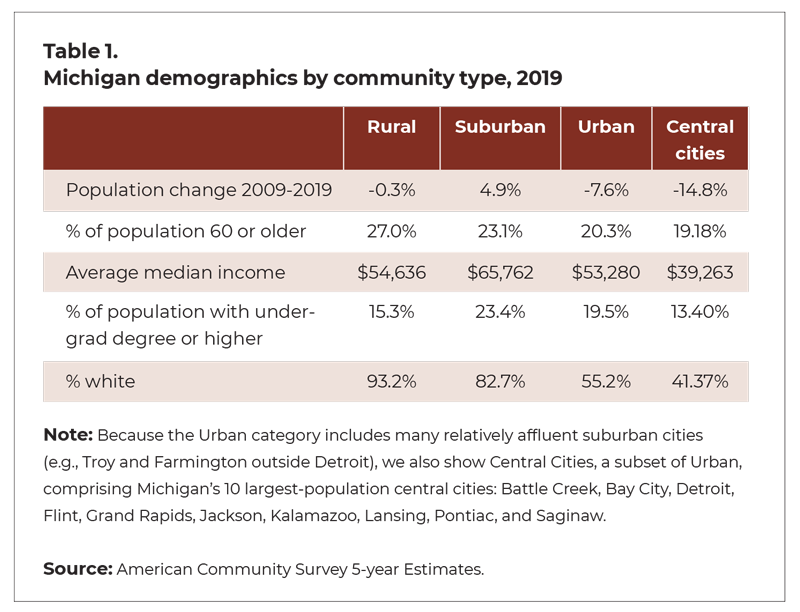
Roughly 20% of Michigan’s population lives in rural areas, while another 20% live in central cities and 60% live in suburbs. Rural school districts make up nearly two-thirds of the state’s traditional public school districts, but they have smaller average enrollments than their metropolitan counterparts. As in other states, Michigan’s rural communities are varied, and each is distinct in many ways. In general, though, the people who live there are getting older and poorer, on average, and the population is shrinking; levels of educational attainment tend to be lower than in urban and suburban communities; and, as in other northern states, the population is predominantly white. (See Table 1 for details.) While Detroit receives a great deal of attention as the nation’s poorest large city, many of Michigan’s rural communities face similarly desperate circumstances. The total number of poor people in Michigan’s rural communities comes to 89% of the number of poor people living in the state’s central cities.
In an important book, The Politics of Resentment, University of Wisconsin political scientist Katherine Cramer (2016) draws on extensive ethnographic research in rural Wisconsin to better understand significant rural-urban divides in the state’s politics. She argues that political differences are grounded in the core identities of rural residents, or what she designates “rural consciousness.” Rural identity often includes a sense that government decision makers routinely ignore rural places and, importantly, that urbanites and government officials misunderstand and disrespect rural citizens (Cramer, 2016).
Like Wisconsin and many other “battleground” states in national elections, political maps of Michigan show the state’s vast rural areas as solidly red, while blue shading is mostly restricted to metropolitan areas. Yet, neither the state Republican nor Democratic party devotes much explicit attention to rural concerns. Michigan has nothing resembling a rural education policy agenda. Our own public land-grant institution, Michigan State University, had no College of Education professors with specialization in rural education until two years ago.
Because rural districts hadn’t received much attention, we set out to better understand both the unique challenges rural school districts in our state face and the efforts that have been made to address these challenges. We also hoped to learn how state policies help or hinder these efforts, and we aimed to identify possible policy solutions. We drew on the experience and expertise of superintendents in 25 rural school districts. The districts are diverse on multiple dimensions, including region of the state, funding levels, and enrollment size and trends. The communities also vary in terms of their economic prosperity, population growth or decline, and remoteness from metropolitan areas. The superintendents completed two surveys, allowed us to interview them at length, and participated in focus groups. While we focused on their individual stories, it’s worth noting that the information they shared closely echoes quantitative government data about rural communities.
Rural school challenges
We presented superintendents with a wide-ranging list of specific district operations and asked them to rate how difficult it is for their districts to perform these functions effectively, using a five-point scale from “Not difficult at all” to “Extremely difficult.” Because we were most interested in ongoing, long-term challenges, we were careful to distinguish challenges that arose during the COVID-19 pandemic from those experienced before the pandemic. The superintendents highlighted four areas as most problematic for their districts: teacher recruitment and retention, serving students with mental health problems, broadband internet access, and state funding.
Teacher recruitment and retention
More than 80% of the superintendents reported that teacher recruitment and retention is very or extremely difficult for their districts. They receive few, if any, applicants for open teaching positions, and this hiring problem has become much more challenging in recent years than it was in the past. Consequently, superintendents devote a great deal of effort to finding and attracting suitable candidates. One superintendent noted, “It’s my biggest summer nightmare — a massive headache. I cringe every time I get a resignation, or I get a retirement letter, because I don’t know if I’ll ever fill that position.”
Several superintendents described teaching positions that they could not fill because no one applied, forcing them to either cut courses or hire long-term substitute teachers. Indeed, the use of long-term substitutes — who, in Michigan, need no formal teacher education and need to have accumulated just 60 college credit hours — increased tenfold between 2013 and 2019 (Wilkinson & French, 2019). Even so, some districts currently lack sufficient numbers of teachers to teach the state’s required curriculum. And retaining teachers is difficult, as well, with some superintendents characterizing their districts as training grounds for teachers who plan to leave for more attractive jobs elsewhere after just a few years.
Superintendents described aggressively pursuing prospective teachers, only to have the recruiting end abruptly once candidates identify their district’s location on a map.
A recent study (Wan, Pardo, & Asson, 2019) found that while enrollment in Michigan’s teacher preparation programs fell 69% between 2010 and 2017 (a greater decline than in any other state; U.S. Department of Education, 2017), the statewide supply of active teachers in Michigan public schools will meet demand through 2022-23. However, teacher shortages are expected to continue to plague the state’s northern rural regions.
What makes hiring and retention so tough? Superintendents pointed to low salaries, geographic isolation, the declining attractiveness of the teaching profession overall, and state certification requirements. As one put it, “We don’t have the resources to be able to attract the high-quality candidates that you could in larger districts with greater resources.”
But even when they find additional funds to attract educators, their remote location remains a serious obstacle for teachers who want to enjoy amenities common in urban and suburban communities, such as a vast choice of restaurants and evening activities. Single teachers, for example, fear being unable to find a partner or spouse in small, remote communities. Superintendents described aggressively pursuing prospective teachers, only to have the recruiting end abruptly once candidates identify their district’s location on a map: “It’s hard to get young people up here because of our geographic isolation . . . I can’t control living 60 miles away from the nearest services.”
Yet, rural districts have always been characterized by relatively low teacher salaries and geographic isolation. So, why is hiring more difficult nowadays? According to the superintendents in our study, salaries in their areas have been particularly stagnant, retirement and health benefits have become less generous, classroom responsibilities have become more demanding, and the status of teaching has declined. Further, they noted that state policy measures to improve teacher quality by strengthening and narrowing certification requirements have only contributed to the problem: In rural districts, teachers must often take on a wide range of classroom assignments. For example, a science teacher may need to teach physics, biology, and chemistry; or a physical education teacher may need to teach in both elementary and middle schools. Very few candidates are certified across multiple subject areas and grade levels, making the state’s more rigorous and specialized certification requirements a burden for rural districts.
Serving students with mental health problems
Even with growing national awareness of student mental health issues, we were struck by the urgency of this challenge in rural schools (even before the onset of the pandemic). Superintendents noted two key factors at play. First is an increase in traumatic circumstances in students’ homes — such as unstable parenting arrangements, poverty, substance abuse, incarceration, and homelessness. And second, professional mental health services in their communities are scarce or nonexistent. As one superintendent noted:
Students are coming, I would say, with far fewer coping abilities, carrying family issues from home with them. We see more signs of depression, suicidal behaviors, lack of ability to form relationships, lack of ability to focus on learning and instruction, non-compliance behavior, or refusal to do work. So, you know, their backpacks are definitely full when they’re coming to school with a lot of mental health issues.
Superintendents would be delighted to have full-time social workers or psychologists in their schools, but most rural districts fall far short of the staffing necessary to meet current needs. Districts are attempting to fill the gap by partnering with community mental health organizations, sharing providers with other districts, and using online services, but the fundamental obstacle is an acute shortage of trained mental health professionals in rural areas, and these measures are not sufficient to make up for that shortage.
In response to growing evidence of need, Michigan recently established a grant program to provide financial support for school mental health services, and rural school leaders welcome the initiative. State officials have discovered, however, that increased funding alone is insufficient in rural Michigan. Without targeted efforts to train and hire new mental health providers and to increase the professional capacity of existing staff, there will continue to be far too few qualified providers to meet the demand (Citizens Research Council, 2021).
Broadband access
The absence of high-speed broadband connectivity is not exclusive to rural areas, but in Michigan the problem is most acute in rural parts of the state. Connectivity varies across rural areas, but in many rural districts, a third or more of students are unable to access the internet at home. In a recent study of Michigan schools, Johannes Bauer and co-authors (2020) found that, regardless of socioeconomic status, rural middle and high school students who cannot access the internet from home, or who depend on a cell phone for internet access, have lower grades and standardized test scores, are less interested in STEM careers, and are less likely to attend college. Superintendents are acutely aware of the disadvantage this poses for students: “Without the internet, our students are behind. Every day. . . a child in a town who has high-speed internet can just look it up and get done. That puts them one step farther ahead of our students. And that’s not OK.”
Superintendents told us they are working diligently to expand connectivity for local families by providing hot spots for students to use at home or setting them up in school parking lots for the entire community to use. However, this rarely solves the problem: “They can turn on the Verizon hotspot and it’s not going to get a signal, or if it does, it’s not going to get a strong enough signal to use Zoom or get on Google Classroom.”
School and district leaders have even tried to negotiate with internet service providers on behalf of their communities to bring greater connectivity, but it is unprofitable for private internet service providers to run fiber-optic cable to areas with low population density. Most superintendents believe that the problem can only be surmounted with concerted government initiatives, and many pointed explicitly to the 1930s federal Rural Electrification Act as a model.
School funding
Like other states, Michigan allocates operating revenue to school districts on the basis of enrollment, and local districts have little control over funding beyond efforts to attract larger numbers of students. For two decades, state funding has not kept pace with inflation, and it does not consider variations in local costs over which districts have no control (Arsen, Delpier & Nagel, 2019). For example, given their low population density and large geographical areas, rural districts must devote a larger share of their budgets to transportation than metropolitan-area schools, but this is not reflected in state funding. Almost all the rural superintendents we surveyed discussed the financial burden of student transportation.
Already small enrollments mean the loss of even a few families can generate large declines in revenues without much change in costs.
Because they cannot spread fixed costs (e.g., operations and maintenance, administration) over a large number of students, small-enrollment districts also have higher per-pupil costs (Andrews, Duncome, & Yinger, 2002). This high per-pupil cost also applies when schools want to offer specialized instructional programs. The number of students who might take those courses is often so low that the cost is prohibitive, and, as a result, the range of course offerings is limited:
I would have loved to run that AP chem class, the pre calc and trade class this year, but it’s just not economically feasible to run a class with a handful of kids, even though it would benefit them as they go to college. We just couldn’t.
Special education services are expensive for all school districts, but this lack of scale makes them especially difficult for rural districts. Every superintendent in our study talked about the financial challenges of providing required special education services.
Finally, declining enrollment, under the state funding structure, poses serious financial challenges because revenues decline faster than costs — some costs are relatively fixed — forcing schools to make cutbacks in services for remaining students. In Michigan’s rural areas, where 84% of districts lost enrollment between 2009 and 2019, the already small enrollments mean the loss of even a few families can generate large declines in revenues without much change in costs:
When my enrollment goes down, my costs don’t drastically decrease. You know, it’s hard, it’s just really hard when you take a loss. I think it was my second year as a superintendent, we lost 35 kids. It was huge, huge! And for me to reassess and reallocate resources to still meet the needs of the district. I don’t know what else to say. It’s just hard.
Taking stock and moving forward
These four areas are the ones superintendents in our study selected as the most challenging, but they are not the only problems rural schools commonly face. Many leaders, for example, noted that the growth of state reporting requirements pose a special burden for small districts with few central office staff. These duties typically fall to superintendents who are already stretched very thin and wear many hats. The rural superintendents in our study also longed to provide stronger career and technical education programs for interested students, rather than adhere to state curricular requirements that presume (incorrectly) that every student aims to complete a four-year college degree.
Rural superintendents act tirelessly to “make it work,” often in highly creative ways, yet they face challenges that are often beyond their control
Rural superintendents act tirelessly to “make it work,” often in highly creative ways, yet they face challenges that are often beyond their control. They frequently expressed anguish over failing kids because of their inability to adequately address these challenges, and they said that carrying this feeling takes a personal toll on them and their sense of efficacy as school leaders. They also shared a high degree of frustration about the ways in which state policy requirements are at odds with rural realities in each of these areas, and they expressed an almost unanimous belief that most state policy makers do not understand or care much about districts like theirs.
Today, important principles like equity and opportunity are receiving long-overdue attention in education policy deliberations. But according to these superintendents, we must become more mindful of how concepts like fairness and opportunity play out in rural settings, particularly with respect to the interaction of poverty and isolation. What does equity mean when a child must sit on a bus for an hour and half each day? Or when social supports for needy children are simply not available? Or when enrollment will never be high enough for students to have an opportunity to play in a school orchestra?
Many observers have documented the distinctive and important roles that public schools play in rural communities (Sipple, Francis, & Fiduccia, 2019). Likewise, our findings highlight just how fundamental public schools are to the identity, social engagement, and recreational and cultural activities of rural communities. Schools are also integral to the economic base of rural communities and their ability to attract or retain residents. And schools are nearly always among the largest, if not the largest, employer in any rural community. For this reason, supporting rural schools and students is also a way to promote rural communities’ well-being and prosperity. For example, efforts to make rural communities more attractive to teachers, social workers, and psychologists will enhance a community’s desirability to other college graduates. Those professionals will need skilled tradespeople in their communities, which will mean more jobs.
To be sure, none of the challenges we have discussed are unique to rural school districts, but the challenges are especially acute in rural areas. Teacher shortages, student mental health, broadband access, and school funding are all areas of ongoing statewide concern and policy attention. Generic statewide policy initiatives to address them, however, are unlikely to solve the specific challenges in rural areas and can inadvertently make superintendents’ jobs even more challenging. More focused policies directed to the distinctive circumstances of rural communities are needed. At the same time, a likely consequence of states seriously deliberating on rural policy agendas will be the recognition among school leaders in urban settings that they face parallel challenges, thus creating the groundwork for new alliances and better education policies for urban areas as well.
Who has the experience and standing to bring broader public awareness to these ideas? We found rural superintendents to be impressive leaders — dedicated, competent, and in touch with diverse segments of their communities. Their jobs naturally lead them to think in terms of their whole community, and they speak effectively about equity, community development, and state policies. In an era when state policies largely control public schooling, those (overloaded) rural district leaders need to be heard if states and local leaders are to work together to provide the best services possible for all students and communities.
References
Andrews, M., Duncombe, W., & Yinger, J. (2002). Revisiting economies of size in American education: Are we any closer to a consensus? Economics of Education Review, 21 (3), 245-262.
Arsen, D., Delpier, T., & Nagel, J. (2019, January). Michigan school finance at the crossroads: A quarter century of state control. Michigan State University.
Bauer, J.M., Hampton, K.N., Fernandez, L., & Robertson, C. (2020, October). Overcoming Michigan’s homework gap: The role of broadband internet connectivity for student success and career outlooks (Quello Center Working Paper No. 06-20). Michigan State University.
Citizens Research Council. (2021, June). Meeting the mental health needs of Michigan youth with school-based health services (Report 410, Memo 1165). Author.
Cramer, K.J. (2016). The politics of resentment: Rural consciousness in Wisconsin and the rise of Scott Walker. University of Chicago Press.
Sipple, J.W., Francis, J.D., & Fiduccia, P.C. (2019). Exploring the gradient: The economic benefits of ‘nearby’ schools on rural communities. Journal of Rural Studies, 68, 251-263.
U.S. Department of Education. (2017). Higher Education Act Title II State Report Card (SRC) Reporting System [data series]. U.S. Department of Education, Office of Postsecondary Education.
Wan, Y., Pardo, M., & Asson, S. (2019, August). Past and projected trends in teacher demand and supply in Michigan (REL 2019-009). U.S. Department of Education, Institute of Education Science, Regional Educational Laboratory Midwest at American Institutes for Research.
Wilkinson, M. & French, R. (2019, August). Michigan leans on long-term substitutes as its schools struggle. Bridge Michigan.
This article appears in the December 2021/January 2022 issue of Kappan, Vol. 103, No. 4, p. 8-14.

ABOUT THE AUTHORS

David Arsen
DAVID ARSEN is a professor in the College of Education at Michigan State University, Lansing.
Tanner Delpier
TANNER DELPIER is an economist at the Michigan Education Association, East Lansing.
Annie Gensterblum
ANNIE GENSTERBLUM is a doctoral student in education policy in the College of Education at Michigan State University, Lansing.
Rebecca Jacobsen
Rebecca Jacobsen is an associate professor in the Department of Educational Administration at Michigan State University, East Lansing, Mich.
Alexandra Stamm
ALEXANDRA STAMM is a doctoral student in education policy in the College of Education at Michigan State University, Lansing.