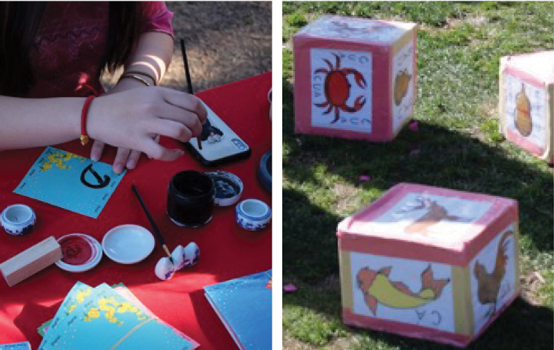
A WHS student pens good wishes to staff and students in calligraphy during the Tết Fair (left). WHS students play a life-size version of a traditional Tết game called bầu cua cá cọp or bầu cua during the Tết Fair to celebrate Lunar New Year (right). Photos courtesy of Khang Vũ.
A California high school preserves Vietnamese culture and language to help students stay connected to their families, community, and heritage.
U.S. tanks plowed through the gate of Independence Palace in Sài Gòn, Viêt Nam on April 30, 1975. Sài Gòn, the capital of South Viêt Nam at the time, was renamed HÔ Chí Minh City by the new regime. Hundreds of thousands of Vietnamese people fled the country any way they could — including by land, ships, planes, and even fishing boats — in search of freedom (Dang et al., 2015).
After the Fall of Sài Gòn in 1975, hundreds of thousands of Vietnamese refugees fled the country and resettled all over the world. Many gathered in Orange County, California, and founded Little Sài Gòn, known today as the capital of the Vietnamese diaspora and home to the largest population of Vietnamese people in the U.S. (Carreira & Kagan, 2018; Dang, Võ, & Lê, 2015). Little Sài Gòn is an ethnic enclave. For the first generation of Vietnamese Americans, Little Sài Gòn is their quê huong thú nhì, or second home. Vietnamese markets, restaurants, tax services, tutoring centers, and law offices can be found unapologetically displaying Vietnamese letters on their storefronts all over Little Sài Gòn today, offering comfort and familiarity to the community. Little Sài Gòn has become a refuge where generations of Vietnamese Americans in the community communicate in their heritage language.
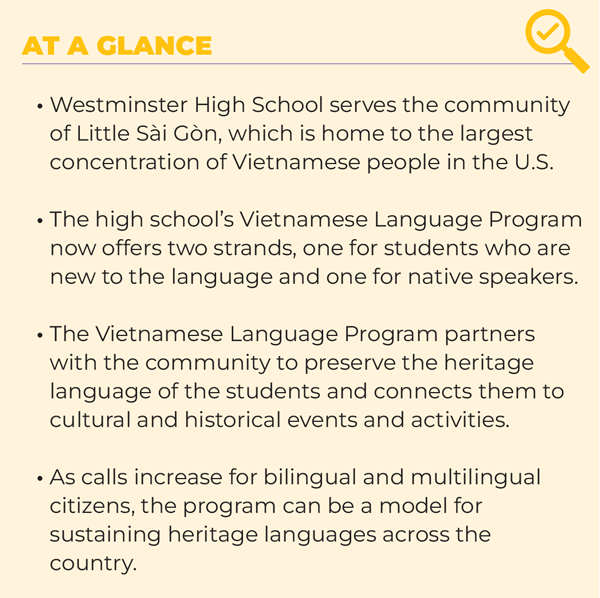
One of the ways educators and the community endeavor to keep the Vietnamese culture and language alive is through the Vietnamese Language Program at Westminster High School (WHS). Part of the Huntington Beach Union High School District, this Orange County high school serves many of the families who live in and near Little Sài Gòn. The Vietnamese Language Program could serve as a model for other language preservation efforts across the country.
Community activism for language preservation
To keep heritage languages alive, language programs must have strong community support. Developing successful multilingual education opportunities for students requires substantial time, intention, and effort, which was the case for the WHS Vietnamese Language Program (Carreira & Kagan, 2018).
WHS has a student enrollment of more than 2,600 students, 43.5% of Asian descent (Westminster High School, 2023). Many of those Asian students possess Vietnamese heritage. In 1999, in response to growing demand from community members, students, and parents, WHS became the first high school in Orange County to offer Vietnamese language courses (Vietnamese American Curriculum Project Committee, 2001). The Vietnamese Language Program has thrived for more than two decades, and it continues to grow because of its relevance to the local community.
Why Vietnamese language education matters
As Vietnamese language teachers, my colleagues and I recognize that if the language gap between the older and younger generation in the Vietnamese American community widens, Little Sài Gòn, the ethnic enclave that has historically provided security and peace to the community, could soon cease to exist.
The older generation of refugees that provided services in Vietnamese will soon retire. However, the need for these services remains as more immigrants from Southeast Asia arrive. According to the Migration Policy Institute, as of 2019, immigrants from Southeast Asia account for the largest total Asian immigrant population in the U.S.; of that number, more than 1.4 million originate from Vietnam (Hanna & Batalova, 2023). The Vietnamese population continues to grow, and approximately 65% of Vietnamese people in the U.S. are classified as Limited English Proficient, meaning that they spoke English less than “very well” (Hanna & Batalova, 2023). Community members and new arrivals who depend on services in their language may lose access if the Vietnamese language and culture continues to diminish in the U.S.
The younger generations of Vietnamese Americans need to be able to access quality Vietnamese language and culture education to keep the language alive, especially since the range of Vietnamese language learners continues to diversify annually. Through heritage language programs, young people gain a deeper understanding of their roots and help new arrivals function in daily life. In addition, they will be able to thrive in an increasingly globalized economy (Bong, 2023).
The story of a former WHS student named Tâm illustrates why keeping the language alive is so important. Tâm immigrated from Vietnam when he was very young. After several years in the U.S., he became fluent in English. However, his English-language skills progressed at the expense of his Vietnamese-language skills. As a result, Tâm needed to relearn Vietnamese to better communicate with his parents and grandparents because they still spoke Vietnamese rather than English. Through the program, he gained not only proficiency in Vietnamese, but also a deeper knowledge of Vietnamese culture, practices, and customs. The immersive experience of the Vietnamese Language Program helped Tâm navigate his split heritage as a Vietnamese American.
However, a language barrier still existed between Tâm and his parents. Tâm’s elderly parents struggled to learn English, and Tâm was the unofficial translator for his family as a Vietnamese language learner himself. This language barrier led to serious consequences when Tâm was hospitalized for major health issues. He and his parents experienced racial microaggressions from the health care staff. They were denied translation services, and at one point, a nurse harshly asked Tâm, “Don’t you speak Vietnamese? Why don’t YOU translate for your parents?” Tâm tried his best to translate a few words, but she sharply dismissed his efforts with, “That’s it?” Tâm couldn’t translate medical terms or medical conditions to help himself or help his parents understand. This situation would have required him to know healthcare language in Vietnamese. Tâm’s experience reflects the problem many young Vietnamese Americans in this country face, even those who live in and around Little Sài Gòn.
Multilingualism incentives
Keeping heritage languages alive requires systemic incentives. The relevance of Vietnamese language education extends beyond Little Sài Gòn because it responds to the national effort to produce highly multilingual and multicultural citizens (Bong, 2023). The California State Seal of Biliteracy was established in 2012 to officially recognize students’ multilingual backgrounds and award them for engaging in formal education to optimize their multilingual skills (Bong, 2023). Almost all U.S. states have approved a State Seal of Biliteracy.
The heightened demand for multilingual education opportunities has led to a critical need for high-quality multilingual teachers (Garcia, 2020). California intends to double the number of bilingual teacher preparation programs at state-approved educator preparation programs within the next 10 years (California Department of Education, 2019). Promoting accolades such as the Seal of Biliteracy in K-12 schools encourages youths to elevate their multilingual skills, potentially putting them on a path to becoming multilingual teachers.
As long as community members, school systems, and teachers are invested in language preservation efforts, heritage languages can be sustained in the U.S.
Since its inception, the Vietnamese Language Program has grown steadily to accommodate the diverse range of Vietnamese language learners in the school community. This fall, eight different levels of Vietnamese language classes are being offered to accommodate native and non-native language learners. Those course levels include four courses for Vietnamese Language Learners and four courses for native Vietnamese speakers, with 19 sections of Vietnamese classes being taught, four more than the previous school year. WHS has four Vietnamese language teachers, three full-time, and one part-time. As of the 2022-23 school year, more than 550 students were enrolled in Vietnamese language courses at WHS, meaning that more than 20% of the school population was learning Vietnamese as a world language.
The role of teachers and community partners
Teachers and community partners play major roles in language and heritage preservation efforts. In the case of the WHS Vietnamese Language Program, teachers take initiative in finding opportunities for students to grow their Vietnamese language skills and awareness of Vietnamese culture. Teachers collaborate to enhance and extend learning beyond the classroom. To enrich Vietnamese language learning, we incorporate project-based learning and strategies like comprehensible input, which is language that can be understood by learners even if they don’t understand all the words. Moreover, we advise the Vietnamese American Culture Club that helps promote the Vietnamese language and culture within the school and the larger Orange County community. We also collaborate with other Vietnamese American teachers on campus to coordinate events such as our annual Têt (Lunar New Year) Show, Têt Fair, and cultural performances for local elementary schools.
In addition, to enhance our students’ knowledge of the Vietnamese American community’s culture and history of resilience, we partner with community organizations such as VietRise and the Vietnamese American Arts and Letters Association, among others. Community partnerships ensure the growth of the program, provide students access to linguistic and cultural enrichment opportunities beyond the classroom, and keep the language alive in the community (Carreira & Kagan, 2018).
By and for the community
The demand for multilingual education continues to grow across the U.S., and multilingualism has been touted as a way for workers to stand out in the world economy. However, preserving heritage languages is also important so students can stay connected to their communities and overcome potential language barriers. As long as community members, school systems, and teachers are invested in language preservation efforts, heritage languages can be sustained in the U.S.
Note: Anthony Nguyên, a Vietnamese language teacher at Westminster High School, contributed to this article.
References
Bong, D. (2023). Why heritage language learning matters. Seal of Biliteracy.
California Department of Education. (2019). Global California 2030: Speak. Learn. Lead.
Carreira, M., & Kagan, O. (2018). Heritage language education: A proposal for the next 50 years. Foreign Language Annals, 51 (1), 152–168.
Dang, T.V., Võ, L.T., & Lê, T. (2015). Vietnamese in Orange County. Arcadia Publishing.
Garcia, A. (2020). A new era for bilingual education in California. Phi Delta Kappan, 101 (5), 30-35.
Hanna, M. & Batalova, J. (2023, February 14). Immigrants from Asia in the United States. Migration Policy Institute.
Vietnamese American Curriculum Project Committee. (2001). Vietnamese Americans: Lessons in American history. An interdisciplinary curriculum and resource guide. Orange County Asian and Pacific Islander Community Alliance.
Westminster High School. (2023). Westminster High School 2021-22 School Accountability Report Card (pp. 1–28).
This article appears in the October 2023 issue of Kappan, Vol. 105, No. 2, pp. 29-31.

ABOUT THE AUTHOR

Pauline Phi Nguyên Đồng
PAULINE PHI NGUYÊN ĐỒNG is a Vietnamese language teacher at Westminster High School, Westminster, CA, and a doctoral student in the Educational Leadership program at California State University, Long Beach.