
A Michigan school district takes a team approach to understanding individual students’ literacy development and giving them the supports they need to thrive.
Educators work tirelessly to meet the unique needs of striving readers. Yet despite state and federal reforms, local initiatives, advancing research, availability of methods and programs, intensive professional development, and the work of literacy coaches, school districts still have students struggling to read or write on an expected timetable. A few may have been diagnosed as having dyslexia. Some may have individualized education programs (IEPs); many others may not. Others are navigating multiple languages or interrupted schooling. Many are students of color who have found themselves in the throes of “school desegregation, compensatory education, expulsion and suspension, academic disparities, tracking, ability grouping, special education, and giftedness” (Ladson-Billings, 2021, p. 192).
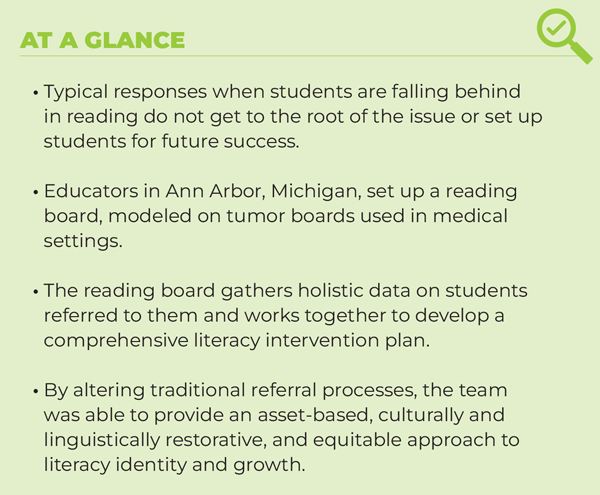
Typical responses when a student is behind in their literacy development may involve placing that student in a commercial intervention program, moving them to a different classroom, retaining them in a grade, or even honoring a request for costly private tutoring. But these quick fixes do not get to the root of the issue or set up students for future success.
As instructional leaders for Ann Arbor Public Schools in Michigan, we sought an alternative to the traditional response to intervention model used in the district at the time. Our goal was to acknowledge and address the depth and breadth of individualized diagnoses, instructional needs, and social injustice. In addition, we wanted to subvert the overrepresentation of subgroups of students, primarily students of color, in special education. The answer turned out to be a districtwide reading board.
The development of a reading board
The idea for the reading board came from a case of metastatic osteosarcoma. Deborah Wolter’s daughter had been diagnosed with this adolescent bone cancer, and her oncologist had outlined the recommendations of a sarcoma tumor board for treating her (Siegel et al, 2015). Tumor boards include physicians who specialize in different areas and meet regularly to discuss diagnoses and treatment options for their patients.
As Wolter drove to work from the oncologist appointment, she thought about Jeremy (a pseudonym), a student she had recently been consulted about. She realized that a reading board, modeled after the sarcoma tumor board, could review and discuss the reading progress of students like Jeremy and build a plan for systemic support, just as clinicians came together to make a plan for her daughter. And so the reading board was established as a districtwide approach for addressing the needs of students who, despite best efforts, were not making adequate progress.
When the board was established in 2018, Ann Arbor Public Schools, the fourth-largest district in Michigan, contained 32 schools serving more than 16,000 students. Approximately 50% were students of color, and more than 60 languages were spoken. Even though the district, set in a large university town, was considered high-performing, the reading board was concerned about the remaining students not experiencing expected achievement. The percentage ranged from 10% to 50%, depending on the neighborhood school. The district had provided material and training in various approaches and commercial programs, but the state continued to flag the district for issues related to disproportionate results for student subgroups.
Since its founding, the intent of the reading board has been to address gaps in curriculum and instruction as part of the standard of care for all students (Duke, 2019) and to provide additional and optimal intervention as needed. Most important, the board emphasizes restorative justice, culturally and linguistically responsive teaching, and equity. Members are district educators with relevant expertise and differing perspectives, experiences, and knowledge in literacy learning. They include the assistant superintendent for teaching and learning, a special education director, a district literacy coordinator for elementary education, a district literacy coordinator for secondary education, an inclusion specialist and reading interventionist, and a special education literacy consultant. While expertise was crucial, having an asset-based mindset was equally important. The number of members on the team varies, depending on the needs of individual students and building resources. An educational psychologist, a speech and language pathologist, and a coordinator for English learning may also join the team, depending on the needs of the current caseload. Each student the reading board supports has a building-based team of teachers and service providers as well.
Three coordinators of the reading board meet weekly to discuss the 8 to 10 students the board is supporting at any given time. The coordinators analyze progress-monitoring data, determine who is ready to exit, and review new requests for support. Like the tumor board, which did not have patients attend meetings, the reading board does not have parents attend its initial sessions. Thus, board members can hash out their concerns, expertise, communication, and coordination in a professionally safe manner. Families are kept closely informed throughout the entire process.
Individual and systemwide support
The reading board works with school teams involved in supporting each individual student whose case is brought to the board to develop that student’s comprehensive literacy intervention plan (CLIP). Akin to an IEP, the CLIP is a dynamic and living document covering background and contextual information, responses to previous interventions, and a flexible research-supported action plan that includes progress monitoring, an ongoing communication log, and exit plan.
The idea underlying the CLIP is that all students are striving, exploring, and growing readers and writers, regardless of their placement in such categories as special education, English learning, or Title I. When developing the CLIP, the board recognizes that reading development is a complex process for all students, including proficient and fluent readers. Therefore, no one method or program will reach all students. The job of the board is to examine how various supports can be unpacked and repackaged together to enable a child to thrive.
To understand how the board works to support students, let’s look at Jeremy. Jeremy identifies as a Black boy and uses both white mainstream English and Black language (Baker-Bell, 2020). In 3rd grade, he was reluctant to read, tested poorly on assessments, and spent several hours per day in a resource room. Jeremy was prone to outbursts, especially during small-group instruction. He attempted to wander between classrooms and hallways during literacy instruction. He often communicated that he could not read or write and asked his peers to help him.
The school had tried a variety of interventions with increased frequency, intensity, and smaller group sizes to meet Jeremy’s needs. But these efforts did not bring about sufficient improvement, so Jeremy’s father requested that the district offer an independent assessment and tutoring through a private agency. The administration was ready to support a new approach, and Jeremy became one of the first students to be supported by the reading board.
Gathering data
The board gathered both qualitative and quantitative information to gain a better understanding of Jeremy’s educational experience, including previous interventions both inside and outside school. The qualitative information included each school team member’s perception of Jeremy’s strengths and areas of growth. Quantitative data included results from unit assessments, district assessments, and standardized tests.
The inclusion specialist and the literacy consultant made several observations in both classrooms and intervention settings, along with interviewing, reading, and writing with Jeremy. The board also reviewed available email communications and reports from multidisciplinary teams, outside agencies, and physicians. They checked his school records for hearing and vision screens, home language, interrupted schooling, chronic health conditions, and disciplinary actions. Once the board had a full, detailed picture of Jeremy’s learning experiences and documented them on his CLIP, they were ready to move forward with a positive, asset-based mindset.
A student new to the board requires several hours of analysis, discussion, and requests for further information before meeting with school teams. When the reading board reviewed the collected information on Jeremy’s CLIP, they found that some information was mismatched and needed to be confirmed. For example, Jeremy’s father reported that Jeremy’s vision acuity was normal, but a vision screen in his school record indicated otherwise.
A reflective and holistic process
The reading board’s intent is to disrupt typical paths toward labeling and tracking. The board focuses on the whole child and attempts to walk in students’ shoes, reflecting on questions about their experiences and how they foster students’ reading and writing skills and their literacy identity. These might include:
- What does a day of literacy instruction look like for the student in terms of schedules and routines, access to instruction, and reading material?
- What strategies does the student use to decode unfamiliar words, understand concepts, and deepen comprehension?
- What might have been the missing learning links or accommodations that impeded the student’s expected growth?
- What are the student’s literacy identities at school? At home? At large?
- How can school teams view the student as a striving reader and writer (Harvey & Ward, 2017)?
- How can school teams cultivate the genius that already lies within the student and their teachers (Muhammad, 2020)?
- How will school teams use stronger relationships to help the student forge a literate life (Beers & Probst, 2020; Howard, Milner-McCall, Howard, 2020; Minor, 2019)?
For example, a question like “Where is Jeremy struggling with literacy skills?” could become “What does literacy look and feel like for Jeremy from his vantage point?” And “What are Jeremy’s weaknesses?” could become “How can we build on Jeremy’s strengths and areas of interest to address areas of need?” By restating these questions in this way, the board is a stark contrast to traditional student study teams, which too often focus on the child’s deficits and remediation and become a direct route to special education (Johnson, Jenkins, & Petscher, 2010), resulting in opportunity gaps for marginalized groups or a one-size-fits-all approach to delivering intervention.
The reading board aims to build capacity within school teams by serving as a working conference with embedded professional development for members from different departments. Coaching, consulting, and other learning opportunities, such as book studies for group members, aid this process. Before coming to the board, Jeremy received reading and writing instruction from numerous providers in accordance with each department’s rules and regulations. The result was an isolated and fragmented approach to instruction. Deeper collaboration was imperative. Each leader on the board communicated information, funding sources, expertise, and advancements from their respective departments. As facilitators of the process, the board ensured that the collaboration between departments led to better time management, communication, and development of new approaches.
Examining instruction
The board examines the quality of the general education curriculum and instruction (i.e., the standard of care) each student receives against Michigan’s Literacy Essentials, “a set of research proven effective approaches to markedly improve literacy skills” (Early Literacy Task Force, 2016). Examining the barriers teachers face as they deliver daily classroom instruction provides insight into the professional learning and support that teachers require.
School teams receive coaching on the Michigan Literacy Essentials, culturally sustaining teaching (Paris, 2012), and social-emotional learning. Often, the school team’s new learning informed the need for districtwide professional development. School leaders developed a deeper understanding of the challenges of delivering curriculum in classrooms, which led to more support. Teachers reported that they felt more confident and autonomous in their teaching after receiving coaching and additional professional learning opportunities.
The board recognizes that reading development is a complex process for all students, including proficient and fluent readers. Therefore, no one method or program will reach all students.
The reading board envisions that all readers and writers will thrive when their reading instruction closely matches their assessed strengths and areas of growth, cultural and linguistic backgrounds, motivation and interests, identities, and needed accommodations. Jeremy, for example, was interested in books about space and animals and enjoyed rereading. While Jeremy demonstrated accurate decoding skills, he was working on strengthening metacognitive strategies and comprehension in unfamiliar texts. Jeremy and his teachers were made aware of the linguistic features of his oral languages and of print and were assured that the characteristics of Black language that Jeremy used were not deficits. The board encouraged Jeremy’s teachers to take inventory of the classroom library to ensure that it included a rich range of diverse, high-interest reading material that was not limited by a reading level, which often led to inadvertently tracking students to lower-level content. It was a matter of equity to make sure Jeremy had access to grade-level content. Further, the team was encouraged to learn more about Jeremy’s background so they could include culturally affirming texts in his repertoire.
Evolving supports
The time a student spends with the reading board varies, and the supports in each action plan is determined by the evolving needs of the student and their team. In general, the goal is for any intervention to have the most minimal impact possible on the student’s inclusion in the standard instructional program. Recommendations on the CLIP have included a variety of activities, including the following:
- Providing professional books, chapters, and articles relevant to the student’s support team.
- Professional learning, including coaching, for interventionists, service providers, and classroom teachers.
- Correcting gaps in curriculum, daily routines, and groupings.
- Increasing teacher confidence with high-quality instruction.
- Removing deficit mindsets.
- Fostering anti-racist/anti-bias work.
- Supporting families.
- Embedding specialized intervention, such as a structured multisensory reading program.
- Purchasing diverse books for classroom libraries.
- Offering guided choice and/or independent reading.
- Coordinating consistent care from multiple service providers to address anxiety, trauma, and identity.
- Supervising progress monitoring.
Progress monitoring, a communication log, and an exit plan round out the CLIP for each student. The reading board revisits individual CLIPs frequently to ensure equity and growth for students. Staying with the student throughout grade levels and building changes is paramount even if it means the board must create a new action plan for the student. Although the specific recommendations for coaching, consulting, professional development, and interventions vary widely for each student, movement toward change and growth occurs quickly with support, collective efficacy, and administrative funds.
In Jeremy’s case, all team members, including Jeremy’s father and his classroom teacher, were cautioned not to “help” Jeremy by correcting his miscues. Instead, they were to offer both metacognitive and phonetic strategies for him to figure out unknown words independently. Service providers, such as the occupational therapist and social worker, worked closely with the team on literacy growth, as opposed to setting IEP goals from their assessments in isolation. Intentional coordination of services allowed for cohesion that benefited not only Jeremy, but also his peers. As a result of the team’s work together, Jeremy began to thrive, and his teachers reported significant gains on the district’s assessments for all of their students.
Emphasizing identity, agency, and equity
Because the board wants to develop asset-based mindsets in classrooms and school communities, members make an explicit effort to remove labels, categories, and tiers. For example, the board made sure Jeremy was seen as a reader or writer, rather than as a “Level J” or “special education” student.
Instead of grouping students by abilities, teachers or reading coaches, with guidance of reading board members, hold restorative circles to share on equal footing about tackling challenging words, phrases, and concepts. In a circle, all students and adults in the school learn strategies for decoding and encoding words, determining meaning, and acknowledging the common challenge of confronting unknown topics and concepts, no matter what “level” we are at in our learning or what texts we come across. Through processes like these, Jeremy was able to communicate his learning preferences, such as working independently or with peer or adult collaboration, and his desires and goals for growth.
Because the board wants to develop asset-based mindsets in classrooms and school communities, members make an explicit effort to remove labels, categories, and tiers.
Once all components of Jeremy’s action plan were fully implemented, the gains in motivation, engagement, and reading achievement were astounding. Jeremy’s benchmark data increased from reading two grade levels below to reading on par with his grade-level peers. Everyone in Jeremy’s life was able to observe the growth of his identity as a reader. And Jeremy himself declared, “I’m a reader!” While he needed coaxing to choose books at the beginning of the process, after a few months he was bringing piles of books to class to read and share. Jeremy wasn’t just reading books but was talking about them as well, making connections between classroom content and books that he read for enjoyment. Other students the reading board served experienced similar outcomes in taking ownership of their reading and writing growth.
A ripple effect
Reading boards should be composed of team members dedicated to inclusion, anti-racism, anti-ableism, social justice, literacy research, and an ongoing sense of collaboration and learning through working directly with students. School teams should refrain from unchecked fidelity to a particular assessment or program and maintain fidelity to the student.
Not only did Jeremy and his peers experience growth as literate beings, but teachers, service providers, coaches, administrators, and the board itself also did. Additionally, teachers, principals, and entire school teams began to see the benefits of altering their usual response to intervention approach to become more asset-based, culturally and linguistically restorative, and equitable. The work with the reading board gave teachers more expertise and confidence in approaching literacy in an authentic manner for other students. Several principals adopted a reading board approach in their individual buildings using their own staff, eliminating students’ need for additional service time outside the classroom. In one building, five children, all students of color, were removed from the special education caseload or avoided a special education referral altogether.
The work of a reading board has the potential to improve the trajectory of not just the students directly involved, but also the entire school community, as everyone learns to take an asset-based approach to learning.
References
Baker-Bell, A. (2020). Linguistic justice: Black language, literacy, identity, and pedagogy. Routledge.
Beers, K. & Probst, R.E. (2020). Forge by reading. Scholastic.
Duke, N.K. (2019). Reading by third grade: how policymakers can foster early literacy. National Association of State Boards of Education, 19 (2), 6-11.
Early Literacy Task Force. (2016). Essential instructional practices in literacy. Grades K to 3. Michigan Association of Intermediate School Administrators General Education Leadership Network.
Harvey, S. & Ward, A. (2017). From striving to thriving: How to grow confident, capable readers. Scholastic.
Howard, J.R, Milner-McCall, T., & Howard, T. (2020). No more teaching without positive relationships. Heinemann.
Johnson, E.S., Jenkins, J.R., & Petscher, Y. (2010). Improving the accuracy of a direct route screening process. Assessment for Effective Intervention, 35 (3), 131-140.
Ladson-Billings, G. (2021). Critical race theory in education: A scholar’s journey. Teachers College Press.
Minor, C. (2019). We got this: Equity, access, and the quest to be who our students need us to be. Heinemann.
Muhammad, G. (2020). Cultivating genius: An equity framework for culturally and historically responsive literacy. Scholastic.
Paris, D. (2012). Culturally sustaining pedagogy: A needed change in stance, terminology, and practice. Educational Researcher, 41 (3), 93–97.
Siegel, G.W., Biermann, J.S., Chugh, R., Jacobson, J.A., Lucas, D., Feng, M., . . . & Hasen, J. (2015). The multidisciplinary management of bone and soft tissue sarcoma: an essential organizational framework. Journal of Multidisciplinary Healthcare, 8, 109.
This article appears in the October 2023 issue of Kappan, Vol. 105, No. 2, p. 42-47.

ABOUT THE AUTHORS

Erica Rodriguez-Hatt
ERICA RODRIGUEZ-HATT is an early literacy and literacy coaching initiatives coordinator at Washtenaw Intermediate School District, Ann Arbor, MI.
Jennifer R. Poliquin
JENNIFER R. POLIQUIN is a building literacy coach in Ann Arbor Public Schools, MI.
Deborah L. Wolter
DEBORAH L. WOLTER is a retired literacy consultant for student intervention and support services in Ann Arbor Public Schools, MI.