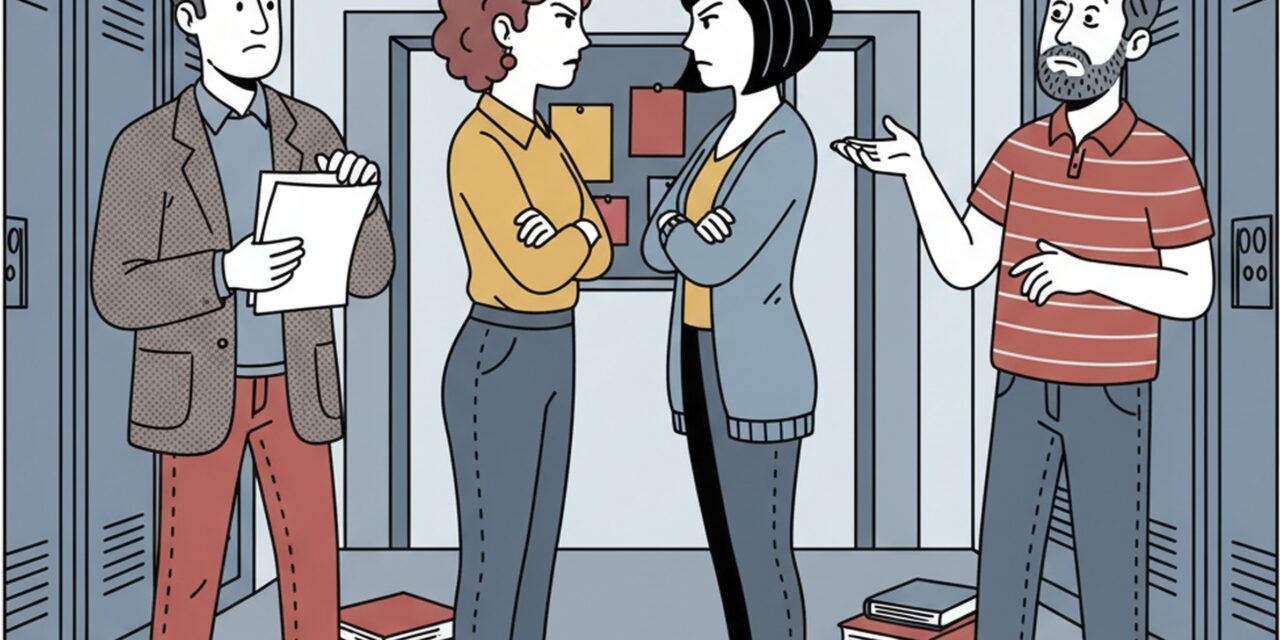
Q: “How do I get my teacher team on the same page, so they can help students better? The team’s adversarial relationships are negatively affecting students in our small school, and I’d like to help improve the culture.”
A: When a teacher team is out of sync — especially in a small school where everyone feels the ripple effects —students notice first. They experience inconsistent expectations, uneven support, and the stress that leaks from adult dynamics into classrooms. I spent a good portion of my teaching career in a small school and understand this challenge keenly. We often disagreed on what was best, and until we all reached a common understanding, there was quite a bit of triangulation, which wasn’t good for our students. The good news is that “getting on the same page” doesn’t require everyone to become best friends. It requires shared commitments, predictable routines for collaboration, and a way to repair trust so adults can focus on the work: helping students learn.
Here are practical steps you can take to begin shifting the culture while keeping the work grounded in student needs.
Start with a clear, student-centered “why” (and make it visible)
Adversarial relationships often persist because the team is operating from competing priorities or interpretations of what matters most. Begin by re-centering on a shared purpose: what students need from the adults in the building. In a team meeting, use a short protocol: “What are students experiencing right now because we’re not aligned?” and “What do we want them to experience instead?” Capture the answers in plain language (e.g., “consistent expectations,” “calm transitions,” “aligned grading,” “fewer surprises”). Turn that into a simple team aim for the next six to eight weeks. When the goal is adult harmony, it can feel personal and vague; when the goal is students get consistent support, it’s concrete and motivating. And remember, whatever is agreed upon should be done with grace, and we should talk with the students about the process to shift the power dynamic again. If you agree, everyone must do what is agreed.
Create working agreements, not vague norms
Many teams have “norms” such as being respectful or assuming positive intent, which are hard to live by when trust is low. Replace (or supplement) them with working agreements that specify behaviors. Examples: “We address concerns directly with the person involved within 48 hours,” “We don’t triangulate (no venting to a third person as the primary strategy),” “We separate decisions from debriefs,” and “We use evidence (student work, attendance data, assessment results) when we make claims about what’s working.” Keep the list short — five to seven agreements — and define what happens when an agreement is broken. That last part matters: “If we slip, we name it and reset in the moment,” or “We pause and use a quick repair script.” Agreements aren’t about control; they’re about predictability.
Use a meeting structure that reduces conflict by design
I recall department meetings at my small school. Each of us had big personalities, and someone was always vying for the floor. It was challenging to be productive without structure. Unstructured meetings amplify tension: the loudest voices dominate, old grievances resurface, and decisions get revisited repeatedly. Put a consistent structure in place for at least a quarter. Consider a weekly 45-minute team meeting with this cadence:
- Five minutes of wins/bright spots connected to students.
- Ten minutes of logistics (timed).
- Twenty minutes of student-centered problem solving using a protocol.
- Ten minutes for decisions and next steps with owners and deadlines.
Rotate facilitation while keeping the agenda template consistent. Assign roles — facilitator, timekeeper, notes/decisions recorder — so the meeting isn’t dependent on one person’s personality.
Bring evidence to the center: Student work, not adult opinion
Adversarial teams often get stuck in “my experience vs. yours.” To shift the conversation, anchor collaboration in shared artifacts. Pick one routine: a quick student work look, a common assessment, or a “one student, many lenses” discussion (academic data + behavior patterns + engagement observations). The point isn’t to judge teachers; it’s to create a shared picture of student needs. When the team is reviewing the same evidence, it becomes easier to ask, “What response will help?” rather than “Who’s right?” We need to avoid assigning blame and determining who’s right as much as possible. This is about kids, not adult egos, and sometimes we forget that. Using these opportunities to focus on the impact the team is having on student learning can create powerful aha moments.
Define “same page” precisely (and keep it narrow at first)
Trying to align everything at once — curriculum, grading, discipline, homework, intervention — can overwhelm a strained team. Choose one or two high-leverage areas that students experience daily. In small schools, consistency in expectations and grading often has an outsized impact. For example, you might align: (a) late work policy, (b) minimum grading/redo opportunities, or (c) a shared classroom routine for entering class and getting started. Write the agreements down in a one-page team “playbook.” Then test for six weeks and collect feedback from students: “What feels more consistent? What’s still confusing?” Start with low-hanging fruit so that you can try and feel the impact immediately and adjust before going on to something larger.
Build in repair, because trust won’t rebuild without it
If relationships are adversarial, there are likely unresolved hurts — some small, some significant. You don’t need to force a “feelings circle,” but you do need a way to address harm when it happens. Teach and normalize a simple repair script for adults: “When you said/did __, I interpreted it as __. The impact on me was __. What I need going forward is __.” The receiving script matters too: “Thanks for telling me. What I hear you saying is __. I can do __. Here’s what I intended.” If the conflict is entrenched, bring in a neutral facilitator (an administrator from outside the team, a coach, or HR/union-supported mediation). Repair is not extra; it’s infrastructure.
Sometimes we don’t even know when harm has been caused, and that’s how resentments and adversarial relationships get started. We need to communicate respectfully with our colleagues so we can continue to serve students. Once we understand the harm caused, we can begin the essential work of repairing it. The trust we need to build takes time and can’t be rushed. Be patient with each other and always remember to put the learners first.
If you have an issue that you would like me to address, please email me at ssackstein@educatorsrising.org or complete this form. You will be kept anonymous.
ABOUT THE AUTHOR

Starr Sackstein
Starr Sackstein is the Massachusetts state coordinator for PDK’s Educators Rising program, COO of Mastery Portfolio, an education consultant, instructional coach, and author. She was a high school English and journalism teacher and school district curriculum leader. She is the author of more than 15 educational books, including Hacking Assessment (Times 10, 2015), Making an Impact Outside of the Classroom (Routledge, 2024), and Actionable Assessment (Routledge, 2026).
Visit their website at: https://www.mssackstein.com/