If you’re worried about the future, visit a kindergarten classroom — it’s a cliché, I know. However, I saw for myself this summer the truth of this sentiment, cliché or not. If you’re worried about the future of education, spend time with students who plan to be teachers.
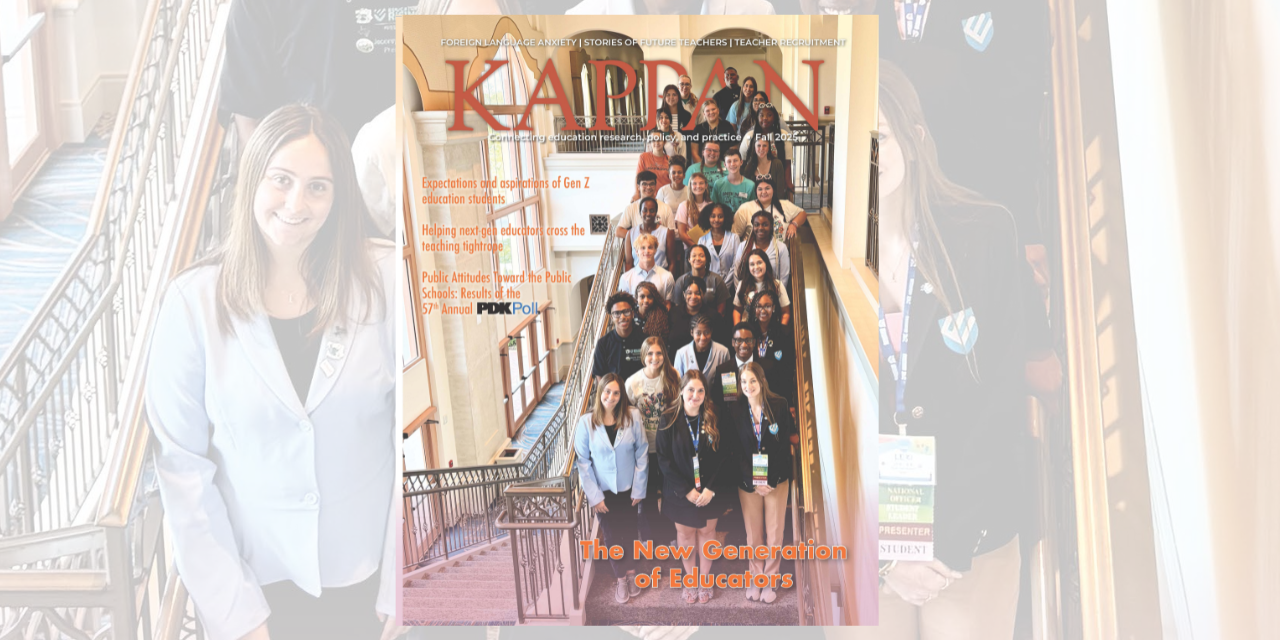
I attended the Educators Rising annual conference in June in Orlando. No one could feel pessimistic about the future in the presence of students who exude so much passion and excitement about the teaching profession. Missy Testerman was the keynote speaker on the first day of conference. The 2024 National Teacher of the Year was sitting in the audience when the doors of the ballroom opened and the students burst into the room, singing, laughing, and cheering. Testerman was so impressed that she mentioned it in her address. The students’ enthusiasm, she said, sent a message to current teachers: “Help is on the way.”
Help is indeed on the way. And those new teachers might need some help, too. In this issue of Kappan, we consider the new generation of teachers coming into schools. How can we set them up for success, so they turn into veteran teachers?
We asked our Educators Rising students to tell us what they want their future colleagues to know about their generation. Their answers can be found in this issue’s Students Speak section.
Speaking of help, we could use yours. Would you consider submitting an article for an upcoming issue of Kappan? Here are the themes for the 2025-26 publishing year.
WINTER 2025
Technology and the AI wave
Deadline for submissions: Sept. 15, 2025
The first one-to-one programs emerged at the start of the century, and post-COVID, many schools’ expansion of available technology exploded. ChatGPT was introduced to the public in November 2022; since then, the use (and misuse) of artificial intelligence in classrooms, schools, and districts has exploded. AI has the potential to bring big changes to K-12 and higher education. It also presents risks and challenges. In this issue, we want to explore the benefits of educational technology and AI’s educational uses, as well as what might be coming next.
SPRING 2026
Focus on curriculum and instruction
Deadline for submissions: Dec. 31, 2025
What and how we teach are education’s essential building blocks. We are midway through the 2020s, and numerous trends have emerged in curriculum and instruction that reflect changes and demands of our society, including microlearning, immersive learning, gamification, Universal Design for Learning, career pathways, and AI-enhanced personalized learning. How are these trends shaping and reshaping teaching and learning? Potential topics include: Strategies teachers need to truly personalize learning for their students, such as flexible pacing. Professional development that actually changes instructional practice. Evaluating the effectiveness of curriculum. The best ways to introduce different instructional practices to teachers. Ensuring curriculum coherence across grades and subjects. Overcoming barriers and roadblocks for instructional innovation.
SUMMER 2026
Teachers as leaders
Deadline for submissions: Feb. 5, 2026
Teachers are closest to the learning. They see firsthand what works — and what doesn’t — for students. That’s why it’s crucial to include their voices in the decisions made for their schools and districts. However, many teachers believe they must leave the classroom to be a leader. Others aren’t sure where to start. What does it mean to be a teacher leader? Can teachers lead from their classrooms?
Our writers guidelines are available at kappanonline.org/write/write-for-kappan.
This article appears in the Fall 2025 issue of Kappan, Vol. 107, No. 1-2, p. 4.

ABOUT THE AUTHOR

Kathleen Vail
Kathleen Vail is editor-in-chief of Kappan magazine.
Visit their website at: https://pdkintl.org/