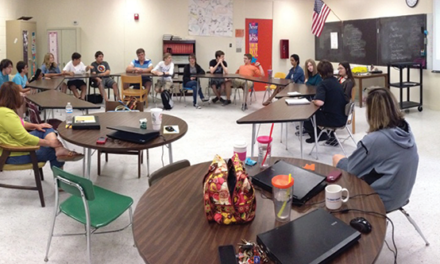
An after-school program encourages at-risk teens to stay in school by providing tutoring, therapy, and enrichment.
For many children, school simply doesn’t work. Many underprivileged children have found that the 9 a.m. to 3 p.m. program fails to educate and prepare them for life. What if we created after-school programs, separate from schools, to help these children learn? What if children received close attention in a public after-school program that worked on motivating students, increasing their self-esteem, and making the program age-appropriate?
And the location of the program would be in their own communities, so they felt comfortable and happy studying near home with folks like them. The idea is that the site would reduce dropouts by providing education in an alternative context, meeting the needs of students who fail to thrive in traditional education settings (Sarason, 2003).
This is not just a hypothetical. Such a Dropout Prevention Center has existed for more than 20 years near Tel Aviv, Israel. Early funding for the Dropout Prevention Center, established in 1992, consisted mostly of donations. Now the Tel Aviv Department of Education funds the center. Its target population is students, ages 12 to 18 from underprivileged families, and its goal is to help those children develop and succeed in the mainstream. The center works to involve the students as it makes full use of those afternoon hours, five days per week, where youth tend to hang out and get into trouble.
The center has become a supportive home for students — a nurturing, understanding place.
The dropout prevention program works out of Beit Dani in the Hatikva Quarter in southeast Tel Aviv. It is the largest community center in the Middle East. The hardscrabble surrounding neighborhood is composed of immigrants from Arab and North African countries, foreign workers, and illegal immigrants from Southeast Asia and sub-Saharan Africa, and is predominated by single-parent families. Nationally, Israel has only a 3.4% high school dropout rate, but it is much higher around Beit Dani. Before the center was established, few pupils in this area had the skills necessary to pass the Bagrut exams, a prerequisite for higher education in Israel. In 1992, only five Hatikva pupils passes the Bagrut; in 2013, before final numbers were tallied, it appears that 70 students would successfully complete the exams. In the last 20 years, about 1,000 Hatikva students graduated and completed the Bagrut exams.
The center has become a supportive home for students — a nurturing, understanding place where they feel welcome and where their intellectual, cultural, educational, emotional, social, and vocational needs can be addressed with sensitivity and professionalism. The program helps students improve themselves by working through a number of aspects intended to improve their academic and personal skills that include:
#1. One-on-one and small-group tutoring.
Students receive preparation for the Bagrut exams to ensure that the number of high school graduates among the at-risk population increases. Moreover, the center offers reinforcement classes and social activities to develop social skills, improve self-image, and self-value by creating a network of mutual support. Children in the program receive daily reinforcement lessons in all the subjects: math, physics, English, grammar, etc. by trained teachers, with the help of volunteers who work one-on-one with students. Program leaders monitor their progress and cooperate with their schools and teachers in an effort to propel significant academic improvement and strengthen their self-esteem.
#2. Junior high school-level (ages 13-15) computer classes in cooperation with Tel Aviv University.
This program is intended to create an academic atmosphere to support students who have shown an interest in technology and to provide enrichment for gifted and talented students. The program provides an academic-study atmosphere in the neighborhood, using selected students as role models and promoting self-esteem and motivation in students while allowing them to fulfill their potential.
#3. Homework assistance and developing learning skills.
Students improve their academic capabilities as a result of the tutoring they get on their homework. In time, the students become more independent learners. The assistance focuses on developing learning skills, such as the ability to prioritize and plan, meet deadlines, maximize learning from lectures, improve their attention span, identify personal deficiencies, and develop coping strategies to overcome them. Divided into groups, students practice participation in group discussions, comprehending texts, memory exercise techniques, reading, skimming and scanning, vocabulary enrichment, speed reading, test preparation, dealing with test anxiety, writing papers, research skills, group study, and decision making in course selection.
The center works to involve the students as it makes full use of those afternoon hours, five days per week, where youth tend to hang out and get into trouble.
#4. Counseling and therapy for children and their parents.
As part of the psychological support the program offers, a psychologist regularly meets with the children and their families to follow up on progress and prevent possible problems in the children’s home environment. Each child receives individual psychological counseling. Difficult cases are given special attention: The psychologist visits the children’s home and conducts therapy sessions with the participation of both the children and their parents.
#5. Parent group meetings.
One of the center’s biggest challenges is involving parents in their children’s academic and extracurricular activities. Many parents have come from distressed families and troubling backgrounds and don’t have the capabilities, knowledge, skills, or even the will or energy to be actively involved in their children’s education.
Having parental support plays an important part in the children’s progress and level of motivation.
#6. Financial aid and awards for success.
Children and at-risk youth sponsored by the program receive financial aid to buy school supplies — books, school bags, electronic dictionaries, school uniforms, and other basic needs. In addition, graduating students receive a symbolic financial award in addition to a guaranteed full academic scholarship
#7. Sponsorship for further and higher education.
The program guides and helps young adults who wish to pursue academic studies. People between ages 18 and 24 who are deemed at-risk and have a high school diploma and a desire to pursue academic studies are provided counseling, SAT courses, supervision, financial assistance, and scholarships.
Other services
In many cases, students also participate in additional social and athletic activities, music, and dance to build an identity and avail themselves of the same opportunities that middle-class children normally enjoy. These students also often join other youth and community service organizations, such as the Boy Scouts, Girl Scouts, and service clubs to help the elderly and the ill.
Each year, the center tracks students’ progress to show exactly what they are learning. Evaluations show that students improve their performance in math, literature, and the sciences by 20% each year compared with their grade upon entering the program. Student attendance is high (80%). Most program participants report being very satisfied with the program. During the summer, the center operates as a special, smaller workshop for students who appear to be at-risk of dropping out, giving them heavy doses of tutoring.
Conclusion
The best indication of the Dropout Prevention Center’s success is that the Tel Aviv education department has identified it as a model program. In addition, in 2009 an independent evaluation by ISEF— a nationwide foundation dedicated to helping gifted students from underprivileged backgrounds — found that students in the Dropout Prevention Center made strong gains at their schools. Most of the students improved their grades, and many of them improved their chance of getting into and doing well in college. Students’ self-esteem and motivational levels also increased as did their satisfaction with the program.
Since education is key to having an independent adulthood, Israel has invested in a comprehensive program that helps high-risk adolescents improve their school performance as well as build up their social and personal skills. Other nations could benefit from following the same course.
- Related: Global voices Malaysia: A global effort for educational equity
- Related: Global voices India: The true gift of education is more giving
- Related: Global voices Burkina Faso: Two languages are better than one
- Related: Global voices Haiti: Making education a right
- Related: Global voices Brazil: A new agenda for Brazilian education
- Related: Global voices Russia: Russia’s own Common Core
- Related: Global voices | France: Leadership lessons for French educators
Reference
Sarason, S. (2003). The skeptical visionary. Philadelphia, PA: Temple University Press.
CITATION: Sela, I. & Cooper, B.S. (2014). GLOBAL VOICES ISRAEL: Helping underprivileged children succeed. Phi Delta Kappan, 95 (5), 76-77.
ABOUT THE AUTHORS

Bruce S. Cooper
BRUCE S. COOPER is a retired professor of education leadership at Fordham University, New York, N.Y.
Israel Sela
ISRAEL SELA is founder and executive director of the Dropout Prevention Center, Tel Aviv, Israel.