All the best education journalism, media commentary, & newsroom changes.
In this week’s newsletter:
📌 Year 2 of the Trump administration — as illustrated by Iowa
📌 Parent-centered education news in 2026
📌 Best Substacks of the week (new feature)
📌“All I’m asking is that [the] media cover Hochul + Mamdani on child care better than they covered Michelle Lujan Grisham and New Mexico.”
ALL EYES ON IOWA
The big education story of the week:
The big education story of the week is the start of the second year of the Trump administration’s efforts to revamp K-12 through a combination of carrots and sticks.
Following a first year that featured volley after volley of demands and investigations, the second year of the Trump administration is likely to feature efforts to add new demands — in areas such as federal child care funding — and to make first-year changes stick (Post and Courier, K12-Dive, Politico, NPR).
A big focus will be debate over federal regulations governing the upcoming expansion of private school choice — even as states like Florida and Tennessee demonstrate the challenges and opportunities of universal choice programs (The 74 , WLRN, Politico, Chalkbeat Tennessee).
At the same time, the Trump administration is loosening some strings on state spending of federal education funding, starting with Iowa — a state that just announced it would be the 7th state to participate in the federal choice program (Chalkbeat, Washington Post, AP, KCRG, Des Moines Register).
Other big education stories of the week include Minneapolis schools canceled in the aftermath of the killing of a protester and ICE officers near a high school (The 74, Minneapolis Public Radio, Sahan Journal, CBS, NBC), the AFT’s Charlie Kirk lawsuit against Texas (WSJ, The Hill, EdWeek, Washington Post), and the further spread of school technology bans including New Jersey (NJ.com, NYT, LA Times, Newsday, Atlanta Journal Constitution, Houston Chronicle, Chalkbeat Indiana).
LA FIRES, VOUCHER FAILURE, & AI SLOP
The best education journalism of the week:
🏆 L.A. Fires: Tracking the fires’ impact on eight schools after one year
Timed to coincide with the first anniversary of the Los Angeles fires, this interactive piece from EdSource’s Yuxuan Xie delivers a simple and creative piece of service journalism. By selecting a particular school from a drop-down menu, readers can see how the school was damaged, where the students transferred, and what the future of the school is.
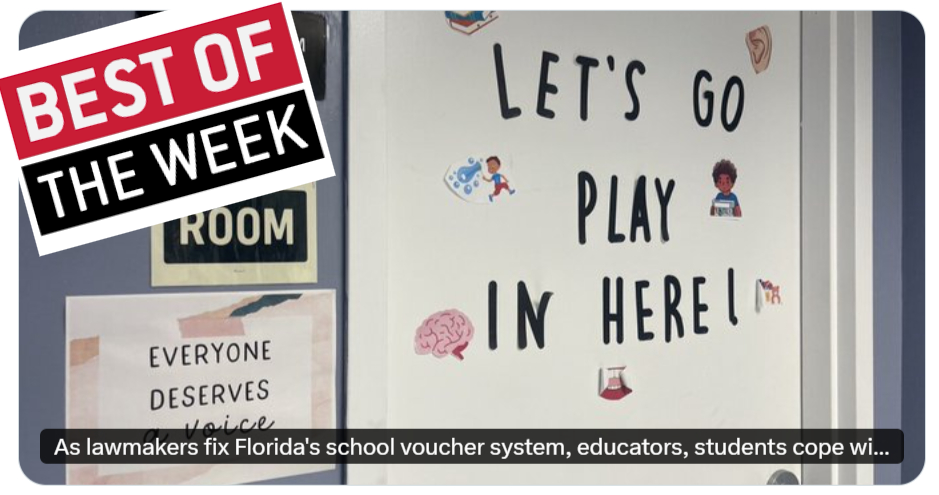
🏆 As lawmakers fix Florida’s school voucher system, educators, students cope with financial fallout
Everyone knows that Florida’s rapid voucher expansion had significant issues — but this story from WLRN Public Media’s Natalie La Roche Pietri shows the human cost. From schools on the verge of eviction due to missed state payments to student accounts that were improperly frozen, this story provides a vivid look at who gets hurt when a new policy is scaled up too quickly without sufficient infrastructure or checks.
🏆 How CU Boulder’s student news site got taken over by AI slop
Education, journalism, and AI intersect at CU Boulder’s independent news organization after an old web domain name was taken over by a scammer who keeps the paper’s branding and filled the site with fake articles and invented reporters. As the story from the Denver Post’s Elizabeth Hernandez shows it’s all happening in a legal gray area that makes it difficult for student journalists to limit the damage. What the scammer is getting out of it is unclear, although it’s likely tied to making money.
The best Substacks and magazine articles of the week include Tim Daly’s The Best American School System, Evan Bonsall’s 5 Hard Truths Democrats Must Face on Education (in the Washington Monthly), Tara Garcia Mathewson’s ‘My grandmother never talked to me again’, The Atlantic’s The College Backlash Is a Mirage, and — new Substack alert! — Nora Gordon’s Why are the regional programs (probably going to be) like this? Any others we missed? Let us know.
PARENT-FOCUSED EDUCATION NEWS IN 2026
Latest offerings from The Grade

One of the most obvious changes the beat needs to make is to become much more parent-centered — a topic that The Grade has addressed numerous times.
The education beat is going to have to change some of its traditional approaches if it wants to be the trusted and compelling source of information it once was.
Read about my journey to this conclusion: Why I became an education journalist.
In a new video interview, newsroom veteran Scott Van Voorhis describes how he’s stepped in where Boston news has fallen short — and is now reviving a long-running public television news show.
PEOPLE, EVENTS, & MORE
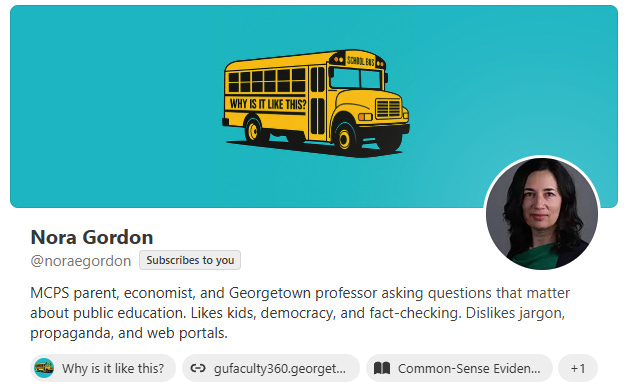
Above: Economist and parent Nora Gordon has launched a new Substack.
📰 Outlets: Asked why she decided to launch a new education Substack (above), Gordon told us that she — and the vast majority of the parents she talked to — couldn’t figure out what was going on in their kids’ schools. “This seemed weird to me because K-12 policy is my research area,” she told us. “It’s hard to make change and hold anyone accountable when you don’t understand who, if anyone, is in charge.”
📰 People: Education stories snagged eight of The Newswomen’s Club of New York 2025 Front Page awards, including one for the Hechinger Report’s Jill Barshay. Other awardees include the WSJ’s Oyin Adedoyin and The 74’s Jo Napolitano. The Argument’s Kelsey Piper writes about falling into education reporting — including the benefits of “knowing nothing” going in. Larissa Phillips writes about teaching a student how to spell curse words in her series of student profiles for the Volunteer Literacy Project.
📰 Jobs: Silas Allen is joining the Dallas Morning News’ education lab after a lengthy stint at the Fort Worth Star-Telegram. The Pittsburgh Post-Gazette plans to shutter in May — a good opportunity to revisit this 2023 column from Andrew Goldstein, a striking Post-Gazette education reporter. Arizona Luminaria has brought aboard Shannon Conner as an education solutions journalist — more of this, please! Meanwhile, EdSource is seeking to hire a Managing Editor. And Vox’s new senior editor for policy, politics, and ideas Benjy Sarlin is welcoming freelance pitches.
📰 Numbers: A new study in Education Next finds that Massachusetts public schools with largely high income student bodies had 5.7% lower enrollment than projected. Enrollment fell among white and Asian students and grew among Hispanic and Black students — but as Jill Barshay notes some districts still seeing growth. Around half of third grade students in Utah can’t read at grade level — a trend that stretches back to kindergarten.
📰 Research: The percentage of counties where kindergartners reached herd immunity to measles through vaccines has fallen from half before the pandemic to just 28%, the Washington Post reports. College enrollment is growing, notes the Atlantic’s Rose Horowitch, even as skepticism in higher education climbs. Guess it’s not surprising when the wage premium remains near a historic high according to Dale Chu. DEI programs reduced gender and racial diversity in companies and lowered the performance of the targeted groups, according to a new Arthur Brooks article in The Atlantic.
📰 Quotes
“I think we are currently in the Weimar Republic era of grade inflation in the US.”
“All I’m asking is that [the] media cover Hochul + Mamdani on child care better than they covered Michelle Lujan Grisham and New Mexico.”
“There’s so much the public doesn’t know about what goes on in schools.”
“When I first became an ed reporter 15+ years ago, it was a place where rookies were sent to cut their teeth.”
“The job will not love you back.”
📰 Episodes: At The Argument, Kelsey Piper and Jerusalem Demsas talk about why kids can’t read. In a recent segment on This American Life, one teacher’s comments upend a student’s high school experience. Congratulations to the Education Gadfly Show on publishing its 1,000th episode this week.
📰 Events: Don’t forget about the Chalkbeat Ideas forum on the future of USDOE on Jan. 14, followed by a panel on Massachusetts schools — including yours truly — the next day. Looking further down the line, the Center for Health Journalism at USC Annenberg is hosting a webinar on “How Reporters Can Get Ahead of Misinformation” on Jan. 21 at 1 p.m. EST. Texas’s $1 billion voucher initiative opens for applications on Feb. 4.
KICKER
Always save the best for last.
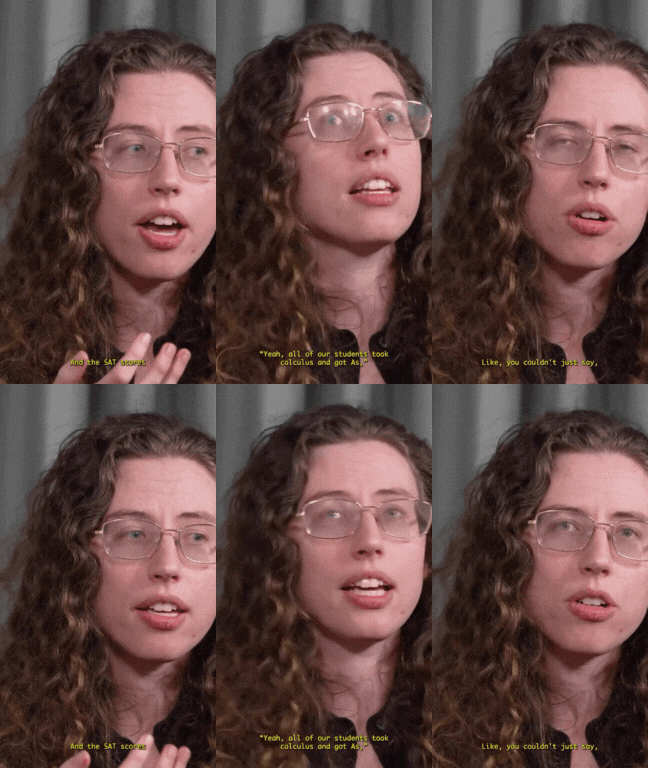
“Once the SAT was abolished, the grade inflation got a lot worse… There’s no reason not to hand out A’s to everybody.”
The Argument’s Kelsey Piper talks grade inflation via Wall Street Apes from the 1:03:00 mark here.