A week’s worth of Boston-area education coverage featured a slew of human interest stories and just a smidgen of non-COVID coverage.
On Tuesday, the Boston Globe published a feature following a group of students vying for spots at the city’s three elite exam schools.
Reported by Meghan E. Irons and Malcolm Gay over nine months, Boston Latin and the biggest test of their young lives, embodies the deep, empathetic journalism that the Great Divide team has become known for, including its landmark Valedictorians Project from last year.
The feature is also the only education article without a significant COVID-19 peg to come out in Greater Boston coverage over the last week, out of over 30 pieces in major outlets tracked by The Grade.
As the pandemic continues to control the narrative, education journalists appear to feel forced to have a singular focus on the impact of the virus.
This week in particular, their stories centered around a human interest theme, exploring the impact of COVID-19 on traditional rites of passage.
In Providence, the Providence Journal’s Linda Borg covered a wide variety of topics, from school closures to union activity, before going out on a weeklong furlough. For the Globe, Providence-based Dan McGowan co-wrote a piece comparing online learning approaches in Massachusetts and Rhode Island.
EDUCATION JOURNALISM IN THE BOSTON AREA
Unlike some other major metropolitan areas, the Greater Boston area has a strong media ecosystem, with two relatively new education verticals as well as beat reporters at its newspapers and digital media-oriented public radio stations.
The Boston Globe launched the Great Divide education team in June 2019, comprised of a dedicated editor (Sarah Carr) and five full-time reporters. The local NPR affiliate WBUR created its Edify team in 2016, which has an editor (Kathleen McNerney) and two reporters. The Boston Herald, CommonWealth Magazine, and public radio station WGBH also cover education.
Providence, Rhode Island, schools are covered by the Providence Journal (Borg) and the NPR member station RIPR in Rhode Island, as well as by the Boston Globe’s Providence-based education reporter, Dan McGowan.
Disclosure: The Grade receives support from the Barr Foundation, which also helps fund the Boston Globe’s education coverage.
THREE MAIN COVID-19 STORYLINES
Three main news stories dominated Greater Boston education reporting during the week of April 21-28 — all of them COVID-related:
The first was Gov. Charlie Baker’s order April 21 to keep schools closed through the end of the school year. The story was covered by education reporters James Vaznis and Bianca Vázquez Toness at the Boston Globe, education reporter Max Larkin at WBUR’s Edify vertical, and multimedia reporter Erin Tiernan at the Boston Herald. Tiernan and Marie Szaniszlo have been on the education beat for the Herald during COVID-19.
The second event was President Donald Trump calling on Harvard to pay back its stimulus funds on April 21, which the university decided to do on April 22. In addition to two pieces by Jeremy C. Fox and Deirdre Fernandez for the Globe, the story was also covered by WGBH higher education reporter Kirk Carapezza.
Finally, on April 28, Massachusetts waived a standardized test requirement, allowing about 1,000 students to graduate. The story was covered by Carrie Jung at WBUR’s Edify and Meghan E. Irons at the Globe.
Related coverage: Assessing the surge in Boston-area education coverage
HUMAN INTEREST COVERAGE
Curiously, several Greater Boston outlets published similar human interest articles focusing on changing rites of passage for high school seniors because of the COVID crisis.
In the Globe, Jenna Russell, Malcolm Gay, and Meghan E. Irons teamed up to write The lost year: High school seniors reflect on glory days they’ll never have.
In the Herald, Marie Szaniszlo wrote For high school seniors, a prom like never before.
For WBUR, Max Larkin wrote With Schools Closed Through June, High School Seniors Miss Rites Of Passage.
Although prom and graduation typically take place at the end of May and beginning of June, the three articles came out within a few days of each other.
While these articles detailed the loss of normalcy for students, previous features published by these outlets during COVID have explored inequities in remote learning or questioned what the future of education might look like, or compared how different states were implementing remote learning.
PROVIDENCE COVERAGE
Coverage in Providence mirrored the major beats in Boston, with the notable distinction that the stories were all written by a single reporter, with the exception of a couple of news pieces in RIPR and WJAR.
The Providence Journal’s Linda Borg was prolific before her 7-day furlough started April 27 (Make sure to check out her daily furlough journal for The Grade.) She wrote a variation on the human interest trend/theme, focusing on students’ decisions to reconsider college choices. Over the week, she covered Rhode Island’s decision to keep schools closed, proposed cuts to top-level staff, a union lawsuit, and the early graduation of Brown medical students, as well as a compilation of testimonies from parents, students, and educators on their experiences with remote learning.
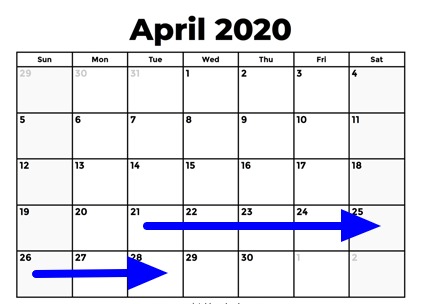
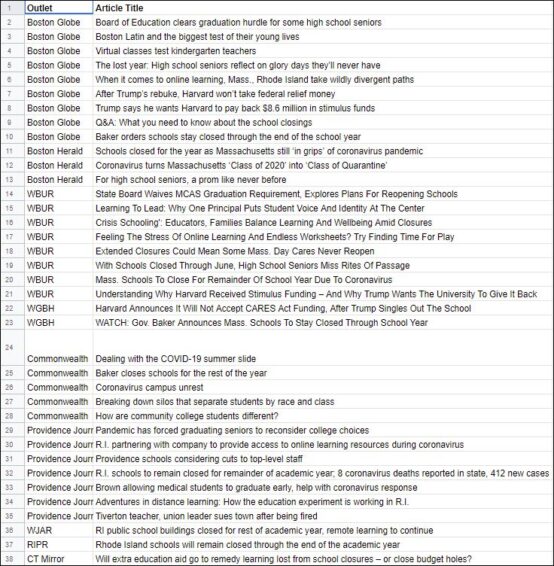
Above: During the week of April 21-28, Boston-area education journalists produced more than thirty articles.
Reporters in the Greater Boston area are branching out into different subject matters and formats with COVID-19, such as Carrie Jung’s WBUR profile of a Springfield principal balancing remote learning with student support.
Even so, aside from the Globe’s long-ranging article on Boston exam schools that had been planned for months, the pandemic still dictates the coverage.
Related coverage from The Grade:
A view from Massachusetts (featuring MASC’s Tracy Novick)
Assessing the surge in Boston-area education coverage
Profiling valedictorians to highlight school inequality
Praise & criticism for coverage of MA’s $41M charter school ballot debate
In Connecticut, fewer reporters, more missed stories
ABOUT THE AUTHOR

Leo Schwartz
Leo Schwartz is a freelance journalist covering New England for the Grade. His work has appeared in Columbia Journalism Review, PBS NewsHour, and the Nation, and he is the web editor at the NACLA Report. You can follow him on Twitter @leomschwartz