In Kappan’s March 1990 issue, Roland Barth shared his personal vision of what a good school looks like. Other people may have a very different vision in mind, and that’s fine, he explained. The important thing isn’t that educators all see eye to eye but that each of us has a clear idea of the kind of school we hope to create:
I don’t believe that any teacher, principal, or professor can be a serious agent of change in a school while only responding to someone else’s vision. Implementing the ideas and ideals of others will always be a half-hearted enterprise. (“A personal vision of a good school,” p. 516)
Over the decades, dozens of Kappan authors have offered their own perspectives on what a high-quality school looks like. And as they’ve demonstrated, how we define good schooling affects everything from our funding decisions and school reform priorities to the ways in which we prepare our teachers, design the curriculum, teach our classes, assess our students, and evaluate our schools.
A multitude of interests
U.S. public schools have a responsibility to educate enormous numbers of students, who come from a very wide range of backgrounds. In a report to the trustees of Teachers College, Columbia University, published in the February 1929 Kappan, William Russell, then dean of the college, argued that this created a tension between the quantity of students our schools seek to educate and the quality of the education schools provide. Was it possible to have both, Russell wondered, and could the nation afford it?
Those who favor quantity are extending educational facilities and welcoming the hordes of students who flock to the doors of our schools and colleges. Those who think first of quality are restricting attendance in order to do their best for small numbers. If it were possible to give a satisfactory education to large numbers in big institutions under conditions of reasonable economy, the results would be of utmost importance. After all, it is a question of the possibility of quantity production of quality in education. (“The triple problem: Quantity, quality, and economy,” p. 130)
Further, whether or not we choose to educate large quantities of children, we still face the challenge of deciding what quality looks like, which requires some consensus about the purpose of our schools. Because Americans hold wildly divergent views on these questions, the February 1934 Kappan featured a discussion guide meant to facilitate productive conversation about these contentious issues:
Neither laymen nor educators are agreed upon the proper aims and methods of public education. One group criticizes the schools because they have no contact with life, while another group deplores the overemphasis on practical things. One group believes that the discipline in the schools is too severe and too much inclined to suppress individuality, while another group feels that easy and agreeable teaching methods are making children selfish and incompetent. One critic feels that the modern curriculum is too varied and urges a return to the simpler offerings which prevailed years ago. Another criticizes the schools because the curriculum is too narrow, formal, and traditional. On the whole, the evidence indicates a common concern for the improvement of the schools and diverse opinions among both educators and laymen as to the methods of bringing about improvement. (“Evaluating the public schools: A manual for use by conference groups discussing problems of public education,” p. 173)
It’s unclear how many people put the manual to use, or whether those people were able to agree on the purposes of public education and how best to improve the schools. However, debates about the nature of high-quality schools continued to rage in the pages of this magazine.
Accountability and effectiveness
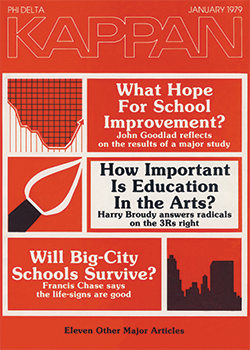
By the second half of the 20th century, most articles about school quality revolved around academics. But even then, authors disagreed as to what a good academic education entailed and how it should be evaluated. Then, as now, many experts considered standardized testing to be an essential means of evaluating schools, while many others decried the ways in which tests were used. In “Can our schools get better?” (January 1979), John Goodlad pointed out that test scores would always, by definition, result in half of our students being below average, and their schools defined as less than good. To determine whether schools were succeeding, he proposed that we use other measures:
It seems to my associates and me that how a student spends precious time in school and how he feels about what goes on there is of much greater significance than how he scores on a standardized achievement test. But I am not at all sure that the American people are ready to put a rather straightforward criterion such as this ahead of the marks and scores we worship mindlessly in much the same way our supposedly more primitive ancestors worshiped the gods of thunder and fire. And so it will be difficult for schools to get better and even more difficult for them to appear so. (p. 343)
Echoing William Russell’s argument from 1929, Goodlad also noted that if our schools serve very large numbers of students, who have diverse needs and interests, then it makes little sense to hold them all to the same definition of success. As the massive, federally funded Coleman Report of 1966 had found, student test scores tend to have more to do with family background and life circumstances than anything that goes on inside the school building. Thus, why should we treat those test scores as an indication of a school’s quality?
By the 1980s, a series of research studies had shown that at some schools located in urban, low-income neighborhoods, students were getting significantly higher test scores, and had better outcomes overall, than similar students elsewhere. In other words, these schools appeared to be unusually “effective,” and perhaps their practices could be distilled and replicated. As Lawrence Stedman explained in the November 1987 Kappan (“It’s time we changed the effective schools formula”), the Effective Schools research had identified five key factors to these schools’ success:
strong leadership by the principal, particularly in instructional matters; high expectations for student achievement on the part of teachers; an emphasis on basic skills; an orderly environment; and the frequent, systematic evaluation of students. By adopting these factors and sometimes a sixth — increased time-on-task — minority students in inner-city schools were supposed to be able to make substantial gains in achievement. (p. 215)
However, Stedman and others — such as John Ralph and James Fennessey, writing in June 1983 (“Science or reform: Some questions about the effective schools model”) — were skeptical about some of these findings, particularly the idea that these five elements could easily be replicated, producing lots of good urban schools. Researchers were overstating the benefits of the model, argued Stedman. The research was biased and may even be subject to data tampering, said Ralph and Fennessey, suggesting that the Effective Schools movement was guided by ideology more than by evidence.
Larry Cuban criticized the Effective Schools movement on different grounds in the June 1983 Kappan (“Effective schools: A friendly but cautionary note”). Instead of challenging the model’s research base, he questioned the vision of good schooling that it promoted, noting that it came with such trade-offs as increased standardization and a narrow focus on academic outcomes. Even if schools improved on some measures, he asked, would the trade-offs be worth it? Would students in these schools be receiving a better education? Would their schools be “good” in a broader sense? Cuban did not disregard the model entirely, but he warned that its vision of success was quite narrow:
Schools are complicated organizations. To judge them solely by a percentile rank on an achievement test is little better than judging a car solely by miles per gallon or the quality of a hospital solely by number of vacant beds. Of course, such numbers tell us something, but they omit so much more that is essential. Now that school officials have embraced effective schools research, concepts, and vocabulary, they still need to use all the tools available to improve schooling, not simply test scores. Tightly coupled organizational procedures, sharply focused on academic goals and measured by standardized tests, are clearly among those tools. Too often, however, those who believe that their only tool is a hammer treat everything as a nail. Such a narrow view can only disserve the children of the nation. (p. 696)
Different students, different needs

In April 1997, William Glasser (“A new look at school failure and school success”) made the strong accusation that “We have been treating our children badly for a long time now. With the new emphasis on ‘accountability,’ the abuse will only multiply” (p. 391). For Glasser, the more we standardize our expectations, the more we contradict what’s known about children and their development, failing “to take into consideration the single clear fact of life: children are different. It is the only psychological truth accepted by all psychologists. Children are different. Certainly educators know this to be true” (p. 391).
Glasser decried the use of reading achievement in particular as a primary measure of student (and, as a consequence, school) success:
For students to become successful citizens, it is certainly helpful to have a command of the written word. But do we need to expose all students to courses in fiction and literature as ninth-graders, in poetry and drama as 10th-graders, in American literature and folklore as 11th-graders, and in British literature as 12th-graders? Can you pick out the slow readers and the nonreaders as you walk down the street? Does a person who hears well, remembers adequately, and works in a nonwriting or nonreading vocation (which includes most) suffer greatly from a reading disability? Only until commencement day, if there is one. The disability disappears as soon as such a student leaves school. Why should school be such an agony? Who declared that reading was so important? (p. 392)
Elliott Eisner also expressed concern about standardization in “What does it mean to say a school is doing well?” (January 2001). Writing just a year before the No Child Left Behind Act was signed, Eisner worried that what he called the “rationalization” of schooling, with its focus on standards, rubrics, and measurement, was taking attention away from more important matters, such as individual student needs:
[I]n our push for attaining standards, we have tended to focus on outcomes that are standard for all youngsters. We want youngsters to arrive at the same place at about the same time. I would argue that really good schools increase variance in student performance. Really good schools increase the variance and raise the mean. The reason I say that is because, when youngsters can play to their strengths, those whose aptitudes are in, say, mathematics are going to go faster and further in that area than youngsters whose aptitudes are in some other field. But in those other fields, those youngsters would go faster and further than those whose aptitudes are in math. Merely by conceiving of a system of educational organization that regards productive variance as something to be valued and pursued, we undermine the expectation that everybody should be moving in lockstep through a series of 10-month years in a standardized system and coming out at pretty much the same place by age 18.
(p. 372)
And so, perhaps, the difficulty of articulating a clear vision for a good school rests in the fact that not all students are the same. A singular vision of a single type of school and classroom that meets all needs may be unrealistic. If we want good schools, we may need multiple visions, with policy makers, educators, and community members working together to ensure that there is a good school available for every student, whatever their specific needs.
ABOUT THE AUTHOR

Teresa Preston
Teresa Preston is an editorial consultant and the former editor-in-chief of Phi Delta Kappan and director of publications for PDK International, Arlington, VA.
Visit their website at: https://prestoneditorial.com/