Writers for Kappan have long sought to understand how newspapers, television, and other media depict schools and how the education community should respond.
Interest in media narratives about schools goes back a long way, and so has the education community’s interest in shaping those narratives. In April 1941, E.L. Callahan wrote in Kappan (“Publicizing the school”) about his survey of Texas high schools that sought to determine how they were using local media to bring publicity to themselves. The answer? They weren’t doing enough. Only a third had any sort of publicity staff and few were making use of the journalism programs within their schools to draw media attention.
The need for public relations
Callahan’s findings raised the question of why schools should even care to attract media attention. As Paul Jones and Clyde Parker explained in March 1947 (“Publicity builds public relations”), schools have a responsibility to the public, and publicity programs enable them to show the public how well they’re meeting their responsibilities:
All well-rounded public relations programs call for reports to the public by the institution. No better method of reporting the activities of the educational organization exists than the day to day publicity stories. The public, as it includes the parents, taxpayers, and private financial backers, has this report due it. (p. 289)
A good publicity program can also provide an essential counter-narrative in a climate where misconceptions and false narratives about schools abound, as Ted Gordon explained in May 1949 (“Pressure, publicity, or public relations?”):
A public slaphappy over its exciting voyage of the past few years can be expected, in the despondency of a depression — after the burst bubble of inflation, if you prefer — to make the schools (and us scholars) the scapegoats for any epidemic of social ills. To avoid future educational pains, let us now consolidate our public relations gains! Let us do it with the soft words of publicity, and let us hold the big stick of pressure in abeyance. Let us tell our story to the public. People will get informed (or misinformed) somehow anyway. Educational leadership must enter into partnership with the public. Why, then, should we not report to our stockholders on their investment, frankly boasting about our gains, admitting our losses, recommending our new plans? (p. 376)
Gordon went on to lay out a 10-point public relations program for schools that included such tips as these, which are notable not just for Gordon’s style but for their applicability even today:
- Speak, sensibly rather than sensationally in the language of the public whose favor we court. Our copy must click, our pictures pull, our statistics live, our personalities please.
- Prove repeatedly that public education is worth what it costs in time, money, and effort. We believe that democracy is not the crude by-product of wildcat drilling in the public schools but the highest octane refinement of the scientific educational process. (p. 377)
Other authors, such as Walter Lovelace (“How to get school news published,” November 1955), offered primers on how news media work so that educators can better understand how to get stories placed in their local outlets.
Understanding the media narrative
Kappan authors have taken an interest not just in the practical nuts and bolts of media and how to get better school coverage for local schools. They’ve also explored how national media depict schools. In February 1963, for example, George Gerbner (“Smaller than life: Teachers and schools in the mass media”) shared the results of his study of movies, Saturday Evening Post stories, and local and national news media. Most of the teachers in the 81 films studied were male and unmarried, with around half remaining unmarried at the end of the film, which meant that they could “remain fully dedicated to the profession. And it permitted their would-be partners to escape into the stronger, warmer arms of less educated but apparently more human creatures” (p. 203).
If the fiction stories in the Saturday Evening Post were any indication, those would-be partners would be financially better off as well:
Although teachers were shown as not striving for material success nearly as much as other adult characters, teachers (as well as students and schools) were more frequently portrayed in material and financial difficulty. As one solution to this problem, about one-third of all teacher-characters quit the profession. In no story was a teacher ever given a salary raise. No student was supported on a public scholarship. No community took the initiative to build or improve schools. There was no normal way in which the financial difficulties of teachers, students, and schools could be resolved. Some degree of poverty was presented as the usual state of affairs. If any solutions were given, they were likely to be fantasy solutions such as hitting the jack-pot, finding a rich donor, or holding a fantastically successful sports event. (p. 204)
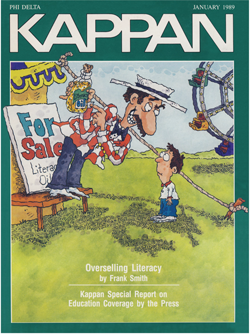
This grim depiction of the teaching profession was not limited to the 1960s. In a pair of special reports in 1989 and 1990, Kappan authors bewailed the image of schools presented in the mass media. In the January 1989 report, Patrick McQuaid (“A story at risk: The rising tide of mediocre education coverage”) explained that education stories, even potentially positive ones, seemed to skew negative:
Even the editor of the Kappan has lamented in print the way the press typically handles the Annual Gallup Poll of the Public’s Attitudes Toward the Public Schools. Although the Gallup Poll often turns up a great deal of good news about the public’s attitudes toward U.S. education, the percentage of respondents who give their schools “failing grades” garners most of the ink. The lesson here is simple. In the competitive welter of daily journalism, good news is no news. (p. K2)
McQuaid interviewed a variety of journalists and scholars for the report, and the reasons they cited for such poor coverage included journalists’ lack of time spent in schools, the need for quick results when they do go into schools, and the high turnover among education journalists.
The following year, George Kaplan (“TV’s version of education [and what to do about it],” January 1990) found that television was no more hospitable to nuanced discussion than newspapers had been:
In an era of what media critic Edwin Diamond calls “disco news,” usually displayed in quick, easily digestible sound and sight bites, education’s slow-moving tale cannot compete with Hurricane Hugo or cold nuclear fusion in a jar. A medium that features profiles, exposes, and confrontation — “Crossfire,” Turner Broadcasting’s nightly half-hour program on Cable News Network (CNN), which tackles education only when it is the day’s lead story, is a classic example of the genre — does not easily adjust to stories that lack bite or sharp edges. (p. K3)
Citing such “mind-expanding” outlets as The Learning Channel (now TLC), the Arts and Entertainment Network (A&E), and the Discovery Channel, Kaplan placed some cautious hope in the growth of cable television, whose “potential for expanding public knowledge of learning-related issues is immense. It could help create a public that is infinitely better informed — or it could create the worst information glut in history” (p. K8).
Countering the myths
One specific media narrative that Kappan authors have concerned themselves with across the decades is the idea that schools are failing. This goes back at least as far as November 1955, when Earle Rugg (“Our greatest social achievement”) observed:
For some years there have been mounting negative criticisms of education, especially of public schools. It seemingly is a favorite indoor sport of some to speak and to write about what’s wrong with the public schools. Too rarely does anyone speak or write about what’s “right” with them. (p. 69)
He went on to debunk some of the false things “they say” about education and to point out that public opinion polls showed that most people actually held positive views of their schools.
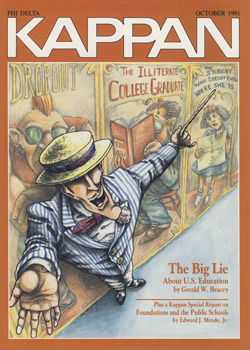
In October 1991, Gerald Bracey (“Why can’t they be like we were?”) took apart the claims of 1983’s A Nation at Risk and similar reports:
So many people have said so often that the schools are bad that it is no longer a debatable proposition subject to empirical proof. It has become an assumption. But it is an assumption that turns out to be false. The evidence overwhelmingly shows that American schools have never achieved more than they currently achieve. And some indicators show them performing better than ever. (p. 106)
In his article, Bracey countered claims about low graduation rates, declining test scores, and international comparisons with his own data and interpretations that presented a different view from the gloom and doom story that had become so common. He directed harsh criticism toward A Nation at Risk, concluding that “To reread [it] eight years after its publication is to see it as a xenophobic screed that has little to do with education” (p. 115).
A year later, Mike Males (“ ‘Top school problems’ are myths,” September 1992) responded to a popular “study” of the top problems in schools in 1940 (talking, gum chewing) and 1987 (drug abuse, alcohol abuse). It turned out that the lists of problems were based not on rigorous evidence but on an informal survey that relied on respondents’ personal memories. But such memories, Males wrote, were no doubt incomplete:
If the public schools of 1992 kicked out pregnant girls; warehoused handicapped, learning-disabled, and troubled students away from public view; and excluded three-fourths of all minority and low-income students, we’d have a fair facsimile of the “public” high schools of 1940. (p. 55)
As these authors have explained, when a narrative takes hold in the public imagination, it can be difficult to untangle what it true from what is assumed. But understanding the stories that are being told about schools and the assumptions behind them is essential to the work of improving schools. By supporting accurate narratives and countering false ones, educators can help get everyone on the same page, working together to resolve the real problems that affect schools.
ABOUT THE AUTHOR

Teresa Preston
Teresa Preston is an editorial consultant and the former editor-in-chief of Phi Delta Kappan and director of publications for PDK International, Arlington, VA.
Visit their website at: https://prestoneditorial.com/