The title of this month’s Kappan, “Research, meet practice,” conveys the idea that research and practice need to be introduced to each other. In reality, it’s more of a reintroduction, as Kappan authors have brought these two branches of the education community together many times, over more than a century.
The place for practical research
In April 1923, Kappan published an issue devoted to the topic of research in education. Authors in that issue noted that scientific researchers in education were making great strides in advancing our understanding of learning, but their research should not be confined to the lab. As Paul West explained (“The practical schoolman and experimental work”), research must also take place in the schoolroom:
One who is in direct touch with a practical school situation has an excellent opportunity for worthwhile experimental studies. There will always be the need for those who are engaged in the pure research of the laboratory, and few, if any, schoolmen can hope to have facilities for refined experiments. But there are many problems which can be studied most successfully in their natural educational setting. (p. 9)
In fact, West noted, teachers engage in small-scale experimentation all the time by trying new teaching methods or introducing new textbooks. But they don’t necessarily have the time or the scientific expertise to make an objective assessment of the results of these experiments.
Kappan returned to the topic in its December 1941 issue on research in education, where authors noted that great scientific advances were happening in the field’s understanding of intelligence, learning, and personality. In his article, G.T. Buswell (“Structure of educational research”) claimed that these “achievements in research up to the present time have contributed mightily to a vigorous development of public education” (p. 167).
Yet, Charles Peters (“Applied research and education”) countered that a great deal of important research was being left on the shelf and, as a consequence, researchers were choosing to take on projects that would serve them and their careers instead of devoting time to studies that seemed more practical. At the same time, teachers were continuing with their own limited classroom-based experiments and generalizing the results without research expertise. If they could learn to use some basic statistical controls, Peters asserted, “it is this body of guarded generalizations obtained by practical schoolmen for their own guidance that is likely to prove to be our most fruitful science of education” (p. 184).
In May 1947, Douglas Scates (“In behalf of educational research”) called for a dismantling of the distinction between lab-based “pure” or “exact” research and classroom-based “applied” research. Both could have their place in the accumulation of knowledge, as long as everyone involved understood the potential for error:
The division between “pure” research and applied research is a silly division and should be forthwith dropped. All genuine research . . . is practical research and any research conducted with the best technique for the problem is “pure.” Differences in research between different fields of investigation are largely differences in method and in the size of the probable error of the results. It is entirely erroneous to attempt to establish qualitative differentiation between research in social science and so-called exact science. There is an overlapping both of method and of equipment. Exact science is exact only in the sense that the error of measurement is likely to be less large. (p. 173)
Exercising caution
Understanding the potential for error is essential when connecting research to practice because, as Dan Cooper (“The impact of research on education”) noted in Kappan’s October 1953 issue on research, some past findings led to changes in schools that were later found to be unwise. Cooper maintained “that the antidote to these errors of research was, and is, more research. Some freedom to make errors is essential in the search for better schools” (p. 17).
Errors might occur not just within research itself but also within its application, as Harold Shane explained in the same issue (“Responsibility for more functional use”). A finding about, for example, students’ ability to absorb information in large classrooms just as well as in small classrooms might be accurate, but is absorbing information the most important part of being in a classroom? What effect would being in a large classroom have on students’ ability to get along with others? Also, a study that is accurate in one situation might not apply in another because “every child and every group is unique. Every situation which is related to the learning process is unique. Procedures and methods may be applicable to more than one group, but not necessarily” (p. 46).
Multiple authors in the March 1958 issue on “What research says about teaching and learning” echoed these concerns about applying research too broadly. James Harold Fox (“Criteria of good research”) reminded readers that:
research rarely reveals to us the whole truth about anything. Discovery of what seems to be the truth concerning the nature of some part of the process of learning often turns out later to be only a crude approximation of the truth. Discovery of a new teaching technique that seems at first to have universal application usually turns out later to have only restricted use. It seems wiser, therefore, to view research findings as a means of approximating the truth instead of revealing the ultimate truth. (p. 284)
Ellis Batten Page (“Educational research: Replicable or generalizable?”) explained that researchers often have to balance the need to conduct studies that are easy to duplicate (i.e., that are replicable) and studies that are relevant to how schools actually operate (i.e., that are generalizable). Creating replicable studies requires removing as many variables as possible, but variables always exist in schools, and if a study is to be useful, it should reflect the conditions in which children actually learn. In that case, Page asserted, generalizability should be given some priority over replicability.
This, of course, was not the last word on the issue. In November 1978, N.L. Gage (“The yield of research on teaching”) said that education research was often criticized for not following the processes deemed essential to scientific research, such as random group assignment, even though such a research structure would run counter to how schools work. Similarly, trying to isolate a single variable in teacher behavior amounts to a fool’s errand, because no single variable is likely to have a significant effect on student achievement, given the many, many other variables at play. The path to responsible research use requires acceptance “that educational research is likely to be fallible, flawed, and open to criticism of one kind or another” (p. 233). Educators looking to apply research in their classrooms will need to do the work of sifting through multiple studies, looking for resonances and points of commonality:
Thus the path to increasing certainty becomes not the single excellent study that is nonetheless weak in one or more respects, but the convergence of findings from many studies that are also weak but in many different ways. . . . Where the studies do not overlap in their flaws but do overlap in their implications, the research synthesizer can begin to build confidence in those implications. (p. 233)
Putting research in action
So once teachers have sifted through the research and found some promising ideas, what can they do? Sometimes, the next step is for teachers to do some research on their own. In the December 1982 Kappan on “Restoring the three Rs through research,” David Hopkins presented an example of a teacher who used research literature to create her own small, informal study. Dissatisfied with her ability to get her students to demonstrate higher-level thinking in response to her questions, she did some reading and learned about the importance of expanding wait time. So, over six months, she tried it out and saw positive results. For Hopkins:
This is an excellent example of classroom-based research. It is also quite different from what is commonly regarded as classroom research. The usual approach uses coding forms and outside researchers, involves the testing of hypotheses, relegates the teacher to a passive role, and culminates in an academic paper or research report. Classroom research of the kind Jane conducted generates hypotheses about teaching from the experience of teaching and envisages the teacher using the research to improve his or her own teaching. It is research carried out by teachers with the aim of improving teaching. (“Doing research in your own classroom,” p. 274)
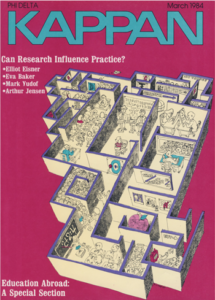
Although authors like Hopkins saw promise in these teacher-centered approaches, the distance between academic researchers and classroom teachers remained an issue of concern. In March 1984, Elliot Eisner (“Can educational research inform educational practice?”) expressed frustration at the disconnect. When practitioners used research, they often relied on “popularized” and “vulgarized” versions of the research that lack the caveats and qualifications trained researchers include in their studies. At the same time, researchers lacked the close relationships with classrooms that would enable them to build meaningful theories. Instead of relying on studies of rats in mazes to build their theories of learning, they should get into the classroom.
In the same issue, Eva Baker responded to Eisner’s article with the observation that practitioners may be influenced by research in more subtle ways than Eisner was seeking. It’s not always so simple as matching practices they’d adopted to studies endorsing them. Still, she concurred with Eisner that researchers should spend more time in schools:
In order to have an influence on practitioners, we must study what is useful to them. I suggest that the most profitable arena for our efforts is the juncture between research and practice, our studying phenomena in the schools themselves, rather than in laboratories. Such research need not have implications only for practice; it can also provide a rich source of information for generating new ideas, hypotheses, and even theories. (p. 455)

The extent to which researchers took that advice is unclear, but the disconnect remained significant enough in the 21st century for Kappan to devote the April 2007 issue to “The research/practice divide.” In that issue, Stephen Davis (“Bridging the gap between research and practice: What’s good, what’s bad, and how can one be sure?”) chronicled how schools had for decades been driven toward one reform or another, many of them informed by research that was not very good, poorly interpreted, or improperly applied:
Unfortunately, conversations about the reform du jour usually overlook any questions of how to tell the difference between good research and not-so-good research or between the attributes of research in the abstract and research as it may apply to a particular school district, school, or classroom. Perhaps most important, even research of the highest quality may never make its way into public school classrooms simply because the pipeline through which important academic discoveries travel to schools and classrooms is inconsistent, inchoate, and often tainted by the political process used to craft education policy. (p. 570)
He went on to encourage school leaders to take the words of researchers like him, “who ply their trade from the rarefied air of the ivory tower,” with a grain of salt. And they should avoid letting their desire for easy solutions lead them to accept any promising idea as the answer to improving student learning. In short, we can’t expect it to be easy to connect research and practice. If it were easy, we wouldn’t have to spend a century on it.
ABOUT THE AUTHOR

Teresa Preston
Teresa Preston is an editorial consultant and the former editor-in-chief of Phi Delta Kappan and director of publications for PDK International, Arlington, VA.
Visit their website at: https://prestoneditorial.com/