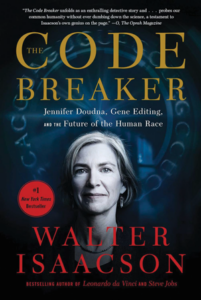
 The Code Breaker: Jennifer Doudna, Gene Editing, and the Future of the Human Race
By Walter Isaacson (Simon & Schuster, 2021)
While this is not an education book per se, Dr. Jennifer Doudna’s journey to winning the Nobel Prize in Chemistry in 2020, as told by this master biographer/storyteller, has many lessons for educators.
The first lesson results from her high school counselor trying to dissuade her from studying science because “girls did not become scientists.” Fortunately, she ignored that advice. But how many other girls (and minorities) are being similarly advised and dissuaded? How many great advances in knowledge never happened as a result of this bias? As educators, we must do everything we can to nurture all students’ interest in science.
The second lesson is about how to teach science (and other subjects). The typical approach is to teach lots of facts. That is not what inspired Doudna. She loved detective stories and one day picked up a book she thought was a detective story. It was the Double Helix, which describes the race to discover the structure of DNA. It was indeed a detective story, with colorful characters in a race to solve one of nature’s greatest mysteries. The book inspired her to view the scientist as a detective trying to solve mysteries. As educators, we should do more to present the drama and mystery of discovery. We should encourage students to ask big questions and be detectives who search for the answers. Even if they are not able to answer the questions now, the search may inspire them to become lifelong knowledge-seekers.
The final implication of the book is the need to redouble our efforts to increase equity. As daunting as it has been to achieve greater equity — we ain’t seen nothing yet. The breakthrough that Doudna pioneered (with another woman) led to CRISPR, a gene-editing tool that was key to creating the COVID-19 vaccines. However, along with the benefits, the potential to alter the human genome creates ethical dilemmas. For example, should altering genes to produce better-looking, more intelligent, and muscular offspring be allowed? If such capabilities were only available to the rich, that would become the most disequalizing event in human history. We will only be able to deal wisely with such threats to equity if we can create a more equitable society now.
This article appears in the November 2023 issue of Kappan, Vol. 105, No. 3, p. 7.

ABOUT THE AUTHOR

Stanley Pogrow
Stanley Pogrow is a professor of educational leadership and equity at San Francisco State University and and professor emeritus at the University of Arizona.