SCHOOLS & VACCINES, PART 3
The big story of the week, according to us.
The big story of the week is how schools and districts are responding to the new availability of vaccines for younger kids — the third big group (after school staff and older students) to become eligible. Some schools are encouraging vaccination. Some are offering shots. A handful are going to make them mandatory, or making masks optional once a certain vaccination level has been reached:
 Schools take lead role in promoting vaccines for youngsters (AP)
Schools to Distribute Covid-19 Shots, Incentives to Vaccinate Children (Wall Street Journal)
Jill Biden Kicks Off Covid Vaccine Campaign for Young Children (New York Times)
If history is a guide, schools will start requiring COVID vaccines (NPR)
COVID-Vaccine Mandates for Kids Are Coming (The Atlantic)
Pfizer’s COVID-19 vaccine is available for kids. Will schools require it? (USA Today)
With Nearly Half of Parents Expected to Forgo Child COVID Shots, Schools Brace for New Wave of Vaccine Hesitancy (The 74)
Local Catholic Diocese: Students Can Evade COVID-19 Vaccine With Personal Belief Exemption (Voice of San Diego)
California Scrutinizes Doctors as Parents Seek Exemptions From School Covid-19 Vaccine Mandate (Wall Street Journal)
Other big stories: Closing schools to give teachers breaks, mask rollbacks in high-vaccine school districts, and last week’s election results.
Did someone forward you this newsletter? You can sign up here.
INSIDE ETHNIC STUDIES & VACCINE INEQUITIES
Best education journalism of the week.
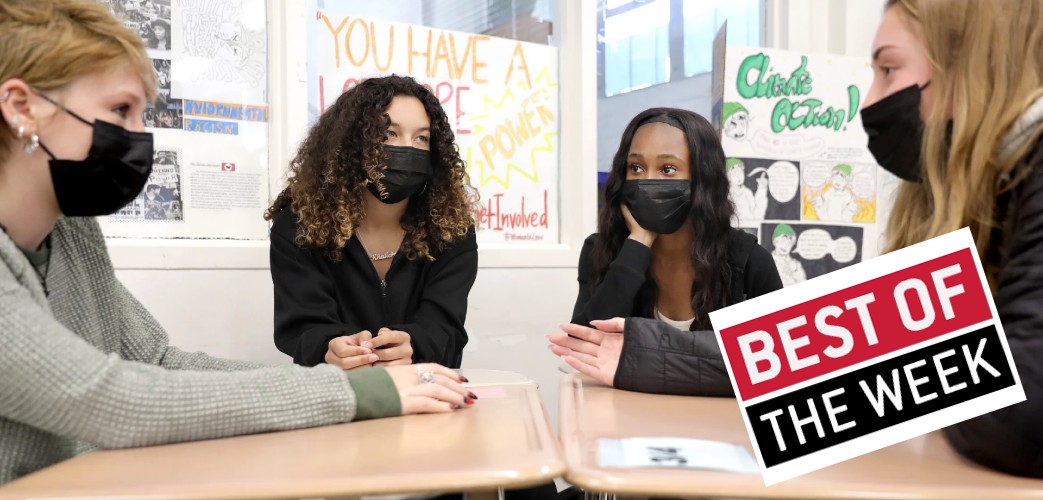
 BEST: The best story of the week is Colonialism, power and race. Inside California ethnic studies classes by Melissa Gomez in the L.A. Times (above). “Far removed from the angry shouting and politics are California students like Talaya and her classmates, whose respectful yet frank discussions about race, power and colonialism unfolded in Kimberly Young’s Culver City class,” writes Gomez. Her story takes us into classrooms in two different districts. It shows us what frank classroom conversation about difficult topics like settler colonialism look like from a student’s perspective. And she puts what’s going on in a national context. Read the piece, check out the picture-filled thread from Gomez here — and consider doing something similar in your coverage area!
RUNNER-UP: This week’s runner-up is How lagging vaccination rates could keep the Bay Area’s Black students out of school by Fiona Kelliher in the Mercury News. The story offers one of the first — and extremely important — looks at how student vaccine mandates could lead to inequities as well as increasing school safety. In the Bay Area so far, three districts have made rules that will force unvaccinated students to disenroll from school or attend virtually if they do not get their vaccines by a certain deadline. But as Kelliher reports, in the five major counties that are involved, 85% of all 12- to 17-year-olds are vaccinated, but only 52% of Black students. The reasons for the disparity are historical and rooted in discrimination — but the consequences of the vaccine mandate may make things worse. As more districts consider mandates, their potential downsides are an important angle for education journalists to consider along with the obvious advantages.
BONUS STORIES:
Did Critical Race Theory Turn Out Voters? (U.S. News)
New Jersey’s Education Rebellion Was a Long Time Coming (NY Magazine)
How Quarantines Impact Learning For D.C. Students (WAMU)
America’s reading problem (The Hechinger Report)
New Review Gives Failing Marks to Two Popular Reading Programs (EdWeek)
Should California De-Track Math? (New York Times)
Schools across U.S. take on a bigger role in student mental health (Chalkbeat/AP)
Would You Manage 70 Children & A 15-Ton Vehicle For $18/hr? (FiveThirtyEight)
PARENT-FOCUSED COVERAGE & AN OUTDATED NARRATIVE
New from The Grade
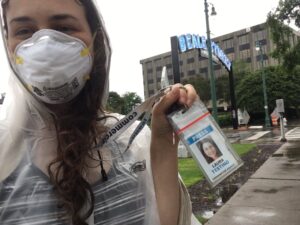
Above: The Commercial Appeal’s Laura Testino.
Our first piece of the week was an interview with The Commercial Appeal’s Laura Testino about making parents a core part of schools coverage. There are at least three key benefits, according to Testino: “When you include parents, there are more people that tell their friends, and more people are willing to speak to you. And they’re reading the paper.”
Our second piece was a critique from the Edunomics Lab’s Chad Aldeman about the problem of inaccurate reporting on school finance. “Well-respected news outlets continue to perpetuate an outdated scarcity mindset that schools have fewer dollars and fewer teachers than in prior years,” according to Aldeman. However, at least one outlet — NBC News — has found a better way.
As you may have noticed, we’ve been emailing our Wednesday columns directly to our readers. If you have any thoughts about this experiment, let us know at here or at thegrade2015@gmail.com. Thanks!
MEDIA TIDBITS
Thought-provoking commentary on the latest coverage.
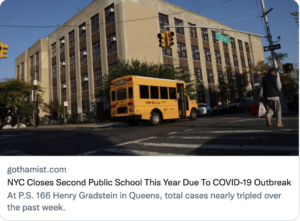
Above: Let me fix that headline for you: “Two months into citywide reopening, 2 of 1,800 NYC schools have been temporarily closed.”
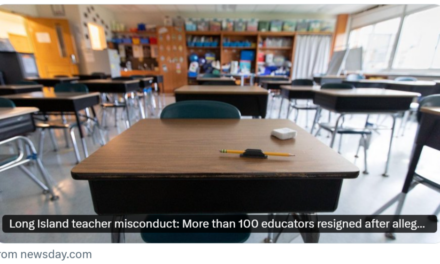
 COVERING EDUCATION, OR COVERING EDUCATORS? Every week, I come across stories that concern me, often because they lack helpful context, seem aimed at frightening readers, or are focused on educators’ experiences above all else. This week was no different. In addition to the Gothamist headline above, there was the New York Times’ ‘I Don’t Want to Die for It’: School Board Members Face Rising Threats, which is typical of the fear-amplifying journalism that has come to characterize coverage from the Times and others. Another concerning story was USA Today’s With staff ‘exhausted,’ schools cancel class or return to remote learning, which gave little voice to parents and students. Remember: it’s the education beat you’re on — not the educators beat.
GETTING BACK INTO CLASSROOMS HAS TO BE A PRIORITY: Former Vox editor Matthew Yglesias generated a lot of attention and debate with two long education pieces this week that addressed topics including CRT, school closures, reading instruction, and the woeful lack of diversity in journalism. Asked about media coverage, he wrote that he’s seen a lot of good journalism about the politics of what’s happening but hasn’t seen enough “coverage of what is actually happening in schools.” How widespread are CRT-inspired lessons and materials in American classrooms? We don’t really know outside of a handful of anecdotes shared on social media and repeated in breaking news stories. But additional reporting could really help. (Yglesias also urges exploration of the apparent shift from an era in which teachers were considered trusted and independent experts to one in which parents’ preferences are prioritized.)
COVERAGE CRITICISM FROM THE LEFT AND RIGHT: Once primarily a conservative talking point, criticism of media coverage is now a fully bipartisan activity. And sometimes, the critiques align across political lines. Take for example this new report from the American Enterprise Institute’s Media’s misleading portrayal of the fight over critical race theory. According to the right-leaning think tank’s examination of nearly 100 mainstream and trade stories over the past year, only a tiny sliver of news accounts “even mentioned the substantive concerns about CRT or sought to explore the actual tensions.” According to AEI’s Rick Hess, the coverage seems designed to “cover the CRT debate in a manner that would aggravate a polarized nation, fuel conservative distrust, and turn a principled debate into a food fight.” I don’t agree with that last part, but I and others who don’t identify as conservatives have noted similar concerns. You don’t have to be conservative to see that the national coverage in particular has been bad. (Disclosure: AEI has funded a series of case studies I’ve written over the years.)
MYSTERY MEN OF EDUCATION JOURNALISM: It’s probably no surprise to read that men still dominate the news media, accounting for about two-thirds of all media credits and bylines. But you might be surprised to find out that, according to a Women’s Media Center study written up in the Nieman Lab, the percentage of education stories written by women is only 48%. Maybe there’s some sort of methodological glitch in the report, but if not, who are all these men writing about schools? My best guess is that they’re general assignment reporters who are called on to write education stories here and there. But I’d love to know more.
Looking for media commentary and analysis all day, every day? Follow me at @alexanderrusso.
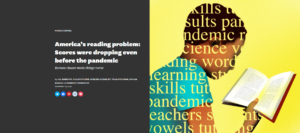
Above: The Hechinger Report and several other outlets have collaborated on a new series about reading remedies.
 Collaborations: Former Boston Globe education editor Sarah Carr managed the reading remedies project (above), with editorial help from former education editor Linda Shaw at the Solutions Journalism Network. “I’m incredibly proud of this work,” Hechinger Report executive editor Sarah Garland said. Meantime, Chalkbeat and the AP collaborated on a look into a Chicago high school with a strong focus on student mental health. Collaborations. Solutions. Community-first journalism. Some weeks it’s starting to look like a whole new world out there.
Kudos: Chalkbeat New York reporter Alex Zimmerman praised the New York Times’ Andrea Elliott for her book “Invisible Child: Poverty, Survival, and Hope in an American City,” saying the book is “one of the most impressive works of nonfiction I’ve read.” Congrats to Chalkbeat for its two nominations in the LION Awards, one in the best pandemic coverage category for their bilingual “Pandemic 360” project and another in the public service category for their coverage of how reopened schools could reduce the risk of spreading COVID with improved air quality. (My favorite current media project, The Objective, is also a LION finalist.) Former Vox editor Matthew Yglesias gave shout-outs to APM Reports’ Emily Hanford and the New York Times’ Dana Goldstein for their reporting on reading and literacy (and the importance of high-quality reading instruction over pretty much every other issue in education).
Job moves: After covering Boston’s elections, former Globe Great Divide education reporter Meghan E. Irons will join the paper’s renowned Spotlight investigative team. And Jimena Tavel, who has been covering higher education part-time for the Miami Herald, has been hired full-time. Congrats to both!
Jobs: The Seattle Times Ed Lab is hiring a reporter. WBUR, Boston’s public radio, is hiring a new education editor. The Wall Street Journal is still looking for an education beat reporter to cover K-12 schools nationwide. WLRN, South Florida’s NPR member station, is looking for a Miami-based education reporter. The Minneapolis Star-Tribune is hiring a metro reporter to cover statewide K-12 education. Education Week is hiring a staff writer for its EdWeek Market Brief team. Edutopia is hiring a remote senior writer and editor. LNP Media Group in Lancaster, Pennsylvania, is hiring an education reporter. Any new job opening out there that folks might want to know about? Let us know.
EVENTS, RESOURCES
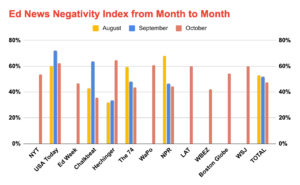
Above: Cafeteria Duty’s new review of October education headlines is expanded to include more local outlets, but the results show just as much negativity as September. Does this match the reality of what’s going on in schools? Does it serve readers?
 Resources: Check out the weekly update from Burbio featuring trends including schools closing for mental health breaks. Also, check out this graph on teacher shortages in the pandemic, broken down by high-poverty and low-poverty districts. Any other regularly updated resources journalists could use? Let us know.
Upcoming: California-based EdSource is hosting a roundtable on Nov. 17 with school leaders from around the state on summer school. And The Wall Street Journal is hosting an event in early 2022 called The Future of Education, but so far there are few details.
Great news for local journalism: A new nonprofit newsroom is opening in Cleveland with a future staff of 25, making it one of the largest nonprofit newsrooms in the country. Fingers crossed they’ll hire some education reporters!
THE KICKER
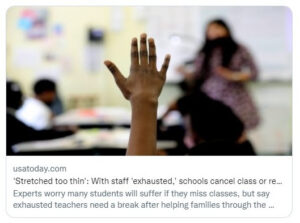
Can education reporters get a day off, too?
Bonus kicker: The Onion nails it with this one.
That’s all, folks. Thanks for reading!
Reply to this email to send us questions, comments or tips. Know someone else who should be reading Best of the Week? Send them this link to sign up.
Using Feedly or FlipBoard or any other kind of news reader? You can subscribe to The Grade’s “feed” by plugging in this web address: http://www.kappanonline.org/category/the-grade/feed/.
Read more about The Grade here. You can read all the back issues of The Grade’s newsletter, Best of the Week, here.
By Alexander Russo with additional writing from Colleen Connolly.
ABOUT THE AUTHOR

Alexander Russo
Alexander Russo is founder and editor of The Grade, an award-winning effort to help improve media coverage of education issues. He’s also a Spencer Education Journalism Fellowship winner and a book author. You can reach him at @alexanderrusso.
Visit their website at: https://the-grade.org/