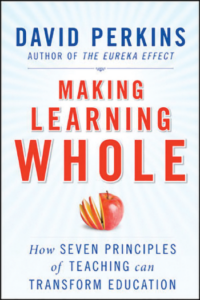
 When I taught high school world history, I wanted, like all teachers, to motivate my students by stirring their innate curiosity, as well as to encourage them to discover the historical discipline’s relevance and value to their lives. But I didn’t know how to make these goals a reality on a daily basis, which contributed to my lasting only one year in the classroom. If I had read David Perkins’ book, Making Learning Whole, in which he uses baseball as a metaphor for important teaching principles, I suspect that my teaching career would have been much more successful.
As an education researcher, I find that Perkins’ book has helped me to understand the most fundamental aspects of effective curriculum and instruction. The seven principles are: 1) Play the whole game, 2) Make the game worth playing, 3) Work on the hard parts, 4) Play out of town, 5) Play the hidden game, 6) Learn from the team, and 7) Learn the game of learning. I don’t even know much about baseball, but I regularly use Perkins’ seven principles as a lens with which to design studies of curriculum and instructional interventions.
Note: Perkins was one of my graduate school professors between 2005 and 2011. I read draft chapters of this book during courses I took as a student and I later supported Perkins as a teaching assistant.
Anna Saavedra’s latest in Kappan
ABOUT THE AUTHOR

Anna Rosefsky Saavedra
ANNA ROSEFSKY SAAVEDRA is a research scientist and co-director of the Center for Applied Research in Education at the Dornsife Center for Economic and Social Research and the director of research for the EdPolicy Hub at the Rossier School of Education at the University of Southern California .