
Getty Images
Lectures are not the only way to prepare students for Advanced Placement exams.
A critical challenge facing the public education system is a lack of equity in student preparation for advanced coursework across student subgroups, schools, and districts. One area where inequities have been evident is Advanced Placement (AP) programs. The desire to improve equity in AP courses, both in terms of student participation and outcomes, has led some schools to try more project-based approaches to instruction, instead of relying primarily on lectures.
But when students take project-based AP courses, do they become as well prepared for AP exams, allowing them to earn college credit for their efforts? And what do these changes mean for students who have typically been underrepresented in AP courses? We sought to answer these questions in our study of a project-based way to teach AP courses called Knowledge in Action.
The evolution of AP
The Advanced Placement program began in 1955 as a means for academically advanced high school students to study college-level material before attending a postsecondary institution, with the opportunity to earn college credit and/or placement in advanced college courses. AP courses are intended to cover topics, through reading materials and laboratory work, in a similar fashion to introductory-level college courses and to require similar levels of effort from students (National Research Council, 2002). Students earn college credit or the opportunity to take advanced courses if they demonstrate achievement on an end-of-year, criterion-referenced AP examination. Students also gain high school credit for successful completion of AP courses, regardless of their AP exam scores.
In the decades since the program’s inception, high school AP teachers have felt tremendous pressure to cover every topic found in college-level textbooks because they didn’t know exactly which topics and details might appear on that year’s exam. Accordingly, a 2002 review of AP courses found that they had “excessive breadth of coverage” and “insufficient emphasis on key concepts in final assessments” (National Research Council, 2002, p. 7). This finding prompted the College Board to redesign its AP course frameworks and examinations to improve the balance between breadth and depth.
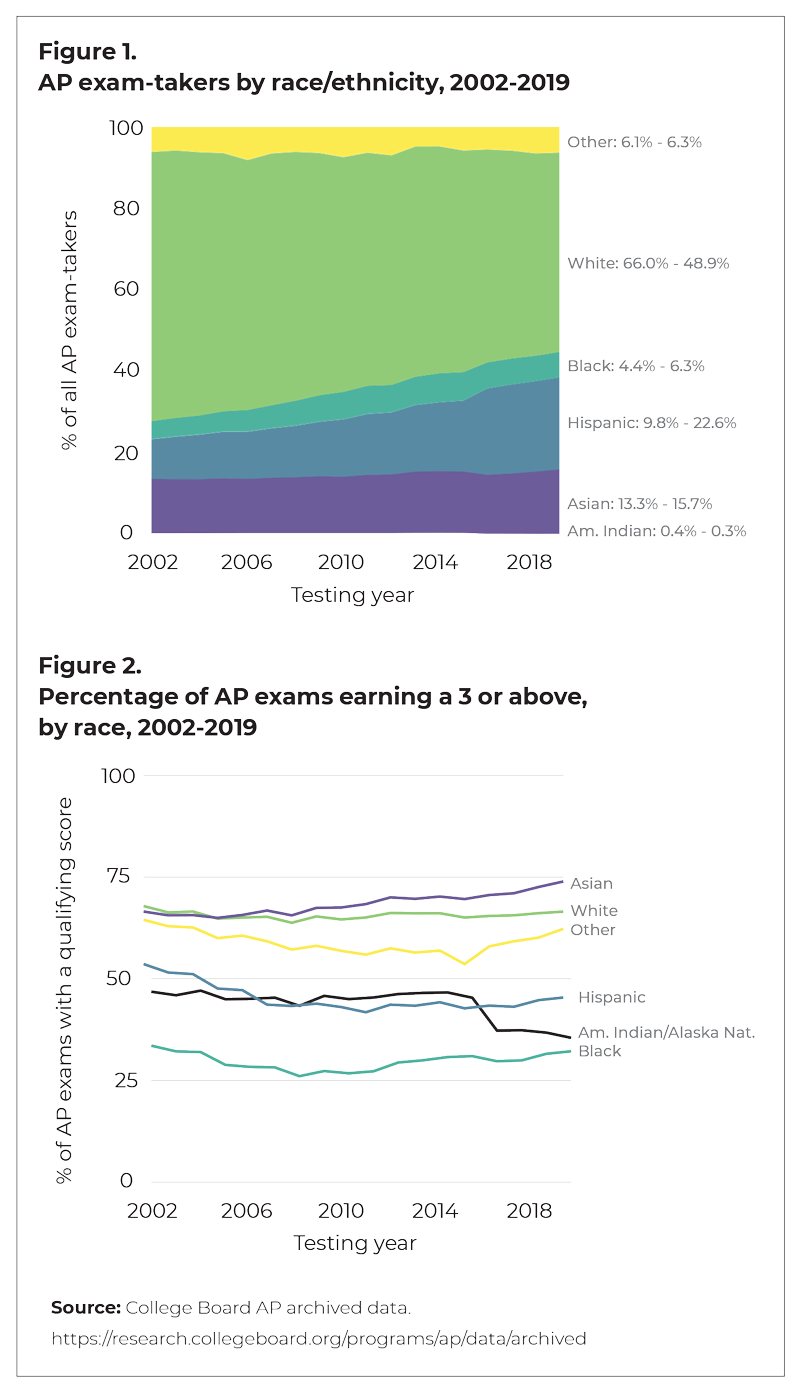 Also, over the past two decades, the College Board and school districts nationwide have made a concerted effort to expand AP course enrollment beyond already higher-performing and advantaged students — including by relaxing prerequisites and encouraging more students to enroll (Finn & Scanlan, 2019; Sadler et al., 2010). As a result, the percentage of high school graduates who took at least one AP exam in high school nearly doubled, from approximately 20% to 40% (College Board, 2020). The proportion of AP exam-takers from low-income families nearly tripled, from 11% in 2003 to 30% by 2018 (College Board, 2019), representing “particularly robust increases” in participation among students from marginalized populations (Kolluri, 2018, p. 2). And as we show in Figure 1, from 2002 to 2019, the percentage of Hispanic exam-takers increased from 9.8% to 22.6%, and Black exam-takers increased from 4.4% to 6.3%, while the proportion of white exam-takers decreased from 66% to 48.9%.
However, while participation in AP courses has increased dramatically, passing rates on AP exams have not. Across the College Board’s 38 subject-matter examinations from 2002 to 2019, more than 60% of white and Asian American students earned scores of three or higher on the five-point AP examination scale, qualifying them for credit or advanced course placement at most colleges. Far lower proportions of American Indian and Alaskan Native, Black, and Hispanic students earned qualifying scores (see Figure 2). This entails not just an educational disappointment but also a financial blow, since these students miss out on the chance to accumulate college credits and reduce their overall tuition costs (Smith, Hurwitz, & Avery, 2017).
These disparities in AP exam scores can be attributed to a number of factors, none more important than the differing quality of the education students receive long before they ever take an AP class. Not to be overlooked, though, is the pedagogy used in AP courses themselves (Kolluri, 2018). Typically, AP teachers rely on a lecture format because they believe this to be the most efficient way to cover a large amount of material (Parker et al., 2013). And some students thrive under that model, particularly if they’ve already enjoyed years of high-quality instruction, including many opportunities to solve the kinds of problems and work with the kinds of material that AP exams feature. But for many other students, a lecture-based AP class entails just another missed opportunity to engage with course content in sophisticated ways — such as by participating in oral presentations, debates, simulations, team-based problem-solving, and extended writing assignments — and develop the skills needed to participate in civic life and succeed in college and the workforce. As one student interviewed for our study recounted, AP class means “sitting in a class and taking notes, and then I don’t understand those notes, and then fail the test and so on.”
Another way to teach AP courses
Given concerns about the limitations of typical AP instruction, we designed a research study to improve understanding of whether AP classes that rely on a project-based learning (PBL) approach (featuring more time in active, engaging coursework, and less time spent listening to lectures and taking practice tests) can help develop students’ deep learning of content and skills while preparing them to do well on their AP exams. We were especially keen to learn whether this model can be effective in districts serving primarily students from lower-income households who may not have had the same level of preparation for the course as students from higher-income households. Further, we aimed to compare teachers’ and students’ experiences, as well as students’ performance on AP tests, in PBL-based versus lecture-based AP classes. Thus, we conducted a “gold standard” research study, in which we randomly assigned schools to a treatment group that used the PBL curriculum or a control group that did not.
Specifically, we studied the Knowledge in Action (KIA) program, a PBL-based approach to AP that University of Washington researchers developed in the 2000s in partnership with local teachers. Our research focused on KIA’s AP U.S. Government (APGOV) and AP Environmental Science courses (APES), which were the first courses developed, although there is now a KIA AP Physics course as well. Curriculum and instructional materials for all three courses (including resources such as documentation of KIA course alignment with AP curriculum frameworks and lesson plans) are available free through the Sprocket online curriculum portal developed and hosted by Lucas Education Research. Also, teachers of the KIA courses in the study received ongoing, job-embedded professional learning (provided by the nonprofit organization PBLWorks), including a four-day summer institute, four full-day activities during the year, and on-demand virtual coaching.
If AP teachers implement a PBL approach, they should feel confident that their students will be sufficiently prepared for the high-stakes end-of-year AP exam.
All five districts in our study were large and predominantly urban. A majority of students in four of the districts were Black and/or Hispanic, and a majority of the students in three of the districts came from lower-income households (i.e., were eligible for free or reduced-price lunch). Overall, nearly half (47%) of the students in our study were Black or Hispanic and nearly half (43%) were from low-income households; 38% of exam-takers in our study were from lower-income households, compared to approximately 30% of the national cross-course sample (College Board, 2019). In addition, a sizable proportion of students in our study scored lower than average on the PSAT. Finally, all five districts had an open AP course enrollment policy, meaning students did not have to meet certain prerequisites or have teacher permission to enroll in the AP course.
Our study of the Knowledge in Action program resulted in four main takeaways:
- The pattern of AP exam results was positive, both overall and for student subgroups. KIA students performed significantly better on AP exams than non-KIA students, with a greater estimated probability of earning a qualifying score on their APGOV or APES exam compared to non-KIA students (with some caveats we describe in our full research report; Saavedra et al., 2021). Notably, improved performance after one year was not driven by any one particular subgroup. Rather, we observed improved performance among KIA students from lower- and higher-income households, among students in districts serving a majority of lower- and higher-income students, in both APGOV and APES courses, and in every one of the five districts participating in our study.
- Project-based learning was a big shift for students and teachers. Teachers reported that using student-centered methods required a significant shift in their practice, and students reported discomfort with the movement away from a lecture format. For teachers, facilitating group work and pacing the curriculum scope and sequence through the year were particularly challenging. Students did not feel prepared to drive their own learning and sometimes wanted more lecture as a way to “rest” between projects. Despite the challenges, 96% of teachers who participated in the KIA program and responded to the year-end survey — even those who struggled — recommended the approach.
- Acclimating to the new approach was hard, but benefits were realized during the first year. It is notable that teachers did not need multiple years of PBL practice before we observed student successes. Our research suggests that the ongoing and job-embedded nature of the professional learning in the first year was a likely contributor to this early success. Further, we saw no erosion of the KIA model’s impact on student AP performance in teachers’ second year, after the formal professional learning had concluded (though some teachers continued to support each other through networks established in their first year). This leads us to conclude not only that participation in the yearlong formal professional learning program quickly translated to gains in AP test scores, but also that the professional learning had lasting effects on teachers’ practice.
- Project-based learning can provide sufficient preparation for AP exams. Our study is the first to provide solid evidence that if AP teachers implement a PBL approach (taking advantage of a course-specific PBL curriculum, instructional materials, and professional learning support), they should feel confident that their students will be sufficiently prepared for the high-stakes end-of-year AP exam. Nothing is lost by giving students more opportunities to work productively in groups, participate in classroom debates, provide feedback to peers, learn time-management skills, practice leadership, and refine their verbal and written communication skills. To the contrary, KIA students’ AP scores were better than those of peers who took lecture-based courses, and their teachers reported that they were more engaged in class and had more opportunities to develop real-world skills. Moreover, students tended to recognize the differences between the PBL approach and lecture-based AP classes and to report that there were significant benefits to KIA’s hands-on assignments, group work, emphasis on civic engagement, and overall approach to preparing for AP exams.
We think it’s important to reiterate, though, that all of the teachers in our study who used the PBL approach had access to ongoing, job-embedded professional learning and a community of peers teaching the same courses. Given that PBL entails a major shift in pedagogy, these supports are likely to be no less integral to its success than the curriculum and materials used. Indeed, based on our study results, PBLWorks, in partnership with the College Board, has begun to offer such professional learning opportunities and supports for APGOV and APES teachers. In summer 2021, they offered both a standard and PBL-based version of AP teacher training. Initial enrollments exceeded expectations, so we expect more courses will be available in the future.
AP, PBL, and equity
We’ve heard educators and policy makers say that students who’ve been underserved throughout their time in school are not likely to be successful in classrooms that feature active and self-directed learning. First, such students need to shore up their basic skills and acquire more content knowledge, they argue, and only then will they be ready for student-driven instructional approaches like KIA.
Even if educators and policy makers reject such dogmatic assumptions, they may have reservations about using non-lecture-based approaches in such a high-stakes context as AP. As one of the teachers in our study explained:
A lot of teachers have a hard time wrapping their minds around, well, my students are different than your students. Your kids have these discussions and they read, and they’re prepared, and then my kids might not have anywhere to sleep tonight. Or they may not have any food on the table.
This teacher emphasized the importance of learning whether students, “can work through project-based learning and get the skills that they need to go on to college.”
Our KIA results, however, challenge the notion that underserved students aren’t ready for student-driven instruction, or that “my kids are different from your kids” and won’t benefit from such an approach. The positive AP score results we observed were not concentrated only among students from higher-income households or from districts serving primarily students from higher-income households. Rather, KIA students outperformed non-KIA students overall, and KIA students from low-income households outperformed non-KIA students from similar households. In short, our results suggest that a PBL approach to teaching AP Environmental Science and AP U.S. Government can better prepare students of all backgrounds for their exams. For teachers who are already interested in shifting their practice toward PBL, this study shows they have good reasons to do so. And for those teachers who have reservations, this study suggests that it’s time to put those reservations aside.
Note: We have retained the term Hispanic, since that’s the term used in College Board data, and it has a slightly different meaning from Latinx.
References
College Board. (2020). AP program participation and performance data [Data set]. Author. Retrieved from https://research.collegeboard.org/programs/ap/data/archived/ap-2019
College Board. (2019, February 6). Student participation and performance in Advanced Placement rise in tandem. College Board Newsroom.
Finn, C. & Scanlan, A. (2019). Learning in the fast lane: The past, present, and future of Advanced Placement. Princeton University Press.
Kolluri, S. (2018). Advanced Placement: The dual challenge of equal access and effectiveness. Review of Educational Research, 88 (5), 671-711.
National Research Council. (2002). Learning and understanding: Improving advanced study of mathematics and science in U.S. high schools. National Academy Press.
Parker, W., Lo, J., Yeo, A.J., Valencia, S., Nguyen, D., Abbott, R., & Vye, M. (2013). Beyond breadth-speed-test: Toward deeper knowing and engagement in an Advanced Placement course. American Educational Research Journal, 50 (6), 1424-1459.
Sadler, P.M., Sonnert, G., Tai, R.H., & Klopfenstein, K. (2010). AP: A critical examination of the Advanced Placement program. Harvard Education Press.
Saavedra, A.R., Liu, Y., Haderlein, S.K., Rapaport, A., Garland, M., Hoepfner, D., Morgan, K.L., & Hu, A. (2021). Knowledge in Action efficacy study over two years. University of Southern California Dornsife Center for Economic and Social Research.
Smith, J., Hurwitz, M., & Avery, C. (2017). Giving college credit where it is due: Advanced Placement exam scores and college outcomes. Journal of Labor Economics. 35 (1).
This article appears in the November 2021 issue of Kappan, Vol. 103, No. 3, pp. 34-38.

ABOUT THE AUTHORS

Anna Rosefsky Saavedra
ANNA ROSEFSKY SAAVEDRA is a research scientist and co-director of the Center for Applied Research in Education at the Dornsife Center for Economic and Social Research and the director of research for the EdPolicy Hub at the Rossier School of Education at the University of Southern California .

Amie Rapaport
AMIE RAPAPORT is a research scientist and co-director of the Center for Applied Research in Education at the Dornsife Center for Economic and Social Research, University of Southern California.

Kari Lock Morgan
KARI LOCK MORGAN is an assistant professor of statistics at Penn State University, University Park, PA.
Marshall W. Garland
MARSHALL W. GARLAND is a senior research scientist at Gibson Consulting Group, Austin, TX.
Ying Liu
YING LIU is a research scientist at the Center for Economic and Social Research at the University of Southern California, Los Angeles.
Alyssa Hu
ALYSSA HU is a Ph.D. candidate in statistics at Penn State University, University Park, PA.
Danial Hoepfner
DANIAL HOEPFNER is a research scientist at Gibson Consulting Group, Austin, TX.
Shira Korn Haderlein
SHIRA KORN HADERLEIN is a researcher at Mathematica Policy Institute, Princeton, NJ.