A conversation with Free Press journalist Cassie Owens about the importance of putting traditional media coverage in historical context — in order to transform it.
By Alexander Russo
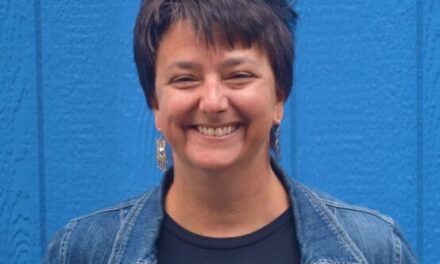
There’s something deeply humbling about listening to Cassie Owens talk about journalism, which she’s been working to rethink and revamp for several years now.
Owens is a Philadelphia-based journalist, organizer, and storyteller who works as the local program manager at Free Press, a nonprofit based in DC that works on issues related to building more equitable media systems.
At national conferences, in interviews, and in her own commentary, she’s been trying to help journalists and newsrooms rethink crime beat coverage.
Along the way, she’s learned the importance of putting contemporary news coverage in historical context — helping journalists understand where newsroom practices and habits come from as a way to help them consider new approaches.
We spoke earlier this year about problems with crime beat coverage, the challenges of changing newsroom practices, and the connections to traditional education news reporting.
If I understand what Owens is saying, she’s telling us that traditional news coverage is deeply inequitable for reasons that go back decades if not longer— and that fixing it going to require a mix of small changes and radical ones
This interview has been edited and condensed.

Above: Owens’ 2025 Nieman Lab prediction.
Russo: I first came across you and your work through your 2025 Nieman prediction, “No more baby steps in fixing crime coverage (above). ” What led to you doing the commentary?
Owens: I was honored to have that opportunity. The inspiration behind it was basically the conversations that I have on a regular basis doing this job.
There’s a lot of different people who want journalism to be better, we have different positions on what that can look like, but sometimes — more than sometimes, very regularly — what can happen in these conversations is pitting incremental approaches up against saying we’re not going to do X, Y and Z or we’re going to rebuild something new that actually holds the intentions of what we want to see.
The reality is, is that there’s, for me, a lot of fatigue about those two things being pitted against each other. I don’t think that, in reality, the way that I experience it, they have to be opposed.
There’s a lot of people who think very radically and who are doing things incrementally at the same time. But the reality is that it’s very difficult to reform something that was never actually meant to be anti-racist into something that can be. If we want to actually have a different system, we have to build a different system.
All the editorial choices for how we packaged that and delivered that information haven’t changed from generations of what in the practices before. So the goal was to give us that boost: no, let’s change some more things. Let’s keep going.
Russo: What was Race And Crime Reporting: Communities Of Color Disproportionately Represented, the January 2024 conference where you presented?
Owens: The purpose [of my presentation] was for us to be able to have a conversation about the roots of why we do some of the things, the way that we do them, and to be able to zoom out and not actually make it the typical conversation that will happen on these issues where someone might take something very personally or feel like there’s this one story where this community had not a good response, and now people are looking at me as a bad person.
It was intentionally trying to get away from that and to actually talk about the roots of why we are producing content in the way that we are, and to actually name that we have as an industry inherited a number of tactics, a number of storytelling forms, that were never meant to be equitable.
“Let’s change some more things. Let’s keep going.”
Russo: Tell me a little bit about the problems with crime beat coverage?
Owens: There really aren’t too many people who like crime coverage. A lot of community members don’t like it. A lot of researchers don’t like it. And there are a lot of journalists who don’t like it — even if they feel beholden to practicing it and making it look editorially in certain ways.
Crime coverage often skews to actually cover black and brown communities, particularly in ways that are criminalizing without a lot of information value, without a lot of opportunities for the people who are consuming that coverage to fully understand what happened and to make decisions about how they want to navigate their own safety and also reconnect with whatever civic activities they want to go and engage with from there.
Crime beat coverage is something that generally leaves people with a lot of fear, and it impacts policy decisions in ways that aren’t always beneficial to not just communities, but our larger society.
Russo: Are there connections between crime coverage and education coverage?
Owens: Yes, and I think that those parallels come from the exact systems that we’re talking about, as well as the systems that we’re covering.
When you are having a conversation about crime and public safety, a lot of the infrastructure that we have for that historically in the United States — especially if we’re talking about before the Emancipation that came during the Civil War.
We’re talking about public safety efforts that were not actually necessarily for the entire American populace. We’re talking about systems and law enforcement that were actually focused on a social order where some Americans didn’t have full rights.
The roots of the education system in America are a system that similarly was not born equitable and didn’t have to serve everyone evenly. And the coverage of both of those systems is coverage that is descended from a time when not only were the systems themselves not evenly shared, but the coverage also wasn’t actually even geared towards every potential reader.
It was specifically from a lens that included not even necessarily all white folks, but white elites and maintaining certain social notions from that lens.
Crime and education coverage both “descended from a time when not only were the systems themselves not evenly shared, but the coverage also wasn’t actually even geared towards every potential reader.”
Russo:I feel like I and many education journalists struggle with the fact that many of us had good experiences in school. We very much believe in schools. We choose the beat in part because we think education is a good thing. And also we think that news coverage is inherently a good thing, that more is usually better. The idea that schools or journalism could be part of the problem is very hard for us to believe. How does that match up with some of what you’ve learned and seen — if at all?
Owens: Sometimes people get into the binary of the idea of the two Americas. Really, there’s many Americas. And even people who agree on certain things might have very radically different experiences. I believe in schools. I believe very strongly in education. A very, very heavy chunk of my family, including my mom and many of my aunts and a lot of close relatives, are educators or retired educators. And at the same time, when I was in high school, sometimes the heat might not work properly.
So I remember when I walked into a suburban school to take the SATs not believing my eyes, because when I was a freshman, my algebra book was older than me, and I had to figure out getting contact paper to repair it so that I could even use it. We didn’t have water fountains that were safe to use. There’s a litany of different things.
I think that there’s a deeper question of why, in our society in the US, it’s okay for some people to have to weather those conditions and be judged if they don’t succeed in those conditions — and that other people, who hold the belief that education is good and never had those experiences, get to present the picture of what our education system is without further critique or further interrogation, and why more of the voices of people who did go through those experiences and may feel that education is a problem don’t actually get the same platforms?
There is a deeper psychological question about why a lot of Americans with relative privilege are holding so tightly to something that someone like me, even believing in education, might feel like a myth.
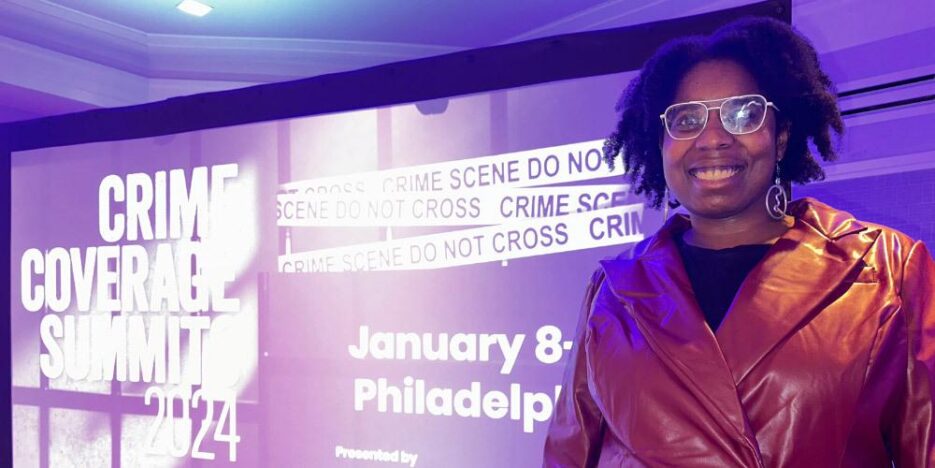
Above: Owens (right) at last year’s National Press Foundation conference.
Russo: There was an education journalist at WHYY Philadelphia who quit the beat in part because he said he was tired of his reporting contributing to misperceptions about the Philadelphia public schools.
Owens: The thing that I would just share about that is that a lot of the editorial practices that we’re using and the narratives that we have don’t always align to people’s experiences.
And so I think that, just like there are questions about whether or not there isn’t a benefit for us to try to understand cycles and patterns of violence in the US through the lens of good and bad people,
I don’t think that it is necessarily always beneficial to students or to communities, to view education in terms of, well, ‘Here’s another failing school but here’s that one smart student who rose up above it all.’
I think that we need more nuanced narratives, narratives that feel more accurate to a wider range of people, and narratives that actually not just fit the truth of what we’re experiencing but can reflect the problems and fault lines that we’re actually trying to address. I think some people do that through solutions journalism, but I don’t think that’s the only method to do it through. And I don’t think that’s something that is new to journalism. I don’t think that we always carry that focus when we’re doing the work.
I think about the journalist Catherine Boo, who brought up that when it comes to issues of poverty, sometimes we report as as if there are no culprits — as if there aren’t specific people and institutions and practices to blame. If you have a role as an investigative reporter to find the culprit with an issue that negatively impacts wealthy people, why aren’t we carrying those same mindsets when it comes to issues of inequity?
Previously from The Grade
Lessons from the crime beat (Cheryl Thompson-Morton interview)
Disgusted and demoralized, an education reporter left the beat he loved
Making education journalism more accessible and inclusive (Nikki Usher interview)
How student journalists at an HBCU took on local media — and won (Scalawag)
In Cleveland, community efforts fill in for school coverage
Education journalism has yet to make good on changes identified during the George Floyd protests
Improving source diversity in education journalism