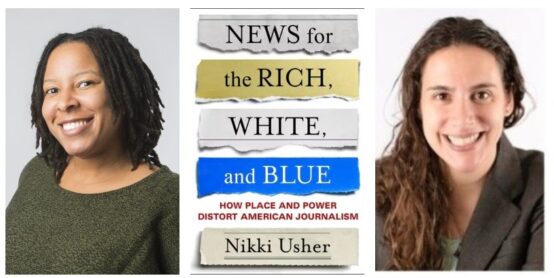
A new book from Nikki Usher highlights the need to refocus coverage away from journalism’s default readers and break into “the actual on-the-ground conversations that people are having about their communities?”
By Amber C. Walker
Nikki Usher’s latest book, “News for The Rich, White, and Blue,” interrogates the current state of the country’s news landscape and offers suggestions for organizations to better serve all readers.
In this interview with the University of Illinois journalism professor, Usher spoke with me about how the themes of her work apply to education journalists — and how the education beat could evolve as media as a whole moves into a new era.
Usher pushes education journalists to consider how some coverage that has been a core part of the education beat could be handled better by other entities in order to move away from “process stories” in favor of issues-focused journalism.
“Are you covering stories for wealthy generally white suburban parents,” she asks, “or are you covering stories about education that hold the largest population of your city?”
Amber Walker: Although your book is not focused on education reporters, there are some overall themes in the text that relate to the beat. Can you tell us about them?
Nikki Usher: Education reporters in particular need to be really vigilant about who gets covered and why, what blind spots or implicit assumptions they might have about the people that are being covered, and how the privileges and experiences that they have are increasingly out of proportion to the people that they’re likely to cover.
Are you covering stories for wealthy generally white suburban parents, or are you covering stories about education that hold the largest population of your city? I think it’s about recognizing that the poor and marginalized don’t get heard and don’t get covered as well, as frequently, or as fairly with the same level of compassion. That’s baked into both journalists’ own experiences and also the economic priorities of newsrooms.
Walker: You use coverage of high school prep sports as an example in your book. Can you say more about how sports coverage illustrates how disparate coverage can be between prosperous vs. marginalized communities?
Usher: Something I’ve noticed is the tendency for these Goldilocks outlets (e.g. the Chicago Tribune) to over-cover high school sports teams that really aren’t all that good — but happen to be in wealthy suburbs where the subscribers are. On the other hand, some of that coverage may be merited, but it reflects unexplored disparities (as in this New York Times article).
There’s also the caution of the “Hoop Dreams” effect of covering underprivileged kids living in rich suburbs that aren’t there for an education but to play sports. When I show the coverage to my classes at Illinois, they sometimes laugh because they know their high school teams were terrible.
The poor and marginalized don’t get heard and don’t get covered as well, as frequently, or as fairly with the same level of compassion.
Walker: One of the most interesting threads for me in your book is the conversation about the tendency of journalists to romanticize what a newspaper represents for a community. In your research, did you encounter anything specific about how education news coverage has evolved over time?
Usher: People imagine every school board meeting is covered and beat reporters are holding them accountable. The reality is that – for vast expanses of the United States — the school board has never been covered in the way that we imagine. In fact, the person who owns the local newspaper or media property may very well even be on the school board. This idea of “impartial accountability journalism” at the local level, really, I think, is mythology for the smallest communities.
My guess is if we were to analyze even the coverage of school boards by a large metro newspaper, it upholds an existing power structure. In Miami, at a time there was only one full-time education reporter for the entire city and its environs. The ability to hold school districts to account that may need the most attention vanishes when you lose that person able to cover it.
Walker: What do you see as the function of education journalists in this new media landscape, considering that they can’t cover everything? What should they focus on and how should they go about finding out what is important to cover for their communities?
Usher: Education journalists obviously are a priority, but they’re also the “broccoli of journalism.” They’re producing these process stories about what happened. I think that if there is an education reporter that is either part of a non-profit or connected to a larger media property, that this focus on process is less important than the focus on issues. It’s a question of redirecting emphasis to think about issues rather than events.
Many school boards archive their meetings and it may be worth thinking about how to use various forms of transcription technologies or ways to make some kinds of coverage more efficient through text. There could be a whole host of innovations that could be applied to the view that we just haven’t thought about.
Education journalists obviously are a priority, but they’re also the “broccoli of journalism.” It’s a question of redirecting emphasis to think about issues rather than events.
Walker: You had a quote in your book from Harry Backlund, the founder of City Bureau, asking, “Is your journalism a luxury or a necessity?” What do you think are the core responsibilities of the press in this historical moment?
Usher: it’s luxurious for me to sit around and read about some really interesting and obscure issues. I don’t want to discredit long-form, resource-intensive, investigative journalism. It’s really important, but I do think that the amount of that journalism that trickles down to ordinary people is very limited.
People need immediate access to understanding, like, “Are the school buses running?” “Are there enough drivers for my kids to get picked up on time?” These are really basic issues that have been thrown into disarray by the pandemic.
It’s not even about news, it’s about information. It may be possible to outsource some education journalism to community members because finding out answers to these questions isn’t rocket science, it just requires time. We might want to think about how [programs like] The Documenters can more collectively mobilize the parent community to provide a complementary role to what journalists are already doing.
I can’t think of a more important thing right now than making education journalism more accessible and inclusive, and it’s something that communities and journalists can work together on.
I don’t want to discredit long-form, resource-intensive, investigative journalism… but I do think that the amount of that journalism that trickles down to ordinary people is very limited.
Walker: How might the unbundling of news look in the education space?
Usher: When I think about unbundling what I mean is, are there things that can be offloaded to the community or other institutions so that journalists can focus on sort of the bigger picture rather than the day-to-day? Thinking really creatively about how institutions themselves can serve as information providers and what journalists really need to do. There are pieces of information that schools have that journalists will never have, like every phone number of every parent that is at the school. I think that it involves journalists dismantling the idea that they’re the only ones that can do something and that’s uncomfortable for a lot of journalists.
Walker: We’ve seen a lot of nonprofit-funded newsrooms pop up across journalism in general and in the education space in particular. How can journalists and publications protect themselves from potential influences and biases that may come as a result of these models?
Usher: I think that nonprofit journalism is in a really tough spot because you can’t bite the hand that feeds you, and that hand is feeding you for a particular reason. [Grantmaking organizations] can be hands-off or not. When we have this larger conversation around non-profit journalism and news models, people don’t really understand the internal mechanisms of how grant reporting works, what you’re actually allowed to do within the parameters of the grant, and how [those parameters] can actually serve as another way of constraining and ultimately advising the kinds of stories that get written, reported or produced.
I don’t know if I have a solution other than making it very clear and transparent how particular grant money is connected to particular projects and what the purviews of the grants themselves are. At this point, the financial disclosure for grantmaking and grant receiving organizations is far less detailed than it was 10 years ago in terms of the IRS. They can’t really even track it.
But I also think the flip side of this is which organizations are getting this money. My guess is there’s almost zero dollars going to rural schools coverage. We need to think about how that money ends up getting distributed and whether that’s being distributed in a way that speaks to the really complicated needs of different communities in the United States.
Disclosure: The Grade receives funding from a number of nonprofit foundations.
Nonprofit journalism is in a really tough spot because you can’t bite the hand that feeds you, and that hand is feeding you for a particular reason.
Walker: Can you provide some examples of outlets and/or reporters that exemplify representative coverage?
Usher: Chalkbeat is crushing it. Perhaps it is because it is a nonprofit with a mission to do better. But the entire set of principles that the Chalkbeat founder Elizabeth Green expresses about covering ALL children and keeping the coverage free is really terrific.
Walker: In the book, you talked about storytelling and information sharing networks that are made up of community members. How can journalists go about finding these micro-communities if they are not publicly available?
Usher: I don’t know. Journalists don’t need to be involved in everything. That’s one thing. I bet what you’re really asking is, “How do journalists break into the actual on-the-ground conversations that people are having about their communities?” I think that is the million-dollar question.
The only way you can do that is by committing serious resources to particular places. Right now, we don’t have a model that allows us to do that at scale. So you’ve got to be thinking about clever hacks to the system and that’s something I think we need to be doing. But I think that the sense of urgency [some coverage has] that the world’s going to fall apart, the sky is falling really misrepresents the extent to which that coverage was either deeply problematic, never done at all or highly inequitable.
Before we try to romanticize what’s lost, we need to think about what was actually there and what we want to be there in the future. Making decisions based on false premises of the past isn’t really a great way to think about creative and inclusive solutions for going forward.
Previously from Amber C. Walker:
In Cleveland, community efforts fill in for school coverage
Education journalism has yet to make good on changes identified during the George Floyd protests
Improving source diversity in education journalism
How personal experiences shaped one journalist’s perceptions
What it’s like being a rookie education reporter
Writing great profiles in the age of remote reporting
Bringing new insights & voices to The Grade
ABOUT THE AUTHOR

Amber C. Walker
In addition to being a consulting editor and columnist for The Grade, Walker is a multimedia journalist and digital content strategist. You can find her @acwalker620 across platforms.