| Earlier this year, after nearly 8 years covering education, WHYY Philadelphia public radio journalist Avi Wolfman-Arent left the education beat.He wasn’t leaving journalism to do something else. And he wasn’t going freelance. He was just leaving the beat. Starting this summer, he became a full-time host for the station.As you’ll see, part of the reason Wolfman-Arent left was that he came to resent readers’ demands for a certain kind of story his most ardent readers wanted but he felt was “inconsequential.”
But even more so, he despaired that his coverage of city schools was having the unintended effect of amplifying the perception that the district was incompetent or worse.
“That part hurt me,” he told me in a phone interview. “Are we giving people this impression?”
He couldn’t change the beat, and he couldn’t change his audience’s beliefs. So he got out.
The following interview has been edited and condensed.
I’m curious what you’d describe as your biggest success along the way?
Avi: You know, I’ve always been partial to the first feature story that I wrote and did audio for when I started covering Philly, which was back in April, maybe 2016. It was just a story about this small group of parents at a school in a truly middle-class part of Philadelphia who were absolutely freaking out because they thought the school district was going to transfer some special education students with behavioral problems to their school.
These parents were worried that these bad kids would come in and ruin the school. And it was this sort of investigative story about something that you wouldn’t think merits investigation, because it doesn’t affect that many people.
What kinds of stories did you try to avoid writing — or wrote a lot but wish you hadn’t?
Avi: I always felt like there was this magnetic pull back to stories about administrative goings on in the school district of Philadelphia, which is by orders of magnitude the largest school district in the state of Pennsylvania.
It always just felt like that kind of coverage was what people wanted, but it wasn’t that consequential. And it always went around in circles.
I never really felt like I found a good way to prove to my audience that I was paying attention and I didn’t not care, but that also there are more important things.
“It always just felt like that kind of coverage was what people wanted, but it wasn’t that consequential.”
What creates the pull towards Philly-centered coverage?
Avi: In Pennsylvania there’s really just one big district. And so if you want to cover a policy or a change in a suburban district, it’s hard to do it because it affects so few people. And you know, this is a regional station. So I think that’s part of what creates the pull.
I think the other thing is that the people who care the most about this, the listeners and the readers we hear from the most, are really locked into the shenanigan of the school district and you know, the board meetings and these people. They care quite a bit.
And I do think it creates a little feedback loop where it’s almost like we’re doing education coverage for this niche of people that is most invested.
And I, I often wondered, okay, but the 90% of people were not hearing from, do they care about this? Does it affect their lives? And are we really serving them?
I’m curious about what you make of the schools coverage during the pandemic that you produced?
Avi: I always felt like I was a beat behind. I would call as many people as I could call and try to understand the science and risk. But, you know, frankly, it was overwhelming and confusing. And it was not a subject area that I felt like I really knew that much about.
I was just trying to learn and it was evolving and I felt like every time you learned there was something else out and some other study and some other set of recommendations.
A big time suck was just covering what the school district’s decisions were and communicating that to the public. Okay, there’s basically 60 of these suburban school districts in our region on the Pennsylvania side of the river. There were a million variations between remote and in person and hybrid. I had a big color coded spreadsheet of trying to figure out who was going to be in school.

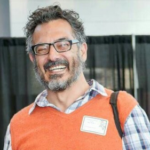
Above: Avi Wolfman-Arent in his current hosting role at WHYY.
What made you decide to leave the beat?
Avi: The pandemic interrupted the flow of my life like everybody else’s, and I was just looking to do something different. Hosting fell into my lap and it was a new challenge. And it gets me into a very different sort of daily rhythm. It’s fast paced. I really needed that in my life. I didn’t pursue it. It kind of just happened.
One of the things I struggled with the most was doing lots of reporting and then just having casual conversations with people about my job. Fairly often, the response would be, ‘Oh, the district of Philadelphia is such a mess,’ and maybe they would blame the teachers or they would blame the superintendent or the school board.
I felt frustrated by that response. I felt in myself a dangerous amount of sympathy for the decisionmakers and certainly a lot of sympathy for the people on the ground. I felt like everyone saw them as incompetent or corrupt, but in my mind they were just people trying to find some way through a system where they were given way less resources and frankly just had a harder job than people in the better funded school districts.
And I kind of felt like, ‘you know what, I think that there should be someone here with more of an edge than me. ‘Cause I just felt like I felt more bitter about those responses that I would get from people out in the world. I felt like I had lost my edge.
“I felt in myself a dangerous amount of sympathy for the decisionmakers and certainly a lot of sympathy for the people on the ground…I felt like I had lost my edge.”
You mean, you felt like you were too sympathetic to the folks in the system?
Avi: It wasn’t even like a personal thing necessarily. It wasn’t like I was cozy with people in the administration. I really never got that close with people. But I recoiled at this line of like ‘All those people, they ruined the school district of Philadelphia.’
I don’t know what other people think, but in my mind, it was administrative decision-making and resource allocation. It’s structural. It is about segregation and deprivation. That’s what I came to believe. And for me it just felt like people didn’t care about that or didn’t want to focus on it. They wanted to blame these people who sort of happened to be there in the system.
And I was just like, ‘I think someone else should put up a ton for me here who can come up with something a little fresher.’ Because I don’t think that was necessarily a healthy attitude for me to have.
Back in the day, I’m told people had their beats switched every three or five years to avoid becoming overly sympathetic or hostile to the people and issues they were covering.
Avi: Right. So you go kind of go one way or the other. And I felt myself being pulled more toward the sympathy side of it. Sympathy almost feels like the wrong word. It wasn’t like I’m sitting here saying these people are all doing a great job. I just felt like they were all kind of trying to work a miracle and taking all these shots.
People would talk about some really well funded school district in the suburbs and the great teachers there. ‘The teachers and the administrators there are just so wonderful.’ I never met anyone in the suburbs that seemed inherently more competent than the people working in the city school system. They just had more to work with.
It really was these dinner party conversations with people and the feeling like, ‘Wait, is my work feeding that attitude? Have we not like explained to people in a way that’s clear that yes, the decisionmakers should be held accountable, but there are also these huge systemic forces that have created this dichotomy?’ It just felt like everyone had gotten the wrong message.
“I never met anyone in the suburbs that seemed inherently more competent than the people working in the city school system. They just had more to work with.”
What you took was not so much, ‘Oh, I need to question the criticism of the district,’ but ‘I need to question my ability to see this clearly and to produce useful journalism’?
Avi: Even more than that, I was questioning my own sympathies but also questioning my role in perpetuating that idea. If you took all of our coverage, collectively, would you come away with the impression that this one school district is run by people who are incompetent or corrupt, and these other school districts are run by people who are amazing at their jobs? That was the part that hurt me. Are we giving people this impression?
This is a totally indefensible situation where the education in the suburban school districts and the resources they have is vastly superior to any city school district. Are we actually giving people the impression that this was just a result of choices made by administrators or just bad teachers?
We were trying our best to explain it over and over and over again — that this is the result of systems and structures baked into society. But I just didn’t feel like that’s what people took away.
If your coverage gives the impression that this is somehow exclusively because of poor decisions by adults within those school districts, then I think you’ve led people astray. Because it’s not.
I would tell people if you think this is just about teachers, what do you think would happen if the teachers from the best school in the city swapped places with the teachers from the “worst” school in the city? I mean, honestly, right? My gut tells me that it wouldn’t make the change that I think some people would assume it would make.
“We were trying our best to explain it over and over and over again that this is the result of systems and structures baked into society. But I just didn’t feel like that’s what people took away.”
What specific or general advice would you give to your successor? Got any pro tips to share?
Avi: My advice would be the same regardless of beat. Be curious. Challenge your assumptions. Don’t rely too much on the people who always get quoted.
Previously from The Grade
‘We wasted a lot of time:’ A veteran reporter reflects
The Great Resignation comes to the education beat
Star reporter Jenny Abamu explains why she left journalism
‘We could have been a lot louder,’ says NPR’s Anya Kamenetz
A brain drain in education journalism |