
Indifference, boundary-crossing, and lack of training create fertile ground for opportunistic school predators, says a researcher who’s studied the problem extensively. And education journalists aren’t paying enough attention.
By Alexander Russo
I only recently became aware of Charol Shakeshaft, when I came across a Harvard Edcast segment on the topic of the problem of sexual assault in schools.
Titled The Problem Schools Are Ignoring, the October 2024 segment features “strategies for educators and families to recognize, report, and prevent incidents of sexual misconduct in schools.”
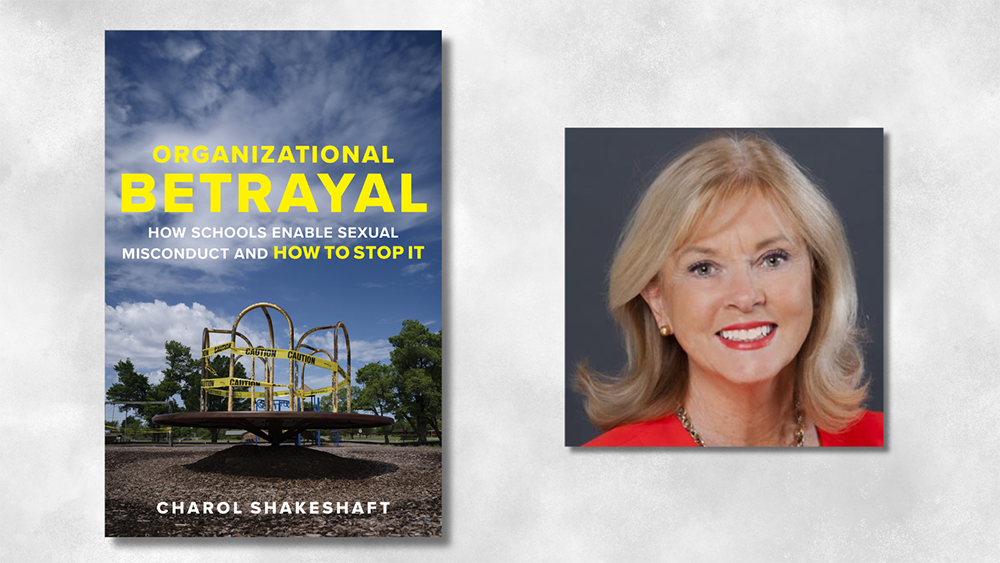
But Shakeshaft has been studying sexual assault of students by school employees and working with schools on the problem for a long time. Her 2024 book is called Organizational Betrayal (How Schools Enable Sexual Misconduct and How to Stop it).
So I’m enormously grateful that the Virginia Commonwealth University researcher and educator shared some of her knowledge and experiences in a recent phone call.
Most people who abuse students are opportunists who operate in a culture in which adults generally don’t call each other out for boundary-crossing behavior, according to Shakeshaft.
And most education coverage tends to focus on the abuser or the abuse that’s revealed — not on the school or school system’s efforts at prevention.
“I’ve tried to get educators to put the safety of children before their own comfort,” says Shakeshaft, who would like to see more of a focus from journalists on “what the school is or isn’t doing to keep kids safe.”
Part Four in The Grade’s series on school secrecy, this interview has been edited and condensed.
Russo: Based on your research, what are the underlying reasons that school sexual assault continues to happen?
Shakeshaft: It continues because schools don’t do much to prevent or stop boundary-crossing by school employees. People see boundary crossings by colleagues and don’t report them. Schools fail to have appropriate policies, and even when they do, they fail to train staff, students, and parents on those policies.
In most every case that I’ve studied — and I’ve studied hundreds — people see something going on. They don’t know exactly what it is. They know it’s crossing a boundary, or it’s not quite right, or the employee shouldn’t be behaving that way with a student, or the employee is too close to the student, or a teacher always has a kid in their room, or always keeps the door shut.
They see these things. They even talk to their families or selected colleagues about the employee’s behavior with students. What they don’t do is report.
Russo: Who are the adults who abuse children?
Shakeshaft: In most cases that I have studied, the school employee isn’t a fixated abuser. In other words, they’re not psychologically programmed just to have sex with 13-year-old girls. They’re people who don’t have good judgment. They’re people who take advantage of situations. They’re often narcissistic or self-focused. And if there’s resistance, if there are barriers, if someone is watching and reporting, they are not likely to cross those barriers.
Russo: Teachers are mandatory reporters under the law in most states for child abuse in the home. Aren’t they also mandatory reporters for sexual abuse in schools?
Shakeshaft: Well, yes and no. The mandatory reporting laws were originally written to prevent and report abuse of children in the home. In some states, if a mandatory report is made to child welfare, they tell the reporter to call the police. In other states, there are agreements made that whoever gets the report will contact law enforcement.
Sexual conduct with a minor is a criminal offense in every state. If there is a suspicion that a child is being harmed, it is the responsibility of an educator to report.
If an educator thinks adult-student boundaries are being crossed, they must report. Sexual abuse of a child is a crime. The specific laws vary by state, and employees in all schools that receive federal funding are required, under Title IX, to report.
“Schools don’t do much to prevent or stop boundary-crossing by school employees.”
Russo: What could schools do to limit or prevent school sexual abuse?
Shakeshaft: The very least that we could do that would have the most impact would be to train people on the acceptable boundaries between school employees and students and how to report when someone is crossing a boundary. Schools used to have codes of conduct, but those are now rare. Schools aren’t educating students, parents, and employees on physical, emotional, and social media boundaries.
Even more than that, we don’t train on and practice reporting somebody crossing the boundaries.
Rarely does anyone actually report to the principal, the Title IX coordinator, or the police. Nobody says anything because we don’t teach them to report boundary-crossing behavior. The culture of schools is that you don’t “rat” people out. Teachers are taught to mind their own business. If we would actually speak up and report what we see as boundary crossing, we’d likely stop that boundary crossing. And if we stopped that boundary crossing, we’d greatly reduce the number of kids who were sexually abused by a school employee.
Russo: Does training school staff work?
Shakeshaft: Without policies, training, and possible personal penalties for not reporting, school personnel say they don’t really want to get involved. That’s how they phrase it. ‘I don’t really want to get involved,’ or ‘It’s not any of my business.’ This is something somebody else is supposed to be taking care of. ‘I don’t know for sure,’ or ‘I don’t want to be a busybody’.
But the more training they have, the more the culture is discussed and changed, and the more policies and laws penalize not reporting, the more likely school employees are to see that it is in their self-interest, as well as the safety of students, to report boundary crossing and suspicion of harm.
If observers started intervening and saying, ‘You have to keep your door open,’ or ‘I’m going to have to tell the principal,’ or ‘You can’t be on social media with the kids,’ that would begin to address and interrupt the boundary crossing. If school employees practiced how to confront and how to report, it would become much easier to take those actions when necessary.
I’ve worked with teachers on interrupting behaviors and reporting. I have them develop a script and brainstorm. ‘How do you say this to your colleague in the room next door? How do you intervene? How do you practice?’ And it turns out, once people start practicing the language, it gets much easier to intervene and report.
“Once people start practicing the language, it gets much easier to intervene and report.“
Russo: What’s your general impression about media coverage of school sexual predators?
Shakeshaft: Most of the time, coverage is in response to a particular incident and doesn’t go beyond reporting that something happened. I understand that because that’s how the news works. But I’d like to see more coverage of why it happens or — more to the point — how it’s allowed to happen. Less focus on the individual predator, if we want to call it that, and more of a focus on what the school is or isn’t doing to keep kids safe.
Russo: Do you have any thoughts about why there isn’t more focus on prevention coverage? We like to think, as a society, that we care a lot about children’s safety.
Shakeshaft: I think we believe we care about children’s safety. As it turns out, keeping children safe is complicated and requires thoughtful prevention approaches. Schools are overwhelmed and understaffed. Things fall through the cracks.
That’s why we need safety requirements and accountability. A reporter might not consider it part of the “story” to look into prevention or the school’s responsibilities for keeping students safe. That might explain why abuse is reported in the press, but the underlying failures of the school to keep students safe are not. The latter requires investigation, which requires the news organization to support investigative reporting.
I would very much like to see more reporting on what the school organization did or didn’t do to keep students from sexual misconduct by employees. The press can inform parents, students, and school employees about what should happen, including policies, training, and reporting of boundary crossing and suspicions. This type of reporting would help school employees who see something to report. It would help parents to ask questions about policies and training. It would help students understand the harm that might occur and the responsibility to report.
“A reporter might not consider it part of the “story” to look into the school’s responsibilities for keeping students safe.“
Russo: A few years ago, an investigative journalist from the Boston Globe told a group of education reporters not to hold off on covering schools like they had done with the Catholic church. What do you make of that comparison?
Shakeshaft: If only because there are more schools than churches, I think that there’s likely to be more sexual abuse in the schools than in the church, but I think the cover-ups are different. School cover-ups are less about protecting the institution than are church cover-ups. I code the church cover-ups as protecting the church and protecting the people in the church. My research indicates that the school cover-ups are less cover-up and more a failure to take responsibility for reporting or failure to take seriously red flags.
Russo: The opposition to transparency and anti-NDA laws, isn’t that a systematic conspiracy to protect adults and to leave children vulnerable?
Shakeshaft: I don’t think it’s a conspiracy so much as it is lack of knowledge about appropriate actions to take. There should be no non-disclosure agreements. Non-disclosure agreements may allow a particular school or district to get rid of a predator. They don’t stop the person from abusing other students in other schools.
Russo: I’m 10 times less an expert on either of these topics than you are, but I feel like the adult interests in these situations are very well protected and the child interests are left unprotected.
Shakeshaft: Well, I absolutely agree with you there. I’ve tried to get educators to put the safety of children before their own comfort. I’ve tried to get educators to pay attention. I’ve tried to get them to stop their colleagues. I think it is going to take more than what I’m doing to change the culture of looking the other way. State and federal laws will help. Media coverage will help.
Previously from The Grade
The ‘soft spot’ to unlocking schools’ hidden secrets (Jim Baumbach interview)
How I penetrated a wall of silence to document sexual abuse of Massachusetts students (Marina Villeneuve)
School secrets and sexual assault (Stephanie Kuzydym interview)
Is K-12’s #MeToo moment finally here — & will journalism help play a role? (Matt Drange interview)
How to investigate sexual abuse at Native American boarding schools.
Your high school journalism teacher was a serial sexual predator
How Bethany Barnes became a star education reporter