Media coverage shapes perceptions of public schools by pushing a pervasive message of crisis. A more nuanced and multifaceted conversation can help.
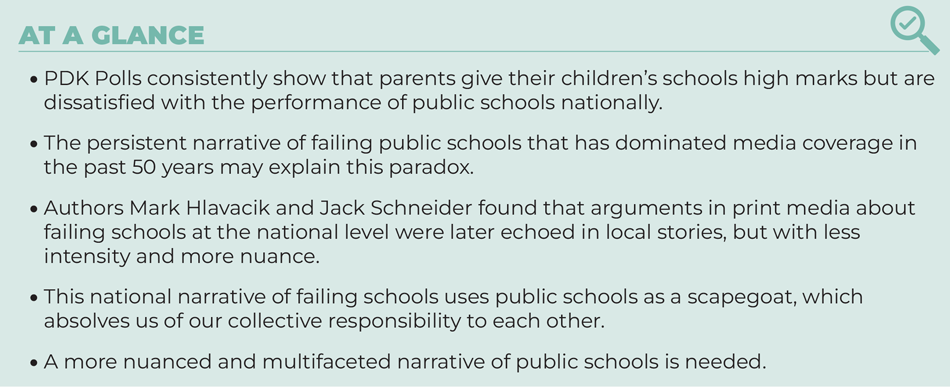
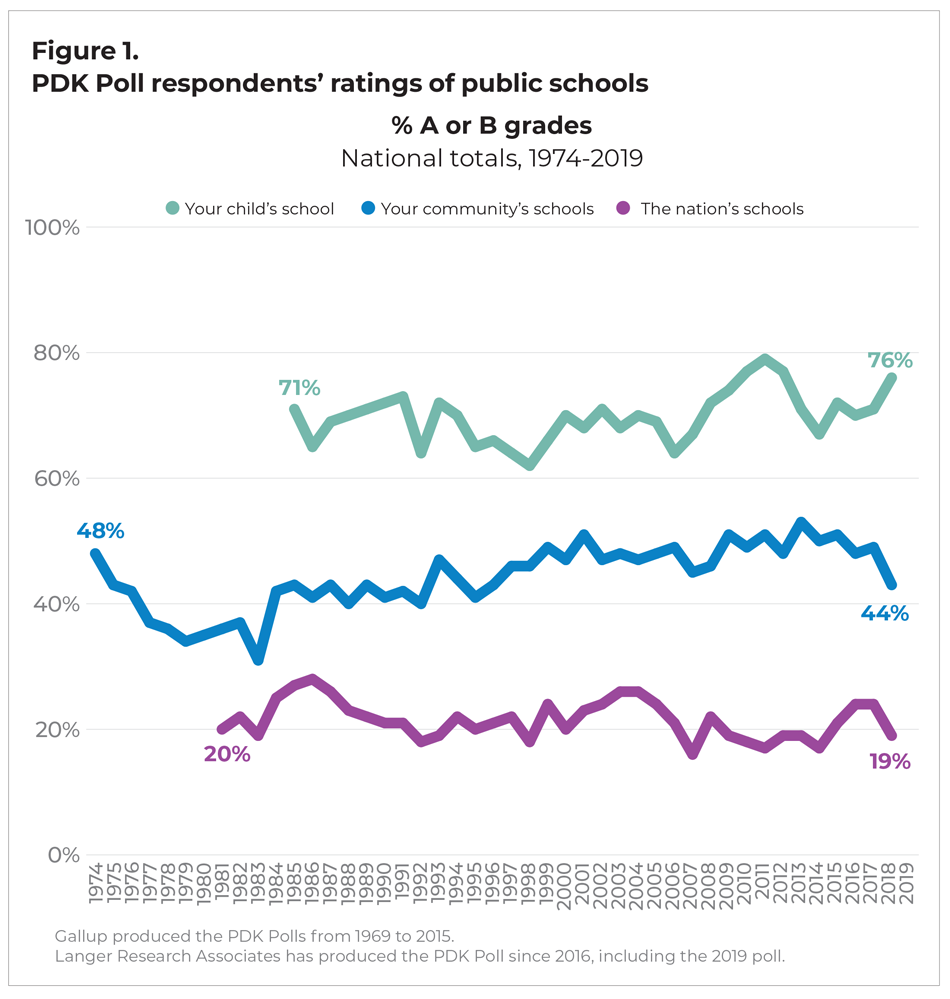
Over the years, the PDK Poll regularly asked Americans to rate the quality of our nation’s schools. And for the past few decades, roughly two-thirds of respondents have indicated low levels of satisfaction. Using the A-F letter grades so often given in schools, they land somewhere around a C or a C-. At the same time, however, the poll reveals higher rates of satisfaction among parents with children actually in the public schools. Although the numbers fluctuate from year to year, roughly 70% of parents give their children’s schools an A or B. If the nation’s public education system is as bad as people think, the parents of school-age children haven’t gotten the news.
Some observers have tried to explain this puzzle by suggesting that parents are underinformed about poor performance of their children’s schools or that they are sustaining an illusion for the sake of their own feelings. However, research indicates that parents have a strong sense of how their children are doing relative to peers in other schools (West, 2014). And given the volume of daily parental grumbling about schools, it seems unlikely that families are naïvely trusting.
Even more confusing, when the poll has asked respondents to grade their community’s schools, their ratings fall neatly between those assigned to the nation’s schools and their children’s schools (see Figure 1). What’s going on here? If parents are generally satisfied with their children’s schools, how do they know they should be displeased with the nation’s schools as a whole? And what’s happening when they rate the schools in their communities?
Different kinds of information clearly play a role. Parents can rely on their personal experiences to evaluate their children’s schools. However, they know little about the 98,000 public schools their children don’t attend — a roster that includes most of their community’s schools, as well. Their firsthand information, in other words, rarely extends past the level of the school, and almost never beyond the district. As a result, their opinions of how schools are doing nationally are shaped by what they hear, read, or watch. And much of the conversation in the media advances a failing schools narrative.
Rhetoric of educational failure
Over the past half-century, conventional wisdom has been that America’s schools are in crisis (Hlavacik, 2016). The narrative is so pervasive, in fact, that we would be surprised if it didn’t affect people’s views. But we wanted to know whether that narrative reflects people’s actual experiences. Is the national-level rhetoric a lagging indicator of real problems on the ground? Or are the concerns of politicians and policy makers driving a national story that’s out of sync with local reality?
To at least partially answer this question, we traced how five major print news sources — The Boston Globe, Newsweek, The Wall Street Journal, The New York Times, and USA Today — have spread the story that schools are failing across roughly three decades. Beginning in 1984, just after the publication of the A Nation at Risk report sounded the alarm about public schools, we looked for different permutations of “failing schools” language all the way through the end of the Obama administration in 2017.
We then categorized different kinds of arguments and analyzed how they work together (using the model described by Stephen Toulmin, 1958). Then, we organized the arguments chronologically in four-year periods corresponding to presidential terms — an admittedly rough-and-ready way of creating distinct periods to compare (Hlavacik & Schneider, 2021).
In addition to organizing the arguments by type and chronology, we separated those that claimed that the nation’s schools were failing from those that contended that individual schools or districts were failing. In doing so, we discovered that arguments about the shortcomings of the nation’s schools during one presidential term became arguments about the failures of local schools during the next. National stories, in other words, seemed to be framing what local reporters looked for and the stories they told, creating a rhetorical echo.
Arguments that echo
This was not just a general phenomenon in which the national coverage would turn negative, only to be followed by a similar turn in local coverage. Instead, specific kinds of arguments — such as school failure as evidenced by low test scores, a lack of accountability, and inefficient management — would emerge first at the national level and then appear later in stories about local schools.
For example, a 2004 USA Today article attributed disheartening results of No Child Left Behind testing for minoritized students to “watered-down reporting requirements” that “dampen the effectiveness of performance standards for improving minority achievement.” This article reflected a larger trend in which national media stories suggested that a lack of accountability allowed schools to operate inefficiently, leading to failure. We found that this pattern of argument about the nation’s schools surged during Bill Clinton’s presidency and remained popular throughout George W. Bush’s time in office. An echoing surge in news reports about local schools and districts then followed.
During Barack Obama’s presidency, the argument emerged with a local focus in a 2013 Wall Street Journal editorial that called Philadelphia’s schools “a textbook case of chronic, systemic failure.” Why? Because, just as USA Today had said of the nation’s schools in 2004, the district’s test scores were disappointing. And just like at the national level in 2004, the city’s inefficient reform committee was said to be unwilling to face facts: “99.5% of teachers are rated satisfactory,” the article guffawed.
The specific line of reasoning here is that low test scores are a sign of school failure caused by a lack of accountability and administrative inefficiency. Regardless of whether one agrees or disagrees with this account of school failure, our work uncovered how it emerged first in stories about the nation’s schools as a whole, peaked during Bush’s presidency, and abated during Obama’s. But the argument didn’t disappear; it took hold as an explanation for why local schools fail. This means what the news media say about the nation’s schools today is likely to be what they will say about individual schools and districts a few years down the road.
Failing schools on screen and elsewhere
Our study analyzed popular sources of print journalism, but those are hardly the only sources of school failure narratives. Many films, for instance, depict heroic teachers resisting or transcending broken systems. In box office hits like Stand and Deliver, Dangerous Minds, or Precious, the protagonists’ dedication is contrasted with the disorder, indifference, and malevolence of a failing school system. This narrative is also common in televised comedies from Welcome Back, Kotter to Abbott Elementary.
Similarly, popular education documentaries don’t typically emphasize the positive side of the U.S. public school system. Frederick Weisman’s High School holds nothing back in portraying the average secondary school as an intellectual and moral wasteland. Davis Guggenheim’s Waiting for “Superman” depicts an education system suffering such profound political dysfunction that it fails at the most essential aspects of its mission. More recently, Peter Nicks’ Homeroom follows a class of high school seniors in Oakland during the COVID-19 pandemic, showcasing their resilience in contrast with their school system’s.
Education reformers, philanthropists, and politicians also share some responsibility. Jonathan Kozol, for instance, in his bestselling Savage Inequalities (1991), described the public schools in East St. Louis using a literary conceit modeled on Joseph Conrad’s Heart of Darkness. In support of his foundation’s Measures of Effective Teaching program, Bill Gates (2005) declared U.S. high schools “obsolete” and called for them to be redesigned, lest they “keep limiting — even ruining” students’ lives. And Arne Duncan (2009), former secretary of education, frequently asserted that because curricular standards are “too low” and “too broad,” schools don’t just fail their students, they delude them. “For too long, we’ve been lying to kids,” he told a gathering of governors, “we tell them they’re doing fine, give them good grades, and tell them they’re proficient on state tests that aren’t challenging.”
Together, these well-known voices in education are telling us that the conditions in our public schools are dire, that our schools are ruining students’ lives, and that any positive results on standardized tests are merely a sinister illusion. It’s quite the picture. But if print news, movies, television, reformers, philanthropists, and politicians are all speaking with one voice on the state of the nation’s schools, and if the argument they’re making about educational failure is echoing in reports about local schools, why aren’t parents rating their own schools more critically?
Local narratives: Less certain and less intense
When we looked more closely at how arguments about the failures of the nation’s school system were echoed in print news about individual schools and districts, we found something unexpected. At the national level, the idea that low test scores are a sign of failure due to a lack of both accountability and efficiency crowded out competing narratives. We found that 85% of the news items we coded contained at least one of those elements, and 59% had all three. Six of every 10 “failing schools” articles made the exact same argument.
However, when that argument filtered down to individual schools and districts, it never grew to dominate the discussion in print media to the same degree. Whereas 78% of news items about school failure at the local level discussed test scores, accountability, or efficiency, just 32% contained all three.
This is why we settled on the term “echo” to describe what we found. The argument repeated, but its repetition was weaker, fuzzier, and less dominant.
We aren’t suggesting that all schools are excellent or that we should ignore systematic inequality in our schools. Instead, we are arguing for a discussion more grounded in reality — one where the charge of failure is less pervasive, and therefore more meaningful.
In other words, the discussion of why individual schools and districts fail was more nuanced than the discussion about the failures of the nation’s school system. No single explanation crowded all the others out of the discussion. This, we believe, helps explain why respondents to the PDK Poll are less negative about their individual and community schools — the rhetoric of school failure about them is neither as certain nor as intense.
Key, too, is the fact that families have a great deal of additional information when it comes to their children’s schools. Whatever they’re hearing in the news, they’re also learning about the school from their children and their classmates, from teachers and school leaders, and from being in the hallways and on the playground.
As for ratings of their community’s schools? Most people would be more likely to hear firsthand stories about them from neighbors and coworkers than they would be to hear about many schools much farther away. Local schools may also benefit from some “spillover” of the views that people maintain about their own children’s schools. After all, how different could other schools in the district be?
Ratings of schools in the community do, of course, remain substantially lower than the ratings people give to their own children’s schools. But that makes sense, too. In the absence of firsthand information, other narratives have more opportunity to take root. We may suspect that other local schools aren’t as bad as the schools we so often hear about, but we don’t know for sure.
Talking about the nation’s schools and our own
Beyond providing an explanation for PDK’s long-standing polling paradox, this pattern presents an opportunity. Perhaps before we repeat something negative about the nation’s schools, we should ask ourselves whether we would say or write the same thing about the schools where we live or the schools our children attend. If we would be inclined to challenge or qualify the argument if it was made about a school we know, maybe we should extend that same degree of consideration to the 98,000 schools we don’t.
To be sure, the rhetoric of failing schools is not going away. It’s simply too useful as a political tool and storytelling device. The invocation of school failure has been there alongside practically every milestone in the history of education over the past half-century. The1983 A Nation at Risk report touched off waves of reform with its assertion that American schools were failing. Two decades later, George W. Bush (2002) signed the No Child Left Behind Act (NCLB) into law, promising that it would “free families from failure in public education.” And more recently, the ostensible failure of our nation’s schools was the rationale for Laurene Powell Jobs’s XQ Super School project, which aims to “scrap the blueprint and revolutionize this dangerously broken system” (Moser, 2015).
Schools really can and do fail students, especially students of color and those who grow up in economically depressed conditions. We aren’t suggesting that all schools are excellent or that we should ignore systematic inequality in our schools. Instead, we are arguing for a discussion more grounded in reality — one where the charge of failure is less pervasive, and therefore more meaningful.
The mixed record of public education
Generic stories of failure may be very good at justifying reform, but they also do a lot of damage. Worse, they don’t address the root cause of unequal educational opportunity. Underserved students aren’t shortchanged because public education is “dangerously broken.” The real story is that our system mostly works; it just doesn’t work for everyone. The fault, then, isn’t only in our schools but also in our selves. We have refused to embrace all of America’s young people in the same way that the most advantaged embrace their own. The narrative of a system in decline scapegoats the nation’s “school system” and absolves us of our collective responsibility to each other.
One lesson that we can draw from the PDK Poll’s persistent finding that parents rate their children’s schools more favorably than the nation’s schools is that we need to strengthen the popular sense of collective responsibility for the nation’s schools. Such a sense of responsibility would need to be reflected in what we say and what we write about schools. This might lead to more positive discussion of the nation’s schools, but it need not result in false praise. After all, the news items we collected about local schools also asserted that schools were failing — they just made the argument with less certainty and intensity. We need narratives about the nation’s schools that are more nuanced and multifaceted. Considering the ones we craft about our own children’s schools would be a good place to start.
References
Bush, G.W. (2002). Remarks on signing the No Child Left Behind Act of 2001 in Hamilton, Ohio. The American Presidency Project.
Duncan, A. (2009). States will lead the way toward education reform: Remarks at the 2009 Governors Education Symposium. U.S. Department of Education.
Gates, B. (2005, March 1). What’s wrong with American high schools. The Los Angeles Times.
Hlavacik, M. (2016). Assigning blame: The rhetoric of education reform. Harvard Education Press.
Hlavacik, M. & Schneider, J. (2021). The echo of reform rhetoric: Arguments about national and local school failure in the news, 1984–2016. American Journal of Education, 127 (4), 627-655.
Kozol, J. (1991) Savage inequalities: Children in America’s schools. Harper.
Moser, L. (2015, Sept. 15). Laurene Powell Jobs just ponied up $50 million to rethink public high schools. Will it go anywhere? Slate.
National Commission on Excellence in Education. (1983). A nation at risk: The imperative for educational reform. U.S. Government Printing Office.
Toulmin, S.E. (1958). The uses of argument. Cambridge University Press.
USA Today. (2004, April 29). Equal access to schools fails to equalize education. Our view: End of sanctioned segregation didn’t close racial learning gaps.
Wall Street Journal. (2013, Oct. 13). The great progressive education disaster.
West, M.J. (2014). Why do Americans rate their public schools so favorably? Brookings Institution.
This article appears in the September 2024 issue of Kappan, Vol. 106, No. 1, p. 15-18.

ABOUT THE AUTHORS

Mark Hlavacik
Mark Hlavacik is an assistant professor of communication studies at the University of North Texas in Denton and author of Assigning Blame: The Rhetoric of Education Reform (Harvard Education Press, 2016).

Jack Schneider
Jack Schneider is the Dwight W. Allen Distinguished Professor at the University of Massachusetts Amherst and director of the UMass Center for Education Policy.