Sexual abuse of students is both a present-day and a historical problem. A pair of journalists behind the recent Washington Post investigation into abuse by Catholic educators and staff share challenges, insights, and practical tips.
By Alexander Russo
During the last week of May, while many of us were focused on newsy stories like campus protests and school budget cuts, the Washington Post produced a massive new series about sexual abuse of Native American children by Catholic school educators and staff called In the Name of God.
Spearheaded by the duo of Dana Hedgpeth and Sari Horwitz, the piece was featured on the front page and a nine-page insert. Hedgpeth and Horwitz answered questions from readers in a recent live chat. The larger history of Native American boarding schools is presented in a slide show.
As we described it in a recent newsletter, the investigation is “a grim, comprehensive look” at what some kids experienced at these schools.
As longtime readers of The Grade are aware, school-based sexual abuse of children remains an issue in the present and has proven to be an enormously challenging topic for education journalists to cover.
Despite a series of government reports and in-depth investigations by reporters like the Oregonian’s Bethany Barnes (now at the Tampa Bay Times), USA Today’s Steve Reilly, and Business Insider’s Matt Drange, serial sexual predators are often allowed to keep working with children and protected from criminal accountability.
Curious about the challenges of reporting and writing this story — and any insights gleaned about covering it — we asked Horwitz and Hedgpeth to answer a few questions. They talk about the challenges or working without documents, interviewing vulnerable sources, and using previous coverage and existing databases to help their work.
The following interview was conducted via email.
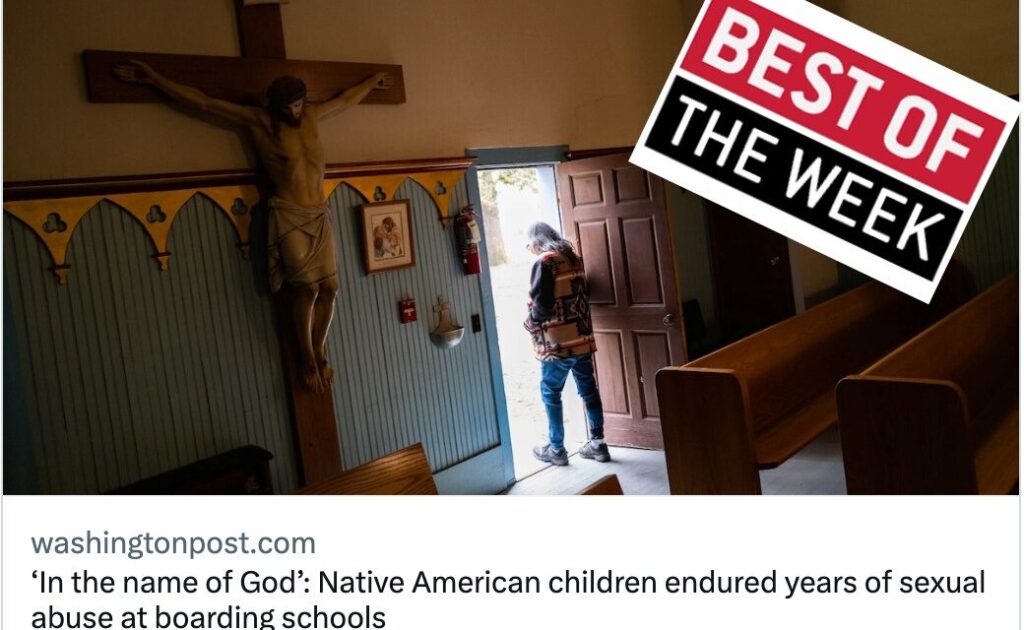
Above: The Grade featured this piece in the May 31 edition of the best education journalism of the week newsletter.
What was the most challenging part of the process of launching, reporting, writing, and shaping this story?
The most challenging aspect of our Indian boarding schools investigation was to tell the story of the widespread sexual abuse of Native American children with very little documentation of the abuse in official federal records.
While there are millions of federal documents in national archives about aspects of the 523 boarding schools, they do not contain records of what happened to children at the hands of the priests and sisters who were tasked with caring for them in the Catholic-run boarding schools.
To report this story, we interviewed two dozen former survivors of the schools and reviewed thousands of court documents, sworn affidavits, oral histories, letters, diaries, memos and government reports.
The Post also spent months examining lists that were released by religious orders and dioceses of priests, sisters and brothers who were credibly accused of abuse and identified those who worked at boarding schools.
In your reporting process, how much/ and what kind of past media coverage did you come across?
There have been several excellent stories in both Indian Country publications and mainstream media outlets that have reported on the experiences of Native Americans at government-funded boarding schools.
We reviewed the work of those journalists, along with books and papers written by historians about Native American history and the boarding school era.
But what made our investigation different are the new details we uncovered, creating a window into the scope of the sexual abuse children faced in boarding schools.
Our story revealed for the first time that 122 Catholic priests, brothers and sisters abused more than 1,000 Native American children at 22 Indian boarding schools, mainly in the Midwest and Pacific Northwest and Alaska.
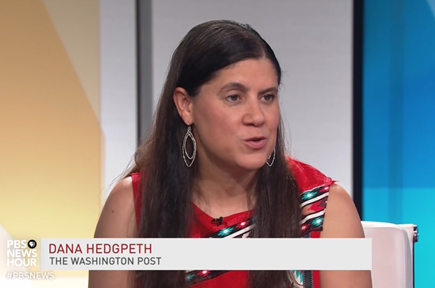
Above: The Post’s investigation resulted in a PBS NewsHour segment featuring reporter Dana Hedgpeth (above).
What makes sexual abuse in schools such a challenging topic to cover, despite the obvious importance and seriousness of the problem?
Sexual abuse, of course, is a difficult topic to cover in many aspects.
We were careful in interviewing elderly boarding school survivors to listen in a sensitive, empathetic and compassionate way as they shared their painful experiences. We spoke with them several times to establish trust, ensure they were mentally prepared and had support from their family and friends. Some of them had only spoken to a few people in their lives about the abuse.
In addition, we also spoke several times to watchdog groups and trauma experts who helped us understand how childhood abuse manifests itself for people often decades later. When publishing details of abuse, we took extreme care to balance the importance of sharing details of our reporting with readers so they understood the traumatic experiences of the children, while not overwhelming them with the graphic nature of our findings.
Practically speaking, what would be the best way for local or regional news teams to build off of your work?
Just as we did for our reporting, it may be helpful to reference the published reporting from Indian Country publications and other mainstream publications on Indian boarding schools.
In addition, news teams can focus on a particular school in a geographic area and examine records at several locations, including state historical societies.
One great resource is the digital archive operated by the National Native American Boarding School Healing Coalition. The U.S. National Archives also operates several offices across the country that contain records on Indian boarding schools.
For example, the National Archives in Fort Worth has boarding school records for many of the schools in Oklahoma.
The archives office in Denver has records from many boarding schools, including those in Montana. And Marquette University has boarding school documents from many of the Catholic-run schools.
Does your investigation have any connections with or lessons for education reporters covering present-day school sexual abuse?
Our investigation looked at a specific historical time period; we found lawsuits involving abuse in Indian boarding schools from within that timeframedgpeth hordgepgpeth e, the 1950s and 1960s, which were helpful sources of information. For present-day education reporters, there are a few ways into this reporting. One possible avenue might be to call law firms around the country that specialize in sexual abuse. If the schools are run by a religious organization, another resource is BishopAccountability.org, which collects information about abusive priests. Child USA, run by Marci Hamilton, is also a good resource.
Click the links to learn more about Hedgpeth and Horwitz.
Previously from The Grade
Is K-12’s #MeToo moment finally here — & will journalism help play a role?
How Bethany Barnes became a star education reporter
‘A gift’: John Woodrow Cox on covering school gun violence
Laura Meckler on de-tracking, school culture wars coverage, and ‘Monday-morning quarterbacking’