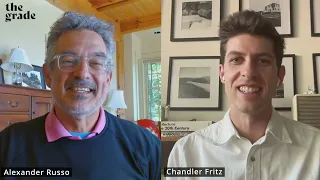
As Harper’s contributor Chandler Fritz explains, private school choice looks a lot different when takes readers inside the classroom and focuses on student experiences.
Early last week, I had the chance to talk with journalist Chandler Fritz, author of the new Harper Magazine’s cover story, The Homemade Scholar.
Like many others, Fritz started out focused on the wacky vendors who’ve flooded the unregulated ESA market in Arizona and elsewhere.
But his story ended up honing in on the much more common micro-school. “I realized actually just how small of a share these sort of oddballs were taking of the ESA pie,” he says.
What Fritz found was a set of intriguing tradeoffs: small classes, a curriculum full of holes, a near-complete lack of accountability — and seemingly happy kids.
He also came away from the experience with the idea that micro-schools aren’t as different from traditional schools as we may make them.
“This is still a publicly funded education system,” he says. “It is still ultimately our tax dollars being committed to educating students who aren’t our own kids.”
What’s really different is that micro-schools like this one seem to address what students want and need better than many traditional schools.
These kids may be “disappearing” from the perspective of traditional schooling (and district budgets) — and their academic needs may or may not be met — but in this one case at least, the students seem to be coming to life.
Fritz’s story is intriguing and his answers are thoughtful. Convinced or otherwise by his piece, journalists would do well to make more effort to bring readers inside ESA-funded endeavors and to feature students’ and parents’ experiences.
This discussion took place August 26, 2025. This automated transcript has been lightly edited.
Alexander / The Grade (00:02.745)
Hi, it’s Alexander with The Grade. This is the Education Show and I’m delighted to be here with Chandler Fritz, who wrote the cover story about micro-schools in Arizona that has everyone talking. Chandler, great to see you. Thanks so much for being here.
Chandler (00:17.614)
Thanks, Alexander. It’s really nice. I’m excited for the conversation.
Alexander / The Grade (00:22.255)
For folks who might not know you or the story yet, can you tell us a tiny bit about yourself and about the story?
Chandler (00:31.534)
Sure. I was born and raised in Phoenix, Arizona, in a suburb of Phoenix called Scottsdale, where I went to a variety of schools. My first school was a charter school and then I went into public schools and then I was a graduate of Arizona State. And the story is me going back to Arizona. I live in New York now and it’s about going back to explore Arizona’s voucher program, which is called Education Savings Accounts or ESAs. And this is a universal voucher. So that means that it’s available to anybody in the state. You don’t have to have a student with a disability or you don’t have to fit into a certain income bracket.
Anybody with a student K through 12 can opt into the program. And its big twist, or its kind of revolutionary aspect, is that the program is not merely a voucher to redeem at a list of schools, but is in effect cash in hand. The state will give you the money that it otherwise would have spent on educating your students at a public school and say, ‘Do with this as you will,’ more or less.
There are some guidelines, but there are shockingly few. And I had heard about [this], because I had been teaching in Arizona a couple years prior. I had heard about this program primarily through the lens of students and teachers who had what I [would] say “disappeared” into it because the state keeps no public record of what they learn or what they’re teaching in these schools that are reliant on the ESA money.
And so I wanted to find out what were they learning, and what were they teaching? Who were these students and teachers who had kind of disappeared into this voucher system? And so that’s what the story is about. It’s about me going back to Arizona and getting hired at what are called a micro-school — schools that are totally dependent on these voucher dollars — and teaching for a summer at this school. And, yeah, that’s the story.
I had heard about this program primarily through the lens of students and teachers who had what I [would] say “disappeared” into it.
Alexander / The Grade (02:42.465)
It’s a fascinating story. I see and read lots of stories on this topic. Sometimes I feel like the topic is over-covered, but I learned a lot from the piece that I hadn’t already known. Great thanks to you. One of the things I liked about the piece in particular was its — “neutrality”” is too bland a word — but even-handedness maybe. Its attempt to examine these schools from a variety of perspectives and it’s general avoidance of charged language.
A lot of stories that I read about private school choice have the feel of “sky is falling.” The language is very heavy. The one place actually that you, which you just cited, the one thing that you mentioned is this idea of kids “disappearing,” which has sort of a … disappearing kids is a scary thing to think about.
Thanks for reading Alexander Russo’s The Grade! This post is public so feel free to share it.
Can you say a little bit, if you don’t mind just jumping into language use issues, can you say a little bit about your efforts to explore this issue in a new and different way and maybe in particular to avoid or where to use weighted language?
Chandler (04:02.06)
It’s a great question, and I can start by thinking about that word disappear, because there was a lot of thought that went into it.
I think that the power of the story comes from what’s new, what’s genuinely new about this program. Vouchers have been around for a long time, for at least 30 years in their modern context, but people were calling for vouchers as early as the late 1800s. [There were] Catholic priests in New York who were arguing that tax dollars that they were giving over to the public school systems, the common school system, should rightfully be diverted back to their communities because their students’ interests were not being represented in the Protestants’ dominated schools in New York City.
So the voucher movement itself is certainly not new. What was very new was the idea of tax dollars being spent on student education and the state having no say in what those kids were learning. And really beyond that, having no idea what they were learning, that was the most surprising thing that had happened, more or less without that much media attention.
Now, of course, every state that’s had one of these voucher programs has been covered in great depth by local state newspaper reporters. But I felt there hadn’t been an effort by a national magazine writer to give the time and space necessary to understand what it means for our taxpayer dollars to go towards a program in which we don’t know what’s happening to the students. The director of the program from the state told me this in very plain language, which is, ‘We don’t know. We have no way of keeping a record of what the kids are learning.’
I felt there hadn’t been an effort by a national magazine writer to give the time and space necessary to understand what it means for our taxpayer dollars to go towards a program in which we don’t know what’s happening to the students.
So I thought “disappear” was the right word to use because for all public records purposes, as a reporter, certainly they disappear. The sort of tools that I would ordinarily use to report an education story, like student directory information, which I can get through a public records request, just wouldn’t show up because there would be no attendance records reported. There would be no grades reported and so on and so forth. So yeah, that was the choice to use the strong word there.
I think in other [parts of the story] I wanted to have a neutral and balanced perspective because I was reporting as a teacher. That was the hardest thing to try to balance in the story was my responsibility as a journalist to tell the truth of what I saw and then my responsibility as a teacher to the students — because I wasn’t a fake teacher. I was a real teacher while I was there, and in fact, it actually became quite easy to be neutral because you just care for the students as a teacher. And so it was easy for me to write, I hope, with compassion about the kids because I really felt that towards them.
The hardest thing about this Alexander was that this school [where] I was teaching had massive curriculum flaws. I mean, absolutely things that make your hair curl — for me at least, what they’re teaching the students in terms of their reading strategies and basic science and mathematics.
But the kids were genuinely happy. And that was difficult to try to figure out: how to talk plainly about student happiness, which is hard to find in a lot of schools today.
This school [where] I was teaching had massive curriculum flaws… But the kids were genuinely happy.
Alexander / The Grade (07:42.703)
And so important. I think of it, and again, it’s your story and you did so many valuable things here. It’s a very minor point, but I think the story is about kids appearing, right? From the system’s point of view, these kids are disappearing from the school district’s point of view. They’re obviously all sorts of, but so much of what I read and so much of what I frankly rail against — this is not your responsibility at all — is against journalism that takes the perspective of the school system rather than the kids. What you were describing, which was so delightful, not only were you taking us inside a micro school, which I hadn’t been taken inside of before, but you were also showing us these kids flourishing in some ways — kids who obviously had been underserved or mis-served by the schools that they’d attended, according to them or according to their parents.
Chandler (08:17.87)
Mm-hmm.
Alexander / The Grade (08:41.549)
So let’s save the rest of this for now. I get what you’re saying and I appreciate the care you put into it. I wanted to ask you about your own experiences in school. I think that so many of us who write about schools had really ridiculously positive experiences in school. Sometimes it gets in the way of writing about schools, the backgrounds that education journalists have had. You, I think, have had a slightly different experience of school than the average bear, and I was curious about what you were like in school, whether you liked it or not and also you allude to your miserable experiences teaching in schools as well. Tell us a little bit about that?
Chandler (09:25.166)
Yeah, I’m similar. It’s actually nice to hear that about other education writers. I didn’t love school [at first]. I ended up loving school. I had an interesting relationship with the public schools that I grew up in. I started at a charter school and moved into a public school for middle school and high school. And this was in Arizona. These were large schools, not small schools. My graduating class in high school was 600-something students. So quite large.
My kind of obtuse angle towards school growing up, which I allude to in the piece, is that I was raised in a Christian family — an evangelical family — and often felt a responsibility to share that with my peers at school. And that wasn’t a pressure that was heavily put on me in the way that certain children missionaries have that pressure on them. But it was part of who I was. As I got older and [we] were taking biology classes and taking geology classes, it would show up in the way that I would respond to questions. And one of the things I cite in the piece is about wanting to read the Bible during free reading time as a little kid, and a teacher telling me I couldn’t do that. And that being sort of the first friction I felt about my identity in a public school.
But no, beyond that, I had actually really very positive experiences as a student. And that was a pressure that’s sort of an undertow in the piece is that I liked public school. I had no personal resentment against the system that educated me. I thought it educated me brilliantly. So I was not one of those kids that were desperate for an alternative at all.
I liked public school. I had no personal resentment against the system that educated me.
My teaching experience is a little bit different. I taught in a charter school, a low income charter school in Phoenix, in the West Valley of Phoenix called Maryville Prep. I taught in a fancy private school here in New York for a couple of years. I taught in the prison system in Arizona, the juvenile prison and the adult prison as well. And I bring it up in the piece, but one of the things that was troubling to me as a teacher was the administrative pressures for not only what I could teach, but how I could teach and, and the paperwork involved in that being very tedious.
This is not a new complaint. I know teachers have been complaining about this sort of thing for a very long time, but I think that we’re at a nexus of both a lot of administrative funding, meaning that there can be kind of a lot of administrative [meddling] in teachers’ lives. And then also we’re at a crisis in students’ mental health, which means that students come kind of freighted with a lot of needs and a lot of what we would call accommodations.
Those things don’t disappear in a micro school at all. You’re still dealing with students and parents and, you know, a boss. But it’s the scale of them that is so much more human that was actually quite attractive to me about going into this, you know, disappearing into this system along with these students and teachers.
I wanted to know both from n the perspective of students, is this serving them well? But I was also undeniably curious as a teacher, you know, would this make life better? And in many ways it did. You know, it really was, it was like a traditional schoolhouse where you just have your one room with your kids. There’s eight of them and
you can give that individualized support, which all teachers know is really what every student needs to flourish, is that kind of one-on-one attention. And yeah, so there are attractive things to this program, for sure.
I was also undeniably curious as a teacher, would this make life better? And in many ways it did.
Alexander / The Grade (13:32.527)
Well, one of the things you raise is the possibility that micro schools could be a boon for teacher satisfaction. This is yet another thing about the piece that I hadn’t seen or frankly even thought about, whether it’s a financial boon or a boon in terms of relationships or meaningful classroom experiences. That was another angle that I hadn’t seen — fascinating to think about and important for all of us to think about. It isn’t just — it may not just be that some students are mis-served by the schools that are available to them. It may be that they’re teachers as well.
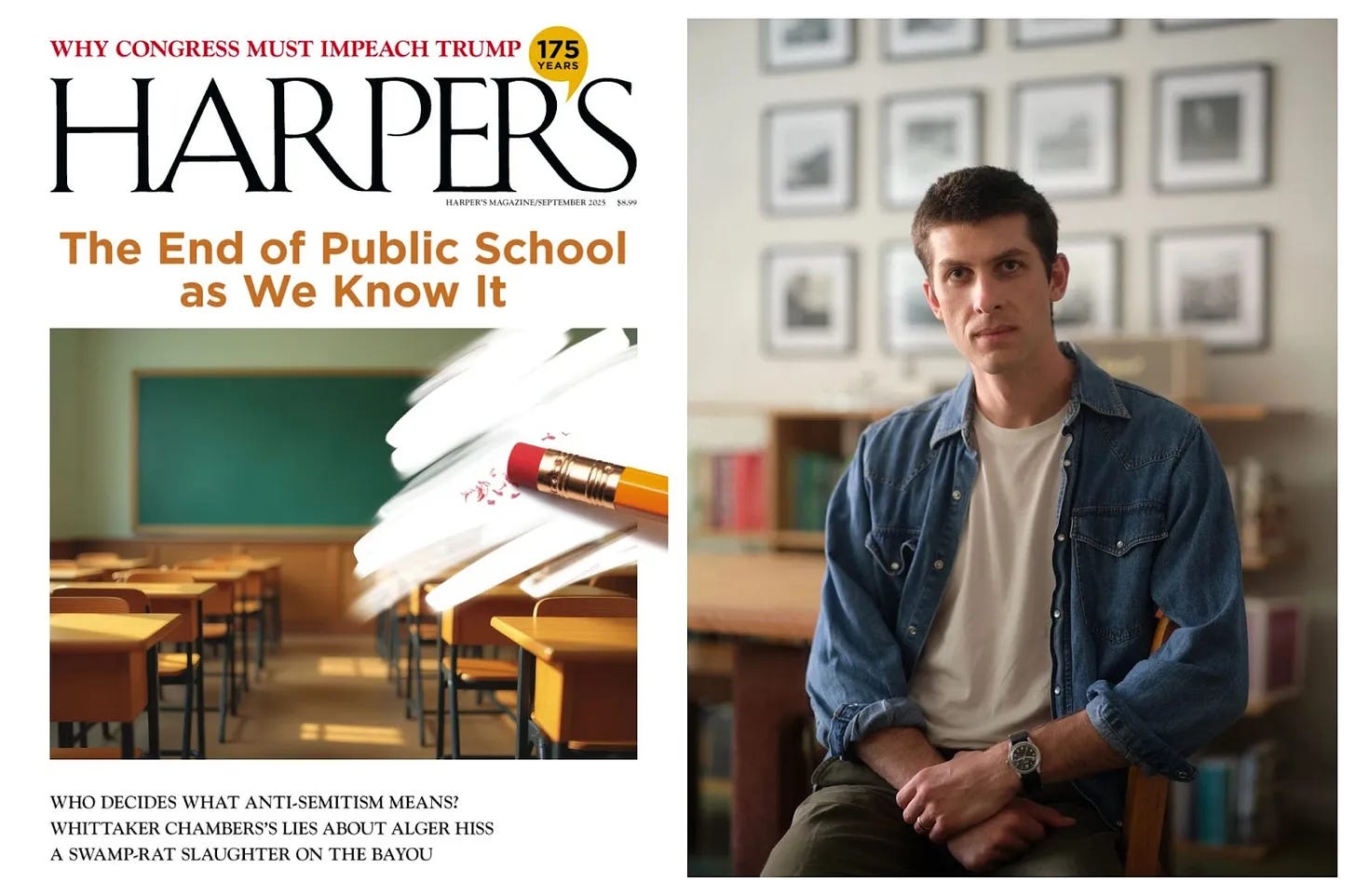
Can I jump in? No, no, I’m gonna jump around for the sake of time. I could keep you for hours, but I promised to not do so. What’s the response been to the piece so far? You published it in Harper’s. It’s not in The Free Press. You published it in Harper’s. There’s this sort of gloom and doom cover headline, “the end of public schools” or something like that. But the piece itself is much more nuanced and muted. What’s the response been as far as you can tell so far?
Chandler (14:51.5)
Yeah, the cover [copy reads] “The End of Public School As We Know It,” which is nice. There is kind of a teasing allusion there that the piece is not going to be total gloom and doom. The response, it’s early days. It’s been positive so far. I’ve been really pleased to hear from teachers. That’s been what’s most heartwarming because that’s ultimately, I think, who I’m writing for. I mean, the piece is for anybody who’s interested in education, but as a former teacher, that really makes me happy to hear teachers from public schools and from charter schools and from private Christian schools and from — I had a mom who homeschooled her students — reach out and express sympathy for my desire to put students first and foremost in education. So yeah, that’s been the response. I know letters to the editor are gonna come in with sharp criticisms of the piece and I look forward to that and to hopefully rebutting those. But yeah, I think it’s been positive. I know it’s been positive.
Alexander / The Grade (16:06.403)
Right. Well, it’s a busy time of year. There’s a lot of education coverage out there. I hope it continues to get thorough airing. And there will be some people who will be very upset about it, either by the publication or by the contents of the piece. But we need to talk and think about these things. It’s an important topic.
I wanted to ask you, speaking of the publication you ended up going with, I wanted to ask you a little bit about the reporting, access, permission, and also how you ended up at Harper’s rather than, I kept thinking, I printed it out on paper without, you know, just without any formatting and I kept thinking, I had to remind myself that it was a Harper’s piece, not a Free Press piece or something else. How did you end up at Harper’s and how did you get access to and permission to do what you did?
Chandler (17:09.426)
I started reporting this piece two summers ago. I had initially thought, okay, what I’ll do is I’ll find the wackiest, they call themselves “vendors” [in the ESA system]. (To sign up to receive these ESA dollars from families, you have to register yourself as a vendor on the Department of Education’s proxy website.) You know, that sounds like it would take a lot of work. It doesn’t. It took me, I think in the piece, I said 18 minutes to do it.
That’s one of the big concerns about the problem is that you don’t have to undergo any fingerprint
clearance test, which is shocking. I mean this is to register yourself as somebody who can work with K through 12 students. So anyways, I had thought well, you know, this is the Wild West of Education. That’s a motif that comes up in the piece There must be some total oddballs out there teaching kids. And so I thought, well, it’d be great to go and do a whole piece in which I survey kind of the wacko landscape that this program has brought into reality.
And the piece covers some of this because those experiences were eye-opening in many ways. I audited a therapy session with a pornography addiction consultant. I audited a financial management class that was basically just for parents to learn how to get rich quick. I audited a teacher who posed as a nutrition expert, but was really just peddling a multi-level marketing product to her students and families.
That was all before I had the commission for the piece. That was what we would call pre-reporting. [After doing that pre-reporting,] I realized actually just how small of a share these sort of oddballs were taking of the ESA pie. You know, these were all really outliers in the system and the real story was about these micro-schools, which are blowing up. I mean, they’re the fastest growing form of education in America, I believe. And so at that point, I thought I would spend the amount of time required to report this correctly, which would be at least a couple of months working for one of these schools. And so that’s when I knew I needed some, I needed a commission.
I realized actually just how small of a share these sort of oddballs were taking of the ESA pie.
So I pitched the story around to all the major magazines you would see at the library, and Harper’s is where I wanted it to go because Harper’s has the deepest and richest tradition of this sort of reporting— we call it submersion journalism—of going out and living that story. That’s what Harper’s has done for 170 plus years. And I had been an intern there. This is also key to know. I had been an intern two summers ago and that really changed my life. I was teaching at that point. I was actually teaching while I was an intern, teaching third grade. And so I had a relationship with an editor there and he was generous enough to — Charlie Lee is his name — he was generous enough to take a chance on the piece. And yeah, that’s how it wound up there. I will say nobody else responded. So I’m really grateful for them.
Alexander / The Grade (20:21.005)
Well, I’m grateful as well. How did you get access to the school, assuming people knew that you were going to be writing a piece about them?
Chandler (20:30.838)
Yeah, great question. I had visited this school during my pre-reporting of just kind of a survey of what was out there. I was interested in the school in particular because it’s in the far western suburb of Phoenix, but it’s not rural or remote necessarily. It’s actually sandwiched between two large public schools. So it wasn’t the case that this was the only option for students. So that made me know the families are actively making this choice to enroll their student there.
And it’s also in an area that is, well, it’s not high-income. It’s certainly mixed-income, but the student body I ended up teaching were all, if not working-class, solidly middle-class students. A big part of the story around these programs is that they’re just serving the rich. They’re serving kids who are already enrolled in fancy private schools. So I was attracted to the school for those reasons.
I had gone and visited them, told them I was a writer. I was just interested in learning more about this program. And after I got the commission from Harper’s, I reached back out and said, I’m actually coming back to Arizona to work as a vendor over the summer. Do you have any students who would like to take a class with me? And so that was how I got my group of students and they provided me with the space and then they ended up, you know, the school is a huge part of the story — is the central part of the story — so I was very grateful for them to take a chance and let me, more or less a stranger, come to teach their kids.
Alexander / The Grade (22:01.865)
I’m always curious about what sources think about stories after they see their depictions. Occasionally, I’ve even gone to sources and said, “Hey, how did you feel about how you were depicted?” I won’t do that here, but I’m curious, what do the teachers and parents and kids have to say so far about how they’re depicted in the context of the story?
Chandler (22:28.054)
I just heard from them yesterday. I was kind of waiting trepidatiously to hear their response and they were very sweet. They were excited for me. They knew how long I had worked on it. They were excited to see that it had come out. And I think they were flattered. I think they saw the best of themselves. Maybe they’re just being nice to me. But from the wording of their response, they said they were quite pleased to be depicted as a school which is in the words of the piece on the brink of history — you know, whether that’s a history that leads us in the right direction or the wrong direction is to be determined. But they were pleased to be thought of as a school that’s kind of on the cutting edge, which they are. I mean, this is something new.
Alexander / The Grade (23:17.889)
I’m so glad that you ended up not writing the story as you originally conceived it, because frankly, I’ve seen and read lots of stories about wacky vendors and fraud. And that is sort of a dominant storyline out there and maybe an over-reported one. I’m curious about what, if anything else you found in reporting the story that maybe was different than those of us who’ve read lots of private school choice stories might understand? Some of the numbers you came up with, some of the context you gave just seemed very different from what I’ve read in other places. Were there any other key points of context that you think are important counter-narratives?
Chandler (24:06.798)
Yeah, I’ll say I think the most important one is I asked the students themselves what type of school they would choose if they could. And I had done it in a more or less clandestine way. I had given them a quiz at the end of the semester. Sometimes parents would be sitting in the room with us during discussion, so I knew to have a verbal discussion about it, they would feel kind of a pressure to answer one way or the other from whatever other adults were in the room. And so I had just embedded it in a short answer quiz that I gave them at the end.
Those responses are all in the piece. You can see them at the end verbatim. And the majority of the students said if they could, they would choose a school like this one, the one that they’re in. And each of them gave their own unique reasons for that. And that’s what I hope is one of the big takeaways of the piece is that for those of us who are advocates for public education — I have to make that clear first and foremost:this is still a publicly funded education system. It’s just one that looks very different from what we’ve had before. But it is still ultimately our tax dollars being committed to educating students who aren’t our own kids. I think that any consideration of what a public education should look like should take into consideration what students want and what students need.
And it’s a strong case to be made that based off this very small sample size from my piece, but also from hearing from other teachers and other education thinkers, that kids do need smaller classes. Kids do need more individual attention paid to them at school. They need spaces that are very easily freed from technology and from cellphones. These are kind of basic needs for kids. And that was something that can be met in a system that funds education like this. Now, whether or not their academic needs, their reading and writing and basic arithmetic needs can be met effectively in that system remains to be seen.
Whether or not their academic needs… can be met effectively in that system remains to be seen.
But those sort of slightly more intangible student needs, those are the things I was surprised to see were being met in the microschool in ways that were more effective than what I’ve seen in the large public charter and private schools I’ve worked in. I don’t know if that answers your question totally, but I would say student responses. That was the most surprising thing to me. I knew I‘d hear a lot from the parents and the teachers and certainly from politicians I spoke to, but it was really cool to hear from the kids themselves about what they felt they needed. I think those are important things. We should listen to the students. That’s what Emerson says for teachers. “Respect the child. Be not too much his parent.” Every parent and teacher who wants to get involved in the system should have that quote posted up somewhere because we can very easily become too much a parent of a student and think we know best.
Alexander / The Grade (27:23.446)
It’s also super appropriate for journalists. I’m always amazed at how infrequently parents and students are given voice in stories about education. It’s something that I’ve written about or commissioned pieces about for years now. There’s an incredible ability to write these stories without actually asking the direct questions that you ask. I think that other kids in other places might answer differently. And certainly there are some non-traditional, non-accredited schools that have turned out to not do very well for kids. But there are also tons of accredited places that haven’t agreed either.
Chandler (28:05.836)
Yeah, yeah, that’s an understatement for sure.
Alexander / The Grade (28:09.327)
I wanted to wrap up with two things. One is I wanted to ask you, I wanted to share my favorite line from the piece, if you don’t mind. And I also wanted to ask you what line or moment every writer has a favorite, either something that they fought to get or fought to keep in the story. I liked so many things about this piece, but in the end, it was the conclusion. “Public education doesn’t have to die when we admit that one size does not fit all. It dies when prejudice and greed contrived to predetermine a student’s future.” That’s my favorite line. What was your favorite line or detail in the piece if you don’t mind sharing?
Chandler (28:56.558)
Thank you for reading your favorite line. That’s very sweet. I think when I’m describing a student, I call him Aaron in the piece. He’s a boy who is dyslexic and who learns best with his hands. And I kind of set him up as a student that I think most teachers will recognize, which is the type of kid who has been an enigma to us for so long. You know, how do we get this kid to sit still or to buy into our lesson plans in big classrooms and traditional kind of school structures? At least this student has always been an enigma to me. And I describe how at this school, he has free rein over the little workshop that they have, which is really just that. It’s like any kind of suburban garage tool shed workspace where there’s a whole host of power tools, most of them definitely not safe to be used unsupervised, but he’s allowed to use unsupervised.
And he took me in there one time after he had been having kind of a hard day during our lesson, just beating up on himself. You know, he has a hard time reading. He has a hard time articulating his thoughts on literature. So I asked him to show me around in the workshop.I was watching him just move through that space and touch tools almost as a [grounding] mechanism for himself. And the line in the piece is, “Physically, the boy came alive touching tools.” And I was really happy we got to keep that, the syntax of that sentence, because I wanted to make very vivid what it was like to see a student who, for so long, as you say, had kind of disappeared in classrooms, suddenly appear. And for that moment, he was suddenly appearing to me as a student.
And that was totally contingent on him having that space in a school where he could kind of come alive and be himself. Every school can have that. It doesn’t just have to be a micro school. But it’s too bad that for, it feels like at least for as long as I’ve been teaching, which isn’t that long, but for the last 10 years, it’s been harder and harder for kids like that to find spaces in schools where they can physically come alive.
Alexander / The Grade (31:23.661)
That’s a great observation and a great place for us to end. Chandler Fritz, it’s so nice to meet you and talk a little bit about your story in Harper’s Magazine. Thanks so much for coming and talking.
Chandler (31:36.802)
Thanks Alexander, I really appreciate being invited on. I hope people get to see the piece.
Alexander / The Grade (31:42.317)
I hope so too.
Previously from The Grade
The Story Behind Washington DC’s School Truancy Crisis
“At the beginning, we were told that truancy became this huge problem for middle schoolers after the pandemic,” says the Washington Post’s Robert Samuels. “But when we did the research, what we had found was that that problem had started long before.”
A Q & A with George Packer, the author of that contentious Atlantic magazine essay
Staff writer George Packer responds to critics of his controversial essay about education in Brooklyn.
‘We could have been a lot louder,’ says NPR’s Anya Kamenetz
Pandemic education coverage failed to capture the losses vulnerable kids and working-class families were experiencing, says NPR’s K-12 education correspondent.
Widening the lens: What makes Casey Parks’ HBCU story so good
Journalist Casey Parks turned a familiar topic into a compelling narrative by reporting deeply and avoiding the temptation to reduce education characters to archetypes.
From cheating scandals to broken schools, how New Yorker writer Rachel Aviv tells education stories
Aviv discusses how she reports her education stories, the similarities between education journalism and criminal justice, and her desire to tell stories from different perspectives.
Dreier describes what it was like to report on a teenager in such a vulnerable position, what education journalists might learn from her experience — and how the luxury of time and her own persistent reporting reversed her initial assumptions about the school’s culpability for Henry’s fate.