📌 Note: Welcome back! Hope you had a good winter break. This week’s edition includes some items going back into December. 📌
In this week’s newsletter: New York joins the effort to revamp literacy programs. Migrant students challenge schools — and boost their enrollment. Colorado schools adjust to help absent kids feel more comfortable returning to school. The Washington Post dismantles its education team. And Harvard student journalists lead the way covering the resignation of Claudine Gay.
NY JOINS LITERACY BANDWAGON
The big story of the week
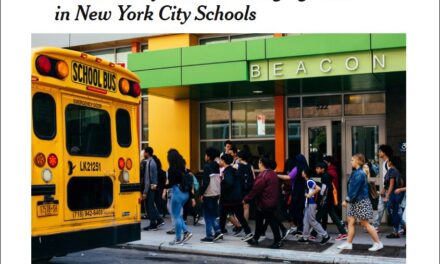
The big education story of the week is the announcement that New York state is joining an estimated 30 other states in attempting to revamp its literacy instruction and help more kids learn to read.
New York’s announcement follows the launch of initiatives in several other states and districts, including New York City. However, New York will not mandate use of specific programs — and it gives districts until 2025 to make the change. What’s more, this week’s announcement from New York Gov. Kathy Hochul requires legislative approval (NYT, Chalkbeat, Politico, NY1, AP, Buffalo News, Newsday, New York Daily News, New York Post).
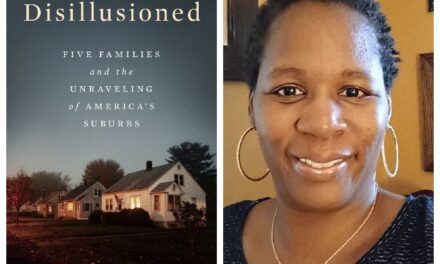
While literacy reform efforts appear to be picking up steam, implementation remains uncertain. Some states like Connecticut have pushed back their timelines and dealt with district waiver requests (CT Insider). Other states have faced district lawsuits (Cleveland.com). And a number of states including Massachusetts have yet to take action (Boston Globe).
Promised yourself you’d get up to speed on the science of reading in 2024? We published a look back at the best literacy coverage since “Sold a Story” came out just over a year ago, thanks to Karen Vaites. And the NYT and EdWeek have helpful new explainers.
Other big education stories of the week:
📰 BUDGET TROUBLES: As ESSER funds run out this year and enrollments continue to decline, many districts are under the gun financially and making tough decisions. The board for Jackson Public Schools in Mississippi voted to close 13 schools in response to losing about a third of its student population since the 2015-16 school year (Mississippi Today). In Baltimore, a principal took what some see as a heroic action in advocating for a school merger to help her students (Baltimore Banner). San Francisco public schools face a $420 million deficit in 2025-26, threatening 10% of jobs in the district (San Francisco Chronicle). And Boston could close up to half its schools under a new district plan (Boston Globe).
📰 MIGRANT STUDENTS: As migrants continue to flood into cities like New York and Chicago (Wall Street Journal), schools are seeing the impact. The good news is that these students are helping some districts stave off enrollment declines (Boston Globe). The bad news is that many schools are struggling to serve them well — and get the funding they need to do it (CBS News, ABC 7 Buffalo). Complicating the matter for students and families is their often uncertain living conditions, which lead to moves in and out of different districts and schools (Boston Globe, NY1). Migrant students are going to be a big issue for schools in 2024, as indicated from the surge of coverage and the number of times the topic comes up in various outlet’s year-ahead previews (Chalkbeat, EdWeek, Boston Globe).
📰 COPS IN, COPS OUT: Starting next fall, police officers may be out of all Chicago public schools under a new proposal that would remove the deciding power from Local School Councils (WBEZ). Meanwhile in Kentucky, it’s been a year since the law required every school to have at least one police officer, yet more than 40% of schools still don’t have one, in part due to a lack of funding, superintendents say (WKYT).

STUDENTS EXPLAIN CHRONIC ABSENTEEISM
The best education journalism of the week
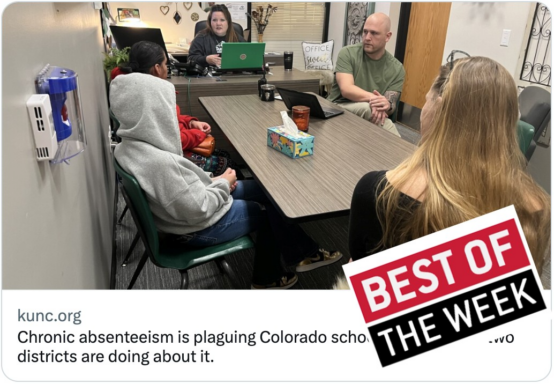
The best education story of the week is Chronic absenteeism is plaguing Colorado schools. Here’s what two districts are doing about it., by Leigh Paterson for Northern Colorado’s KUNC radio.
Paterson’s piece humanizes the issue of chronic absenteeism in Colorado by embedding with teenagers and the counselors tasked with improving their attendance, producing a radio piece that lets students explain what’s keeping them from showing up.
The opening scene, where we hear from a tearful 16-year-old who feels she doesn’t belong in the school, is especially moving. Her mom says she’s being teased and bullied. The options that the school can provide are few — allowing the student to leave early and avoid other kids in the hallway, an alternative place to eat lunch, a favorite snack. The student doesn’t immediately return, but shows up a few days later.
It’s a great piece of storytelling, pulling readers into the room with the student, her mother, and the school staff trying to help.
Other great education stories this week — and why we liked them:
👏 A break room where students can jump on a trampoline, play catch, or practice breathing exercises has made a huge dent in behavioral mishaps at a Minneapolis elementary school, reports Mara Klecker in this solutions-focused story that features student voices and in-school images (Star Tribune).
👏 Possibly the most level-headed report yet on school cell phone bans, this piece from Alia Wong and Nirvi Shah combines nuanced case studies, student opinions, historical trends, and research findings to explain the renewed surge in schools’ attempts to limit distractions and student behavior problems in places like Flint, Michigan. (USA Today). See also this Seattle Times piece about one district policy in particular.
👏 Carolyn Jones foregrounds student and educator voices to show how a majority-Black California district bucked the statewide trend of stagnant test scores by hiring Black teachers, revising its grading system, and offering more after school tutoring (CalMatters).
👏 In a story that both prioritizes families and holds district officials to account, Bianca Vázquez Toness documents how inadequate health care, disconnected cell service, and burdensome paperwork required by Atlanta Public Schools have kept some students out of school for years (AP). See also Donna St. George’s recent story about harsh treatment of parents by districts (Washington Post).
👏 Niki Griswold’s profile of a Ukrainian family searching for stability in Massachusetts schools is both comprehensive and economical, using just over 1,000 words to narrate the family’s escape to the U.S. and its struggle against one school system’s inflexible residency requirements (Boston Globe).

Above: Reporter Jessica Votipka.
A REPORTER CONFRONTS A SCHOOL BULLY
Our latest columns and commentary
Bullied as a child, reporter Jessica Votipka found herself covering student bullying as a reporter and then facing a tough decision about whether she should intervene in a bullying incident she witnessed during a school reporting visit.
“A thing you should take from this excellent first-person piece is that students were willing to repeatedly bully a classmate in front of a reporter,” notes The 74’s Beth Hawkins, who points to research showing that failure by adults to speak up against student bullying is a major issue.
ICYMI: We looked back at the 10 best pieces The Grade published last year, including a profile of a much-admired radio reporter, reporters’ reflections on covering a prolonged teachers strike, and an interview with an ed team editor about (among other things) making education news “more useful” to readers. Check them out here.

Above, clockwise from top left: The Washington Post’s Hannah Natanson, the AP’s Bianca Vázquez Toness, LAist’s Nereida Moreno, and Chalkbeat’s Kalyn Belsha are among those who authored the seven most memorable education stories of 2023, according to us.
PEOPLE, JOBS
Who’s going where and doing what
🔥 Washington Post shake-up: The education team at the Washington Post was hit hard in the recent round of buyouts: Top education editor Adam Kushner is headed to the New York Times to be deputy editor of The Morning newsletter. National education reporter Donna St. George Donna St. George, education reporter/columnist Valerie Strauss, and higher ed reporter Nick Anderson are also leaving. In the last six months, reporter Moriah Balingit and deputy education editor Janel Davis have also left (to the Associated Press and the Atlanta Journal-Constitution, respectively). While it’s sad to see so many good folks leaving, perhaps the change creates room for a rethink of the Post’s excessive focus on school culture wars coverage. The Post PR folks say the paper remains committed to education coverage, but they’ve not yet confirmed whether remaining ed reporters will operate as a team (or be reassigned to national and local desks).
🔥 More career moves: Inside Higher Ed has hired Sara Custer of Times Higher Education to be its first editor-in-chief. Carly Lanich is returning to the education beat at the Mirror Indy. And The 74 has added a new reporter to its staff: Amanda Geduld, previously of The Miami Herald. In a column for The Grade last year, contributor David C. Bloomfield praised Geduld for her investigation into “NX” grades in NYC schools.
🔥 Recognition: It’s great to see the California newcomer Spotlight Schools, launched in 2021, in the New York Times’ roundup of Local Journalism Worth Reading From 2023 for their story on hate incidents in Orange County schools. Chalkbeat New York was also included for its reporting on NYC’s literacy instruction overhaul. On X, Local Matters’ founder Joseph Cranney listed impressive investigative journalism from local newsrooms in every state, including some investigations on seclusion and restraint in schools. EWA Radio’s most popular interviews of the year include The Grade contributor Jessica Votipka and several others. And Poynter recognized the groundbreaking work by The Daily Northwestern on allegations of hazing in the football program as the best student journalism of the year — and also “among the best journalism of the year. Period.”
🔥 Job openings: The Baltimore Banner is hiring an early education reporter. WUNC public radio is looking for a race, class, and communities reporter, which might be a great position from which to cover schools. And New York Focus is still looking for an education reporter to cover statewide issues.

Above: “Only 17 states and Washington, D.C., require districts to disclose information to prospective employers about an allegation, investigation, resignation, or termination related to teacher sexual misconduct,” according to new reporting from Business Insider.
APPEARANCES, EVENTS, & NEW RESOURCES
What’s happening and new research
⏰ Join the list: Mirroring a similar move from APM Reports’ Emily Hanford to amplify local coverage, Business Insider reporter Matt Drange is inviting folks interested in following up on his investigation into sexual predators in schools (see above) to join a group of reporters we’re told already numbers 50. It’s not too late!
⏰ Appearances & segments: In December, “This American Life” aired an education-related episode about three migrant students navigating middle school. WBUR Here & Now had a segment on the shortage of Head Start teachers. USA Today’s Alia Wong was on the outlet’s podcast “The Excerpt” digging into school cell phone bans. Boston higher ed reporters Kirk Carapezza (GBH) and Hilary Burns (Boston Globe) were on Boston Public Radio talking about the resignation of Harvard president Claudine Gay. And the Hechinger Report’s Jill Barshay was on KMOX’s “Total Information A.M.” discussing the worldwide deterioration in math scores.
⏰ Movies & documentaries: The LA Times and the New York Times both reviewed the German drama and Oscar contender “The Teachers’ Lounge,” with the latter review declaring, “Misinformation flies around, helped along by slanted journalism.” And Soledad O’Brien has a new CBS News documentary with the Hechinger Report out on the end of affirmative action.
⏰ Events: Planning for the year? Check out the Getting Smart list of “can’t miss” education conferences in 2024, including SXSW EDU.
⏰ Research: The Washington Post looked at what happens after a book is challenged, finding that half of them return to schools. New research shows that character, attitude, or the lack of a “growth mindset” have little impact on disadvantaged children’s struggles at school.
⏰ Journalism resources: The organization Trusting News created a checklist to help journalists depolarize their stories — a good idea for school culture wars coverage. In a Pew Research Center survey, 39% of Black Americans said they “extremely or fairly often see or hear news coverage about Black people that is racist or racially insensitive.” In case you missed it in November, Imaginable Futures broke down three ways journalism can spur change in early childhood education, featuring work from the Hechinger Report and EdSurge as examples. And check out this Poynter piece about interviewing vulnerable sources, with a list of advice at the end that could be useful for journalists interviewing students.
THE KICKER

“This is *student* journalism,” tweeted Cara Chang, president of The Harvard Crimson. “A steady stream of news — including the breaker of Pres. Gay’s resignation ahead of professional outlets — and 9 (!!) opinion pieces in 1 day.”
That’s all, folks. Thanks for reading!
Reply to this email to send us questions, comments or tips. Know someone else who should be reading Best of the Week? Send them this link to sign up.
Using Feedly or FlipBoard or any other kind of news reader? You can subscribe to The Grade’s “feed” by plugging in this web address: http://www.kappanonline.org/category/the-grade/feed/.
Read more about The Grade here. You can read all the back issues of The Grade’s newsletter, Best of the Week, here.
By Alexander Russo with additional writing from Colleen Connolly and Will Callan.
ABOUT THE AUTHOR

The Grade
Launched in 2015, The Grade is a journalist-run effort to encourage high-quality coverage of K-12 education issues.