Years ago, I attended a discussion group for local educators. The goal was to understand what challenges they were facing and what our organization could do to help them. Almost everyone in the room talked about the influx of non-English-speaking students into their schools. They wanted to help the students learn, but they were overwhelmed and didn’t know what to do.
These educators may have been using a deficit lens that sees newcomer students as a problem to solve. But they also were caught in the maelstrom of competing ideas about how to educate students who don’t speak the school’s primary language. In the May 1998 Kappan, Richard Rothstein explored the complexity of the issue and noted that the question had become so politicized that it was difficult for educators to know and do what was best for their students. (See the summary of his article on p. 5 of this issue.)
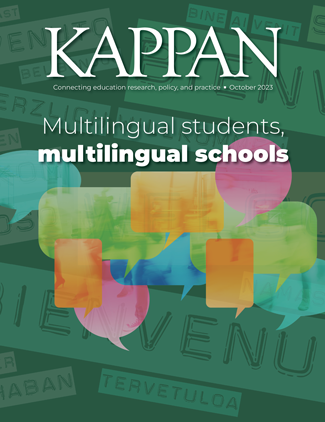
We see the fallout of that politicization in the article by Jennifer Altavilla-Giordano and Emily Blitz in this month’s Kappan. In Massachusetts, sheltered English immersion (SEI) is the law of the land, meaning that most instruction must be in English. Teachers must be trained in that model, even if experts have come to favor approaches using students’ home languages. The authors describe how they have experimented with their own reimagined SEI course that encourages teacher educators to work within the existing model while also recognizing its potential flaws.
Mina Hernandez Garcia, Mary J. Schleppegrell, Hasna Sobh, and Chauncey Monte-Sano present a picture of what happens when students learn in any language, all within a single classroom. The idea behind this translanguaging approach is not to prevent kids from learning English but to allow them to learn other content while they’re learning English. Newcomers to the U.S. don’t have to put all other learning on hold until they’re able to speak English. The authors show how students can learn with and from each other in a way that makes newcomers part of the school community right away. The classroom becomes a place of learning not just content, but also language and culture.
Pauline Phi Nguyên Đong’s description of the Vietnamese Language Program at Westminster High School in California shows us another reason to value students’ home languages — they help students stay connected to their elders and their communities. She shares how one student, Tâm, became fluent in English at a young age, but didn’t build skills in Vietnamese. Having Vietnamese classes in school helped him bridge the language and culture gap.
Ideally, schools should be a place for building bridges. These bridges connect students to each other, to their local communities, and to the wider world. Language, too, can be a bridge. Building one bridge should not come at the expense of another. If English learning comes at the expense of the Vietnamese, Arabic, Spanish, Navajo, or any other language students bring with them to the classroom, that is a real loss for the students, their communities, and all of us. Let’s build bridges and maintain them.
At the same time, we must acknowledge that bridge building is complicated work. Teachers need tools and support to create classrooms where all languages are welcome. The teachers I met who were so distressed about the newcomer students in their schools were distressed because they didn’t have the knowledge or resources to help their students. Supporting teachers like them will ultimately help all students, no matter where they’re from, to become bridge users, bridge builders, and bridge maintainers.
ABOUT THE AUTHOR

Teresa Preston
Teresa Preston is an editorial consultant and the former editor-in-chief of Phi Delta Kappan and director of publications for PDK International, Arlington, VA.
Visit their website at: https://prestoneditorial.com/