
The required sheltered English immersion endorsement has become just another item preservice teachers in Massachusetts have to check off for licensure. How can it be made more up-to-date and engaging?
Numerous models exist to support designated English learners (ELs) in U.S. schools. One of the most common is sheltered English immersion (SEI), in which instruction is primarily in English, using the students’ home language(s) only when necessary. This is in contrast to such models as transitional bilingual education and dual-language education, in which home-language instruction is a core component of content-area learning.
In Massachusetts, SEI is by far the most common model for educating English learners (ELs). Indeed, as of 2021, 90% of designated ELs in Massachusetts are educated through SEI (Balter, 2022). This came about because a 2002 Massachusetts ballot measure instituted English-only education through SEI as the primary instructional model for designated ELs, defined as multilingual students who, based primarily on standardized test scores of English proficiency, have been deemed to require language services to access grade-level curriculum (Massachusetts Department of Elementary and Secondary Education, 2022). Arguing that bilingual education programs were responsible for the “low English literacy levels” of multilingual students, the law stated that “all children in Massachusetts public schools shall be taught English as rapidly and effectively as possible” using only “a minimal amount of the child’s native language when necessary” (Mass. Acts 386, 2002).
After the referendum passed, the state began offering optional professional development to general education teachers interested in learning more about strategies for “sheltering” materials and instruction for designated English learners and for teaching language through academic content. Then, in 2011, the U.S. Department of Justice informed Massachusetts that it was violating the Equal Educational Opportunities Act by not mandating training for all teachers and administrators working with designated ELs (U.S. Department of Justice, 2011). In response, lawmakers established the Rethinking Equity and Teaching for English Language Learners (RETELL) initiative. A requirement that all general education teachers who teach ELs receive an SEI endorsement course is the cornerstone of that project.
Since July 2014, new teachers applying for their initial license in Massachusetts have been required to earn an SEI endorsement. The intent of this endorsement is to provide elementary and secondary teachers, early childhood educators, reading specialists, and special education teachers with the skills and knowledge to effectively support designated ELs to learn English through academic content. Massachusetts is one of 28 states to legally mandate EL-specific training for all teachers beyond what is required by federal law and one of only six states to authorize the SEI model under state statute (Rafa et al., 2020).

The problems with the SEI endorsement course
Today, many teacher candidates perceive the SEI endorsement course as a burden or barrier. When we ask our undergraduate and graduate students why they are taking our SEI course, they often say, “I need to check it off my list before graduating” or “It is something I have to do to get my license.” As professionals who have spent our careers striving to provide an equitable education to designated ELs, we are disheartened by their attitude, but we understand why they feel that way.
Out-of-date approaches
As university professors teaching SEI endorsement courses, we are required to use a state-designed syllabus as a model for our own syllabi. That syllabus has not changed in over a decade, yet state language education policies have evolved. In 2012, when the course was developed, bilingual education was effectively outlawed in Massachusetts. Bilingual education was reinstated in 2017, but instructional strategies for biliteracy development and broader conversations about the complexities of dual-language education (Valdés, 2018) are still conspicuously absent from the SEI endorsement curriculum.
Furthermore, the WIDA English Language Development Standards Framework was overhauled in 2020, in part to align with contemporary theories like translanguaging (García, Johnson, & Seltzer, 2017) and culturally sustaining teaching (Paris, 2012). Those pedagogies take an explicitly multilingual, pluralistic approach to language instruction that received little respect or attention 10 years ago. Also lacking are robust connections between culturally responsive pedagogy and what Tamara Lucas and Ana María Villegas (2013) deem “linguistically responsive teaching.” Although the Massachusetts Department of Elementary and Secondary Education has declared that “culturally and linguistically sustaining practices are essential for all students in the classroom” (Center for Instructional Support, 2023), these practices receive only superficial attention in the SEI endorsement course.
Overemphasis on strategies
The overall goal of the SEI endorsement course is to educate teachers and administrators about the laws, policies, and standards that govern second-language education in Massachusetts. To that end, it exposes participants to theories of second-language acquisition and teaches them strategies for engaging students in both content learning and language development. Out of the 45 hours of required instructional time, more than 30 hours are earmarked for instructional strategies, compared to eight hours on policy and WIDA standards and one hour on theory (Massachusetts Department of Elementary and Secondary Education, 2013).
This outsized emphasis on strategies within the SEI endorsement curriculum implies that “adequate teacher training” in instructional techniques is all that is needed to improve outcomes for designated ELs (Chang-Bacon, 2022). Yet such “technical” (Molle, 2013) or “strategy emphatic” (Chang-Bacon, 2022) perspectives on professional development may not result in meaningful changes for ELs’ language development or content learning. Strategies are only one component of effective instruction for designated ELs (Gándara, & Santibañez, 2016; Harper & de Jong, 2004). Teachers of ELs must, among other things, understand how to address systemic linguistic discrimination in schools (Molle, 2013); how to support students to use their home languages in the classroom (García, Johnson, & Seltzer, 2017; Kibler & Roman, 2013; Lucas & Villegas, 2013); and how to partner with caregivers who may not speak English or be familiar with the U.S. school system.
Goals for reimagining the SEI endorsement course
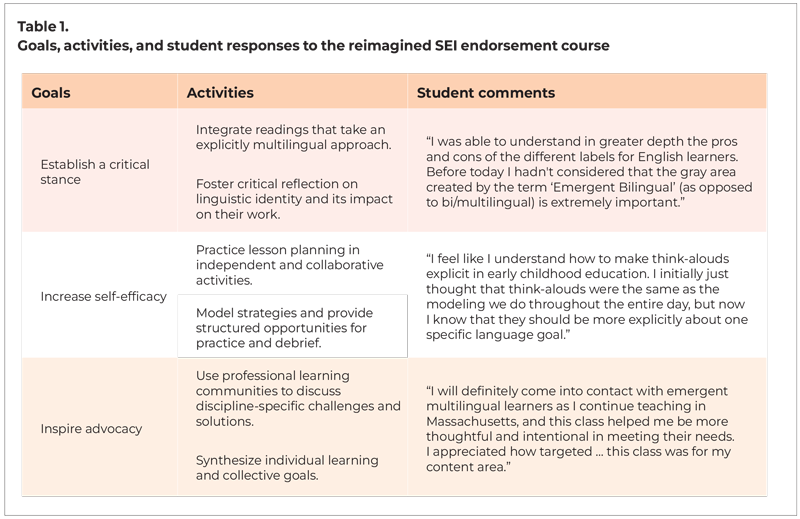
It seems unreasonable to expect our preservice teachers to be invested in a mandatory course that does not center the values, ideologies, and pedagogical stances that we personally believe — and that other scholars have shown — are intrinsic to English learners’ linguistic development and academic growth. We do not want our teachers to leave the SEI endorsement course thinking that effective instruction for designated ELs is as simple as choosing partner reading or reciprocal teaching from a menu of strategies. So, in the summer of 2022, we decided to do something about it. Based on our professional experience and a review of the scholarly literature, we revamped the course with three new goals:
- Establish a critical stance to SEI instruction.
- Increase teachers’ self-efficacy.
- Inspire advocacy on behalf of designated ELs and their families.
We accomplished this by making strategic changes to the course readings, class activities, and assessments; and we used daily exit tickets to assess how our candidates experienced these strategic adaptations. (See below for a summary of activities we used to achieve each of these goals and student responses to the activities.)
Goal 1: Establish a critical stance
Our first goal was to focus more on how teachers should think rather than on what they should do. To that end, we took an explicitly critical stance to SEI instruction, characterized by a “constant questioning of normative assumptions” about language and its relationship to power, privilege, and politics (Pennycook, 2001). Above all, we wanted our teacher candidates to be critical of the exclusionary practices that limited students’ home language use in general education classrooms at the time when the SEI endorsement course was created (Bacon, 2018; Chang-Bacon, 2022).
Additionally, we wanted teachers to ask questions about the label “English learner” itself. What does it connote about language, culture, and identity? How does it differ from other labels such as “emergent bilingual” (Colombo, Tigert, & Leider, 2019; García, 2009); “multilingual language learner” (Farrelly, 2022); or “linguistically gifted” (Thiers, 2022)?
Finally, we wanted teachers to reflect on their own identities and, in turn, potential biases, which have been shown to impact ELs’ language development and social relationships (Sugimoto, Carter, & Stoehr, 2017; Yoon, 2008). Ultimately, our goal was to instill in our candidates the habit of critical reflection: self-examination that leads to the transformation of unjust social systems (Liu, 2015).
We began the course by engaging students in activities and discussions that asked them to examine how their identities impact their work as teachers of designated ELs. To encourage students to confront their biases and prejudices about multilingualism and language development, we had them complete linguagrams (Solano-Flores, 2016): graphs that chart a person’s perceived proficiency in multiple languages or language varieties, across domains. After reading articles about labels for multilingual students (Colombo, Tigert, & Leider, 2019; Martínez, 2018), candidates engaged in a Socratic dialogue about the benefits and drawbacks of these terms and how the language ideologies embedded in these terms shape policies and practices at their student-teaching sites.
In the original course, many of the required readings took an explicit or implicit monolingual stance to instruction for designated ELs, focusing exclusively on English acquisition while ignoring the benefits of home language development (Chang-Bacon, 2022). To encourage students to question monolingual norms and assumptions, we purposefully paired what we perceived as ideologically monolingual texts with articles that took a multilingual approach. For instance, we paired a piece positing that ELs are deficient in academic language (Zwiers, 2004) with an article critiquing that construct (Flores, 2020). We asked candidates to contrast the theory of basic interpersonal communicative skills (BICS) and cognitive academic language proficiency (CALP), which suggests that students need to build skills in academic language in English to learn academic content (Cummins, 1980), with the theory of translanguaging, which suggests that students can use their home language to learn academic content (García, Johnson, & Seltzer, 2017).
Goal 2: Increase self-efficacy
If we wanted our candidates to implement the mindsets, orientations, and instructional strategies from the course, we had to ensure that they felt capable and motivated enough to independently use what they had learned (Osman & Warner, 2020). In particular, we wanted our candidates to feel confident differentiating assessments and objectives for designated ELs based on factors such as students’ linguistic strengths and needs, the language demands of the content area, and the contextual eccentricities of the school (e.g., the daily schedule).
The original SEI endorsement course required participants to complete multiple lessons, without giving them opportunities to practice and master the specific components of the lessons. Instead of requiring our candidates to complete multiple lessons, we asked them to craft a single lesson over the course of the semester, taking time to carefully consider how to adapt each element of the lesson to the ELs they might have in their future classes. They designed the lesson in stages, and we provided two rounds of feedback. Through weekly online discussion board posts, candidates independently practiced key skills (e.g., writing standards-based language objectives, designing formative assessments). They received written and oral feedback on their posts from both instructors and peers.
We wanted students to feel confident in their ability to identify which strategies were appropriate for their target objectives and how to adapt strategies to meet their students’ academic and linguistic needs. We modeled strategies in class and showed videos of other teachers so that candidates could see multiple interpretations of the same technique. Candidates practiced strategies in small groups, using a protocol to discuss the rationale behind their adaptations, as well as the language ideologies implicit in their pedagogical decisions.
Goal 3: Inspire advocacy
Our final goal was to inspire our teacher candidates to position themselves as advocates for designated ELs. An advocacy stance requires teachers to “develop a more nuanced, contextualized understanding” of designated ELs and their communities (Lucas & Villegas, 2013, p. 104). Additionally, it demands that teachers act against injustices that ELs commonly encounter (de Oliveira & Athanases, 2007), such as being funneled into remedial courses or excluded from science. Opportunities for structured collaboration and self-reflection can support the development of this advocacy stance (Gort, Glenn, & Settlage, 2010), so we committed to implementing purposeful, consistent opportunities for small-group discussion.
Any language can be a vehicle for content learning, so all languages — not just English — should be honored in the classroom.
To help foster a sense of shared responsibility for designated ELs among our students, we grouped them into professional learning communities, according to the grade levels or content areas that they intended to teach. Candidates posted to the group’s online discussion board each week and discussed those responses at the start of every class. This helped candidates identify discipline-specific challenges and brainstorm solutions. By discussing those obstacles and potential workarounds in class, our candidates were more prepared to advocate for ELs in their departments and schools.
The original SEI endorsement course concluded with final presentations where participants enacted strategies, but it did not explicitly include any synthesis activity. In addition to enactments, we had our candidates write key takeaways on sticky notes and place them on a class “parking lot” poster so that they could appreciate the collective progress they made as a group. They also wrote or recorded an individual reflection on their experience in the course, which allowed them to synthesize their learning.
Beyond the endorsement course
We are white, female educators who teach predominantly white, female teacher candidates at a private, selective research university. Although we both speak Spanish, we were not classified as English learners as children. We acknowledge that these identities undoubtedly shaped how we extended the content of the SEI endorsement course (Chang-Bacon, 2022). Still, we think that teacher educators can glean two takeaways from our work that may guide them in their own efforts to support preservice and in-service teachers of designated ELs.
Frame multilingualism as the norm. By and large, Massachusetts policies, even the law that reinstated bilingual education, reflect a “monolingual framework” (Rubio, 2022) that treats English as a higher-status language and positions multilingual students as outsiders (Chang-Bacon, 2022). Throughout the course, we used activities, readings, and assessments to frame multilingualism as standard. Any language can be a vehicle for content learning, so all languages — not just English — should be honored in the classroom.
Lead with the mindset, not the strategies. Strategies are a means to achieving language and content objectives, not ends in and of themselves. To help preservice teachers see SEI as a framework for purposefully teaching language through rich content, rather than an assortment of tools that are deployed arbitrarily, we continually asked our teachers questions like these:
- What standards are you trying to address in this lesson?
- What are your content and language objectives?
- How will this strategy support your designated ELs to achieve those objectives?
- What theories of language development does this strategy reflect?
In January 2023, Massachusetts initiated the process of updating the SEI endorsement course by contracting with an external organization to review the existing course and interview EL professionals about their experiences with the endorsement. Their findings will inform future updates to the course materials and syllabus. We are optimistic that the new version will not only “rethink” equity for designated English learners but also truly “reimagine” education for students and teachers alike. Until those changes take effect, we hope that our own work can guide our colleagues in their efforts to ensure that designated ELs receive the education they deserve.
References
An act relative to English language education in public schools, Mass. Acts 386. (2002).
Bacon, C.K. (2018). “It’s not really my job”: A mixed methods framework for language ideologies, monolingualism, and teaching emergent bilingual learners. Journal of Teacher Education, 71 (2), 172-187.
Balter, A. (2022, May). The state of the state: Updates from the Office of Language Acquisition [PowerPoint slides]. MATSOL Conference, Framingham, MA.
Chang-Bacon, C.K. (2022). Monolingual language ideologies and the Massachusetts sheltered English immersion endorsement initiative: A critical policy analysis. Educational Policy, 36 (3), 479-519.
Colombo, M., Tigert, J.M., & Leider, C.M. (2019). Positioning teachers, positioning learners: Why we should stop using the term English learners. TESOL Journal, 10 (2), e00432.
Cummins, J. (1980). The cross-lingual dimensions of language proficiency: Implications for bilingual education and the optimal age issue. TESOL Quarterly, 175-187.
de Oliveira, L.C. & Athanases, S.Z. (2007). Graduates’ reports of advocating for English language learners. Journal of Teacher Education, 58, 202-215.
Farrelly, R. (2022, August). If we must label language learners: EL vs. MLL. TESOL Connections.
Flores, N. (2020). From academic language to language architecture: Challenging raciolinguistic ideologies in research and practice. Theory into Practice, 59 (1), 22-31.
Gándara, P. & Santibañez, L. (2016). The teachers our English language learners need. Educational Leadership, 73 (5), 32-37.
García, O. (2009). Emergent bilinguals and TESOL: What’s in a name? TESOL Quarterly, 43 (2), 322-326.
García, O., Johnson, S.I., Seltzer, K. (2017). The translanguaging classroom: Leveraging student bilingualism for learning. Caslon.
Gort, M., Glenn, W.J., & Settlage, J. (2010). Toward culturally and linguistically responsive teacher education: The impact of a faculty learning community on two teacher educators. In T. Lucas (Ed.), Teacher preparation for linguistically diverse classrooms (pp. 198-214). Routledge.
Harper, C. & De Jong, E. (2004). Misconceptions about teaching English‐language learners. Journal of Adolescent & Adult Literacy, 48 (2), 152-162.
Kibler, A.K. & Roman, D. (2013). Insights into professional development for teachers of English language learners: A focus on using students’ native languages in the classroom. Bilingual Research Journal, 36 (2), 187-207.
Liu, K. (2015). Critical reflection as a framework for transformative learning in teacher education. Educational Review, 67, 135-157.
Lucas, T. & Villegas, A.M. (2013). Preparing linguistically responsive teachers: Laying the foundation in preservice teacher education. Theory into Practice, 52 (2), 98-109.
Martínez, R.A. (2018). Beyond the English learner label: Recognizing the richness of bi/multilingual students’ linguistic repertoires. The Reading Teacher, 71 (5), 515-522.
Massachusetts Department of Elementary and Secondary Education. (2013). Massachusetts sheltered English instruction teacher endorsement course: Participant’s manual.
Massachusetts Department of Elementary and Secondary Education (2021). Culturally responsive teaching look-fors. www.doe.mass.edu/instruction/culturally-responsive/
Massachusetts Department of Elementary and Secondary Education (2022) Guidance on English learner education services and programming. www.doe.mass.edu/ele/guidance
Molle, D. (2013). The pitfalls of focusing on instructional strategies in professional development for teachers of English learners. Teacher Education Quarterly, 40 (1), 101-124.
Osman, D.J. & Warner, J.R. (2020). Measuring teacher motivation: The missing link between professional development and practice. Teaching and Teacher Education, 92, 1-11.
Paris, D. (2012). Culturally sustaining pedagogy: A needed change in stance, terminology, and practice. Educational Researcher, 41 (3), 93-97.
Pennycook, A. (2001). Critical applied linguistics: A critical introduction. Lawrence Erlbaum.
Rafa, A., Erwin, B., Brixey, E., McCann, M., & Perez, Z. (2020). 50-State comparison: English learner policies. Education Commission of the States.
Rubio, J. (2022). Educational language policy in Massachusetts: Discourses of the LOOK Act. Educational Policy, 36 (6), 1440-1463.
Solano-Flores, G. (2016). Assessing English language learners: Theory and practice. Routledge.
Sugimoto, A.T., Carter, K., & Stoehr, K.J. (2017). Teaching “in their best interest”: Preservice teachers’ narratives regarding English learners. Teaching and Teacher Education, 67, 179-188.
Thiers, N. (2022). Juliana Urtubey on seeing families through a lens of gratitude. Educational Leadership, 80 (1).
United States Department of Justice. (2011, 27 September). Massachusetts takes steps to require sheltered English immersion training in response to Justice Department’s letter [Press release].
Valdés, G. (2018). Analyzing the curricularization of language in two-way immersion education: Restating two cautionary notes. Bilingual Research Journal, 41 (4), 388-412.
Yoon, B. (2008). Uninvited guests: The influence of teachers’ roles and pedagogies on the positioning of English language learners in the regular classroom. American Educational Research Journal, 45 (2), 495-522.
Zwiers, J. (2004). The third language of academic English. Educational Leadership, 62 (4), 60-63.
This article appears in the October 2023 issue of Kappan, Vol. 105, No. 2, pp. 19-25

ABOUT THE AUTHORS

Jennifer Altavilla-Giordano
JENNIFER ALTAVILLA-GIORDANO is a lecturer of language education and the director of the TESOL Multilingual Learner Education program at the Wheelock College of Education and Human Development, Boston University, MA.
Emily Blitz
EMILY BLITZ is a consultant for the Multilingual Learner Education department at Somerville High School, Somerville, MA, and a former adjunct instructor at the Wheelock College of Education and Human Development, Boston University, MA.