
Professional development coaches can boost teaching and learning. To work with willing teachers, they need strategies to gain access.
The practice of hiring coaches to provide ongoing professional development for teachers has become increasingly popular (Woulfin & Rigby, 2017). Embedded coaches can support teacher learning in ways that respond to the specific contexts in which teachers work, including the policies and curriculum of the district or state and the needs of the students they serve. Engaging with a coach can have a positive impact on both teachers’ practice and students’ learning (Harbour & Saclarides, 2020; Kraft, Blazar, & Hogan, 2018). In many districts, however, teachers are under no obligation to work with a coach; teachers retain the professional authority to determine if, when, and for what purpose they grant coaches access to their classrooms and practice.
This apparent paradox is entirely intentional. If teachers choose to engage with a coach and have the agency to select what and how they collaborate, rather than having the decision to work with a coach forced on them, they are more likely to learn and see coaching as relevant and supportive (Lieberman & Pointer Mace, 2008). Administrators have a key role to play in positioning coaches as valuable — and expected — resources for professional learning and equipping them with the time and support to do their jobs. Yet, much rests on teachers’ willingness to open their doors to coaches.
Coaches, then, are in a tricky position. They are expected to support teacher learning and instructional improvement, but to do so, they must work with teachers who are not required to work with them. Coaches must work to gain access to teachers’ classrooms to do their jobs.
Gaining access to classrooms for coaching is deliberate — and often invisible — work. We sought to understand this aspect of coaches’ work precisely because it is a necessary condition for the deeper work of coaching. We found that coaches use a complex and flexible network of strategies for gaining access. By making this work visible, we seek to make it available to new and veteran coaches.

Studying coaching in Southampton School District
Southampton (a pseudonym, like all names in this article) is in a metropolitan area in the southeastern U.S. The district enrolls about 14,000 students across 11 elementary, three middle, and three high schools. Southampton employs content-focused coaches who work with teachers in a single academic discipline: mathematics, English language arts, or technology. Of the 28 coaches at Southampton at the time of our study, all were experienced teachers (with four to 30 years of teaching experience) and coached full-time in one or more schools. Twenty were assigned to elementary schools, four to middle schools, two to high schools, and two worked across school levels.
For our research, we interviewed each coach to better understand how they gained access to teachers’ classrooms. We asked coaches to discuss their perceived level of overall access to teachers’ classrooms and the specific strategies they leveraged to gain access. Based on our interviews, we identified 41 distinct strategies and clustered these strategies into six categories. We noticed that coaches frequently discussed coordinating multiple strategies to enhance their access to classrooms, rather than relying on a single strategy, and we analyzed which types of strategies coaches coupled more or less frequently.
Six types of strategies for gaining access
We identified six types of strategies that coaches intentionally deployed to increase their classroom access: relational, structural, direct, indirect, cloaked coaching, and pitching in.
Relational strategies
All the coaches used relational strategies. The goal of these strategies was to build trust with the teacher so they would feel comfortable opening up their classrooms for coaching work. To achieve this, coaches portrayed themselves as nonjudgmental, reliable, respectful, and competent. Coaches emphasized that they were not there to evaluate teachers, maintained confidentiality with teachers, and demonstrated their own instructional competence. In conversations with teachers, coaches defined the work of coaching and explained what they would and would not do. They also explained that coaching was for everyone, not just for teachers who were struggling with their practice, and that their role was to support teaching and learning. All the coaches in our study emphasized that establishing trusting and clear relationships with teachers was critical to classroom access.
Structural strategies
Most of the coaches (26 of 28) reported using structural strategies, embedding themselves into the schools’ communication, planning, and professional learning routines. They became intertwined in teachers’ ongoing professional work, which positioned them to foster and capitalize on opportunities to engage teachers. For example, coaches attended recurring grade-level or disciplinary team meetings and facilitated district- or school-based professional development. This helped them better understand teachers’ immediate problems of practice and know what support to offer.
Coaches also used their own communication vehicles, including weekly emails, newsletters, public bulletin boards, and appointment scheduling apps, in hopes of opening up future coaching opportunities. By including themselves in existing school routines or creating new ones, coaches were able to learn more about teachers’ needs and be present when those needs arose.
Direct offers
Nearly all coaches (27 out of 28) used direct offers of support. For example, coaches offered instructional resources such as mathematics manipulatives, technology hardware, lessons, activities, and professional materials that they perceived teachers might need or find useful. Coaches also directly offered to model, co-teach, or observe and provide feedback on a lesson. Coaches were strategic in whom they targeted, starting with the teachers who seemed most receptive to coaching.
Indirect strategies
While direct offers involved coaches approaching teachers, indirect strategies created opportunities for teachers to approach the coach for support. All the coaches in our study reported using this method, and they did so in three distinct ways.
First, coaches built critical knowledge about the teacher. This involved attending to teachers’ goals and needs, coordinating with other instructional leaders to integrate coaching into other professional work, and learning about the school culture or specific teachers.
Second, coaches demonstrated their willingness to engage with teachers. They made themselves visible and available and provided flexible meeting times and structures. Coaches accepted all invitations and offers from teachers, such as invitations to a classroom celebration or performance, to demonstrate that they likely would agree to more substantive invitations in the future.
Coaches are in a tricky position. They are expected to support teacher learning and instructional improvement, but to do so, they must work with teachers who are not required to work with them.
Finally, coaches used indirect strategies to preserve the teachers’ agency. As we described earlier, giving teachers autonomy to determine when and how to engage in coaching is key to productive professional learning. Coaches deliberately waited for some teachers to approach them, particularly when they perceived that direct offers would be rebuffed. Coaches reported working with more receptive teachers in the hopes that their productive coaching experience would lead to positive word-of-mouth and subsequent open doors elsewhere. Collectively, these strategies cultivated conditions for access without directly asking for it.
Cloaked coaching strategies
Most of the coaches (23 of 28) in our study described using what we have called cloaked coaching strategies to gain access, which deflect attention away from coaching and obscure its purposes. For instance, coaches asked to observe a teacher or try out a pedagogy themselves or asked to be in a teacher’s classroom to focus on student needs. In each case, the real motive was to establish coaching access.
Coaches also described working with groups of teachers, such as a grade-level team, to gain access to the classroom of a hesitant teacher. Similarly, coaches reported intentionally not referring to their collaborative work with hesitant teachers as coaching to avoid any perceived negative connotations. Finally, coaches described how they might use a new policy or district initiative affecting all teachers as a cover for motivating more reluctant teachers to open their doors.
Coaches used these strategies when they perceived that more direct strategies would be unwelcome. These opaque strategies have limitations, however, because they could undermine their goal of establishing trusting professional relationships with teachers.
Pitching-in strategies
Pitching in involved offering to perform duties that were not explicitly connected to supporting teacher learning. Coaches pitched in, typically on a limited basis, to be present and welcome in teachers’ classrooms and to build goodwill for potential future coaching work. Most often, coaches offered to perform instructional duties that did not involve coaching, such as leading a lesson or conducting student assessments, to free up the teachers’ time. At the beginning of the school year, coaches helped with new teacher orientation. They sometimes agreed to be classroom helpers, performing tasks such as photocopying, making bulletin boards, or troubleshooting technology. In each case, these duties were beyond the scope of supporting instructional improvement.
Coaches must have access to do their jobs, but access is not guaranteed. Coaches must work to gain classroom entry by leveraging strategies tailored to each individual teacher.
While most of the coaches in our study used these strategies (21 of 28), they did so reluctantly and temporarily to build goodwill with teachers and be seen as part of the team. However, coaches were aware of the pitfalls, as providing support other than coaching could compromise teachers’ understanding of the coach’s role.
Individual strategies might not be enough
Coaches frequently told us how they used multiple strategies to gain classroom access. They described how they coordinated strategies in different situations and with different teachers over time. The most frequently coupled strategy types were also ones that coaches reported using most often: direct offers, and indirect, structural, and relational strategies. By using multiple strategies, coaches were more successful. For instance, building trust with a teacher (relational strategy) was seen as crucial by the coaches in our study. However, it likely would not lead to access without being paired with a well-timed offer of a resource or coaching (direct offer) matched to the coach’s understanding of the teacher’s goals or needs (indirect strategy).
Claire, a math coach, described one such coordinated approach in the following way:
I’m there [in team meetings], and I’m constantly planning with them. So I know what they’re doing, I know where they’re going. And so when I find materials, I might just pop in a classroom and say, “Hey, I found this [resource].” And then I might stay for five or 10 minutes. That’s not an official coaching cycle, but it lays that foundation of my relationship with them.
Claire coordinated a structural strategy (attending teacher meetings) with an indirect strategy of learning about the teachers’ goals and needs, which she could later parley into a direct offer of targeted resources. Delivering those resources directly to the teacher both got her into the classroom with a chance to observe for a few minutes and helped develop her relationship with the teacher.
Janice, an elementary technology coach, recognized that her teachers were elementary generalists who might see engaging with a technology coach as an additional burden. Janice described coordinating strategies to make technology coaching more embedded in teachers’ existing work:
And it’s another meeting. It’s another meeting. That’s the last thing I want you [the teacher] to feel like, it’s another meeting. And I work really hard to try to get the math coaches and reading coaches to sit in our meeting [with teachers], so that we can all be on the same page. “If we’re going to use [a particular software], how can we use that in reading?” The reading coach can then step in and say something. “How can we use this in math?” The math coach can step in and say something. And this [teacher] team doesn’t feel like, “Hey, this is one person, and this is one person, and this is one person,” but “We’re all a team together.”
Janice began with a relational strategy of valuing teachers’ time, which she coupled with an indirect strategy of coordinating with other instructional leaders, to participate in teacher team meetings (structural strategy). She could then offer a particular technology resource (direct offer) filtered through how it might support literacy or math instruction.
Our interviews revealed that coaches need strategies to gain access, and they need to know how to use multiple strategies under different conditions to achieve that access. Further, they described gaining access to classrooms for coaching as an ongoing process. Coaches might gain access to engage in a single coaching activity, like implementing the software Janice offered, but that does not mean the coach has access later for a different purpose. Coaches were perpetually negotiating access to classrooms in complex, coordinated ways.
Reflecting on gaining access
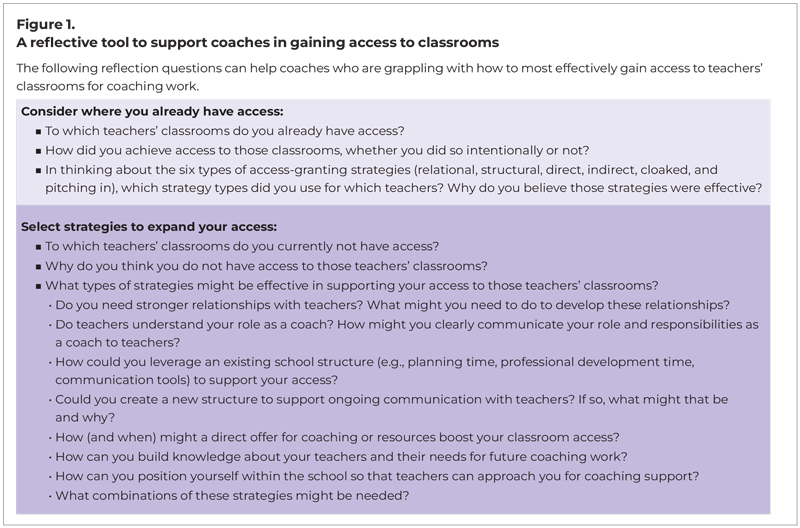
From our study (Munson & Saclarides, 2022; Saclarides & Munson, 2022), we learned that access to teachers’ classrooms is something coaches must carefully and actively earn. Figure 1 is a reflective tool for coaches that will help them think about their current level of access, as well as how they might use strategies to gain access to classrooms where doors are not yet open to them. We expect that coaches will likely have different ideas about the most effective ways to gain access to the varied teachers with whom they engage.
Working to gain access to teachers’ classrooms is a complex coaching practice. Coaches must have access to do their jobs, but access is not guaranteed. Coaches must work to gain classroom entry by leveraging strategies tailored to each individual teacher. Given the complexity of this practice, coaching programs should consider how they support coaches to develop the necessary strategies to gain access to teachers’ classrooms.
The coaches in our study were part of disciplinary coaching communities that met regularly to discuss shared problems of practice, including access. Our coaches cited this as a supportive space for learning about how to effectively gain classroom access (Munson & Saclarides, in press). Other school districts should consider how to create such spaces for coach learning.
References
Harbour, K.E. & Saclarides, E.S. (2020). Mathematics coaches, specialists, and student achievement: Learning from the data. Phi Delta Kappan, 102 (3), 42-45.
Kraft, M.A., Blazar, D., & Hogan, D. (2018). The effect of teacher coaching on instruction and achievement: A meta-analysis of the causal evidence. Review of Educational Research, 88 (4), 547-588.
Lieberman, A. & Pointer Mace, D.H. (2008). Teacher learning: The key to educational reform. Journal of Teacher Education, 59 (3), 226-234.
Munson, J. & Saclarides, E.S. (in press). Conflict and cooperation: Micropolitical forces impacting coaches’ access. The Elementary School Journal.
Munson, J. & Saclarides, E.S. (2022). Getting a foot in the door: Examining content-focused coaches’ strategies for gaining access to classrooms. The Elementary School Journal, 123 (1).
Saclarides, E.S., & Munson, J. (2022). An exploration of coaches’ coordination of micropolitical strategies to gain access to teachers’ classrooms. The Elementary School Journal, 123 (1).
Woulfin, S.L. & Rigby, J.G. (2017). Coaching for coherence: How instructional coaches lead change in the evaluation era. Educational Researcher, 46 (6), 323-328.
This article appears in the October 2023 issue of Kappan, Vol. 105, No. 2, pp. 32-36.

ABOUT THE AUTHORS

Jen Munson
JEN MUNSON is an assistant professor of learning sciences at Northwestern University, Chicago, IL.
Evthokia Stephanie Saclarides
Evthokia Stephanie Saclarides is an assistant professor in the Department of Curriculum and Instruction at the University of Cincinnati, Ohio.