National outlets are doing a lot of spectacle-laden stories sympathetic to the striking teachers, notes guest columnist Steve Rhodes, while local news outlets have produced too much ‘he said, she said’ coverage. Neither gets at what’s really going on.
By Steve Rhodes
In the past, the American mainstream media wasn’t exactly known for sympathetic coverage of unions and strikes. Labor reporters have long been an endangered species.
But if recent sympathetic coverage of teachers strikes is any indication, that pattern is changing. Look now to Chicago, where the teachers union has gotten a pretty sweet ride from the press while they’ve been out on the picket lines the last two weeks.
Being generally pro-labor — and even more so, pro-journalism — I’m all for a fairer shake than unions are used to getting. But there has to be a limit – preferably where cheap sentiment runs up against the facts.
Maybe children marching alongside their parents and teachers holding signs pleading for smaller classes and school nurses — school nurses! — are just too cute to fact-check.
And maybe tales of overworked teachers struggling to hold it together in a dysfunctional district broken by uncaring bureaucrats and outright criminals are simply too heartbreaking to question.
After all, who could be against school nurses and overworked teachers? Are we monsters?
But those kinds of stories — the simple narratives that media gravitate toward — have resulted in a kind of asymmetrical coverage that leaves out salient context.
As it happens, for example, the mayor is in favor of school nurses, too. In fact, she’s offered to put a school nurse, a counselor and a social worker in every school by 2024.
The Chicago Teachers Union (CTU) may disagree with her on how to get there, but the conflict is not between nurses or no nurses, smaller class sizes or not smaller class sizes, pay raises or no pay raises.
The strike is about how much of each the mayor thinks the city can afford. That puts a spin on things not reflected well in at least some segments of the coverage I’ve seen.
National media coverage has been outright lopsided; local coverage has been more evenhanded but fails to dig down to the facts or provide the bigger perspective. And the shortfalls on both sides stem from a lack of sophisticated understanding of the bigger political machinations behind the strike: Chicago Mayor Lori Lightfoot, though she’s progressive, wasn’t the union’s candidate in last April’s election, and the union has been trying to undo her ever since.
Each week, The Grade takes a deeper look at education journalism. Sign up for the free newsletter.

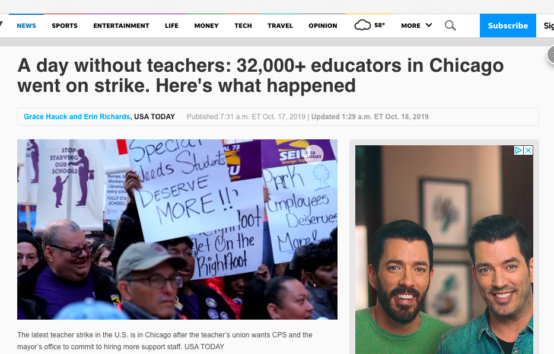
This USA Today piece is an example of coverage that focuses too much on spectacle, according to Rhodes.
National outlets have been doing a lot of stories about underpaid aides and the hard life of a teacher and so on, and the narrative that the strike is not about money but classroom conditions has seeped into virtually every story.
The Atlantic, for example, posted a piece called “How Chicago’s Teachers Explained The Strike To Students.” It included this unsubstantiated statement: “[Chicago Public Schools] and Chicago’s mayor, Laurie [sic] Lightfoot, had publicly questioned why the union was fighting so hard for a raise ….” But Lightfoot has never, to my knowledge, questioned why the union is “fighting so hard for a raise.”
Another example: In the Washington Post, Valerie Strauss, whose work I’ve always liked, writes that “Some 25,000 Chicago teachers are in the second week of a strike called to demand higher pay, more resources and smaller class sizes from the cash-strapped district.” She fails to note that the mayor is offering higher pay, more resources, and smaller class sizes from her cash-strapped district. Strauss says that Lightfoot “had promised liberal reforms,” as if she, in her mere five months on the job, hasn’t delivered. And her piece ignores the new mayor’s appointment of the most progressive school board in CPS history, with the most progressive school board president, and a generous contract offer that, however much it falls short of the CTU’s ideal, is at least the definition of liberal.
Don’t get me wrong, I’m not here to defend the mayor, though it’s true I preferred her over the union’s candidate, the head of the Cook County Democratic Party. But the coverage at times has been misleadingly slanted in ways that deprive readers of a deeper understanding of the issues.
That’s true even when the coverage is straightforward. USA Today’s “A Day Without Teachers: 32,000+ Educators In Chicago Went On Strike. Here’s What Happened” describes a demonstration in which “thousands of teachers clad in red and support staff in purple continued their chants, including, ‘Lori Lightfoot, get on the right foot!’ and ‘Get up! Get down! Chicago is a union town!’”
The description is absolutely accurate. But it’s also all cliché and (empathetic) spectacle with no substantive news. And the union, with a full schedule of marches, rallies, solidarity events, teach-ins, free schools and dance routines, has provided plenty of spectacle. The continual coverage of such activities — hey look, people are doing things; news! — serves to build sympathy for one side while leaving the other side out.
The mayor could dance with her school board, I suppose, but I wouldn’t advise it.
Follow The Grade on Twitter and Facebook to learn more about how the media covers education.

This Washington Post piece presents a narrow version of events leading up to the strike, according to Rhodes.
When the CTU last struck, in 2012, it was a battle royale between rookie Mayor Rahm Emanuel and the union president at the time, Karen Lewis. Emanuel wanted to stomp the union terra to send a message at the beginning of his term that he was the alpha king. He wanted to take things away from teachers. His vision of the school district — privatized, selectivized, portfolioized — was diametrically opposed to the vision of the union.
This isn’t then. But you wouldn’t necessarily know that from reading the coverage that I’ve been seeing. Nor would you understand the important background about the union’s hostility toward the new mayor.
Lightfoot, who took office in May, is an African American lawyer from a working-class background who is raising a child with her white wife. The couple lives in Logan Square, one of the city’s hippest neighborhoods. Lightfoot was among the first group of long-shot candidates to challenge Emanuel when it was still assumed he would run for re-election. Few gave her a second thought, much less a chance.
Lightfoot ended up in a nasty runoff against the CTU’s candidate, Toni Preckwinkle, and waxed her, winning 75 percent of the vote. Upon taking office, Lightfoot appointed the most sympatico school board the CTU has likely ever had to work with, led by a progressive hero named Miguel del Valle.
It could’ve been the start of a beautiful friendship, contract negotiations notwithstanding. Unfortunately, the CTU never stopped campaigning against Lightfoot. Now, they want to make her a one-term mayor and they’ve been on her case since well before contract negotiations heated up.
They’re good at it, too. The union has a well-resourced propaganda arm and social media army that only exacerbate the imbalanced coverage. The mayor’s “war room,” near as I can tell, is basically . . . herself.
I’m not the only one who’s noticed coverage that leaves out some of these key political dynamics.
“There is zero conversation about the fact that CORE [the union leadership team] has to figure out succession,” longtime Chicago education reporter Maureen Kelleher told The Grade. “People always talk about internal politics, but I can’t tell you how precarious their hold on power is.”
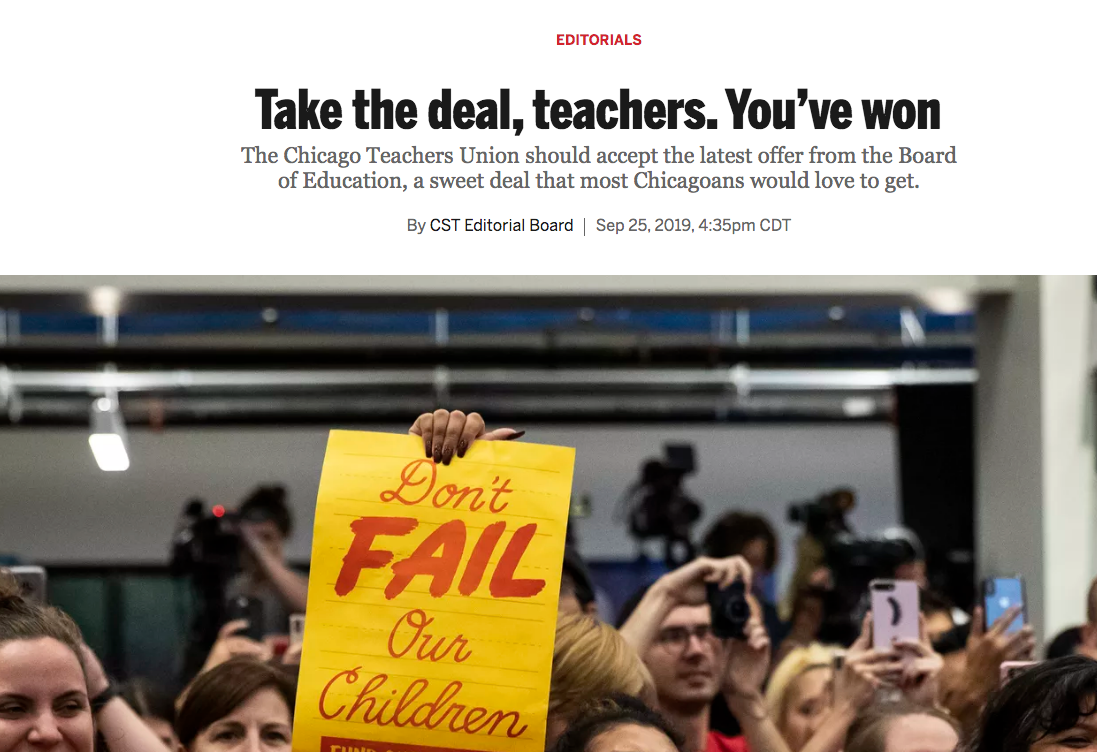
The liberal-leaning Chicago Sun-Times editorial page has repeatedly chided the teachers union in recent weeks, notes Rhodes, including this editorial from last month.
On the ground in Chicago, the coverage is a little more by the numbers — though frustratingly dominated by “he said-she said” stories and live blogs full of daily to-and-fro.
The result too often is a set of competing claims — is the gap preventing an agreement $38 million or $100 million? — that haven’t been squared, leaving readers unable to discern which side is telling the truth. It’s maddening and doesn’t help anyone except the bigger liar.
The coverage has been littered with passages like this, from WBEZ’s strike blog: “On prep time, CPS is digging in, saying if they add prep time for elementary teachers that would cut into the instructional time. The union has argued it doesn’t have to, saying, for example, that time teachers spend supervising student breakfast could be prep time.”
Is that true? Do teachers supervise breakfast and could they spend the time doing prep instead at no cost to instructional time? We can only wonder.
Believe me, I know it’s not easy to report on this strike; long hours are spent chasing moving targets. But maybe at least one news organization could commit to not publishing any claim without providing evidence — a document, a timestamp, math — whatever it may be.
“I wish reporters would crunch the numbers sooner and faster,” notes Kelleher, referring to staffing and class size caps that were obvious budget issues. “It would have been a public service to stop chasing he said, she said and political sour grapes and dig in on how much those items would cost and where the city could get the money.”
There have been other problems, including times where local media coverage has seemed to mimic CTU talking points rather than questioning them.
It’s also worth noting that, unlike the sympathetic news coverage, the local commentariat is pretty squarely against the strike. It’s not surprising that the arch-conservative editorial board of the Chicago Tribune would come out against the union with all guns blazing; they probably just pulled out the editorial they always use when it comes time to give teachers a raise. But it is noteworthy that the Sun-Times, owned in part by the Chicago Federation of Labor, has opposed the strike and continually chided the union on its editorial pages.

Only a handful of local stories like this from the Chicago Reporter have explained enough of what’s going on behind the scenes of the strike negotiations, notes Rhodes.
There are plenty of other reporters and outlets covering the strike.
The best piece I’ve seen is this explainer by veteran journalist Curtis Black at the Chicago Reporter, and it contains my favorite piece of strike reporting, explaining Lightfoot’s concerns about the consequences of trying to hire a fleet of new nurses and social workers without knowing whether there are enough of these professionals around to hire.
Black describes the mayor standing up for equity and the union leader admitting the mayor has a point.
More of this, please — not because it backs the mayor, but because it explains reality instead of merely positioning talking points against each other.
Previous columns about media coverage of teacher strikes:
Much-improved coverage of the Los Angeles teachers strike (January 2019)
New York City 1968 wasn’t a teachers strike; it was a community insurrection (September 2018)
Teacher strike coverage illustrates need to amplify parent, student voices (August 2018)
Oklahoma teacher walkout coverage marred by partisan politics (April 2018)
ABOUT THE AUTHOR

Steve Rhodes
Steve Rhodes is the editor and publisher of The Beachwood Reporter, a Chicago-centric news and culture review. He previously spent a life working for newspapers and magazines, including the Chicago Tribune, Newsweek and Chicago Magazine. Follow him at @beachwoodreport.