Pros and cons of Oklahoma teacher walkout coverage.
By Alexander Russo
The Oklahoma teacher walkout is over and teacher protests in Colorado and Arizona are just picking up.
That makes this the perfect moment to review the teacher walkout coverage of the past couple of weeks and bring any lessons learned into future coverage.
Let’s be clear from the start: The stories on the Oklahoma walkout that took place over the past two weeks weren’t problematic in any obvious way. National outlets gave the story the attention that it deserved. They generally got the facts straight.
The criticisms that have been raised were more in what often wasn’t included: Context, history, and nuance.
“The coverage of events was rather good, but there was so much missing,” noted teacher union expert (and frequent critic) Mike Antonucci, who writes for The 74, a nonprofit education outlet.
In particular, a richer, more complex story about the walkout was frequently replaced with a simplistic and superficial tale of a “red-state revolt” that focused attention on partisan politics and implied some sort of political re-alignment.
The red-state revolt is “a tempting political narrative in an environment in which there’s tremendous eagerness to figure out what’s going to happen in the midterms,” observed freelance reporter Max Zahn, whose work has appeared In These Times and Waging Nonviolence.
But as you’ll see, that storyline isn’t really borne out, according to some of those closest to the ground.
This time, at least, the tempting political narrative wasn’t the best choice to make.
__
Even before the Oklahoma walkouts, coverage of the West Virginia teacher protests had been the topic of vigorous debate:
A March 9th Reed Richardson piece in FAIR complained that MSNBC and other outlets were late and skimpy in covering the West Virginia protest – in part because there are now only a handful of reporters assigned to cover labor issues.
Brooklyn College professor Corey Robin remarked how much more positive the national media coverage was toward the West Virginia protests than it had been during the teachers strike in Chicago just a few years before.
Then came the Oklahoma walkout, which went on for nearly two full weeks, ending on Friday. When all was said and done, the protest generated a historic $500 million increase targeted towards teacher salaries – a $6,000 increase for the average teacher — and a handful of other changes.
In a different way, that walkout also generated concerns and criticism about national media coverage.
An early-April roundup published by liberal-leaning Media Matters for America lambasted Fox News for failing to host teachers as part of its Oklahoma and Kentucky coverage. CNN and MSNBC did much better on that score.
The 74’s Antonucci had different complaints: “more than seven weeks of almost entirely positive media coverage,” by which he means insufficient reporting about protest critics, tradeoffs, and potential downsides.
The quantity of national coverage was no longer a concern, however. Media attention was lavish, its tone sometimes giddy.
New York Times’ national education reporter Dana Goldstein wrote three or four pieces on Oklahoma alone, as part of seven pieces on this spring’s teacher protests over six weeks.
The Guardian’s Mike Elk wrote ten pieces on the Oklahoma protests, which has to be a record of some sort.
The story’s appeal to reporters is easy to understand. Concerns about economic inequality are high, and education is considered a major way to promote social progress. Despite attacks on their work, both perceived and real, teachers are considered among the most honest and ethical professionals in the nation, according to Gallup. A number of newsrooms have unionized in recent years, giving job actions by teachers particular appeal. (The teacher-reporter connection was recently explored by NYT labor reporter Noam Scheiber.)
And, after what had happened in West Virginia, it was pretty easy for national reporters to connect the dots to Oklahoma and other states. There was even time to prepare, especially with plenty of state and local coverage to draw from. “National reporters need state media” to help inform their reporting, Richardson said in a phone interview. And the walkout lasted long enough for the story to remain fresh.
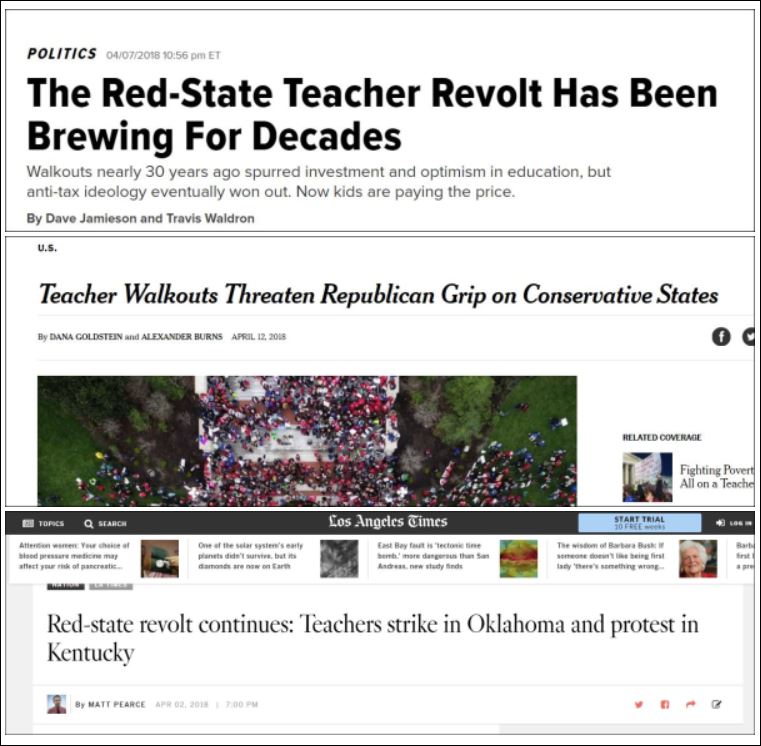
A sampling of national coverage emphasizing a partisan political storyline.
That doesn’t mean that the national coverage was as good as it should have been, however.
In particular, national coverage often over-emphasized the notion of Oklahoma being an example of a so-called “red-state revolt” in which a Republican-run Oklahoma was undergoing some sort of political reconfiguration.
The NYT’s Thursday story, Teacher Walkouts Threaten Republican Grip on Conservative States, is an obvious example, speculating at length about a future event – Republican loss of control of the state – that those close to the ground deem ill-matched to the facts at hand.
A revolt against Republican hegemony in Oklahoma is a sexy notion, The Oklahoman’s Felder noted in a phone interview earlier this week. But it’s inaccurate. As he wrote in a Sunday review of the walkout, the walkouts were fundamentally nonpartisan, and most of the state’s teachers are registered Republicans. (As of 2016, Oklahoma teachers were actually three points more likely to be registered Republicans than the rest of the state.) What happened in Oklahoma simply “wasn’t a progressive pushback,” according to Felder. “It wasn’t the left-of-center crowd rising up.”
“Such a framing is understandable,” wrote Oklahoma University professor Deven Carlson in a Brookings Institute blog post that detailed the circumstances and dynamics that developed over several years leading up to the present. However, it “greatly oversimplifies” what was really going on in the state.
__
Felder and Carlson also criticize some national outlets for shoe-horning the Oklahoma protests into a simplistic national trend story.
For all the surface similarities between the state and others where teachers have been active, the underlying dynamics and mechanisms are “completely different,” said Carlson.
“I wouldn’t overly read into Oklahoma as a narrative for some kind of national trend,” said Oklahoman Felder. “I would be slow to group all these states together.”
But for national reporters, in-state dynamics may simply not be as important as they are to state and local people. And, as The Guardian’s Mike Elk and others noted, West Virginia was a frequent topic of conversation among Oklahoma teachers being interviewed about their inspiration to protest. The relationships between the events seem clear.
But that doesn’t mean that national reporters don’t see flaws in how Oklahoma was covered.
According to the Times’ Goldstein, the biggest challenge in covering the teacher protests has been that the teacher protest story is “happening simultaneously in multiple places far away from one another.” Even an outlet as big as the Times is challenged to cover breaking news out of so many different statehouses. “It’s an exciting but tiring time on the beat,” she says.
Freelance reporter Zahn notes that focusing on major party politics and national storylines tended to leave too little room for other voices like those of school leaders who had joined the teachers. “It wasn’t just the workers who were protesting,” said Zahn in a phone interview. “It was the education establishment as a whole.”
And according to Elk, the mainstream national coverage has been inordinately focused on the roles and needs of white adults.
“The national media has largely erased the role of communities of color… that drove these walk-outs,” he wrote. “Instead, they chased clicks and imposed [the] narrative that this was a “Trump country” revolt by white conservatives.”
Elk’s criticism echoes the discussion that followed the Parkland school shooting, during which white students and parents were featured prominently despite the presence of nonwhite students at the high school and the long history of gun violence affecting urban communities.
Student viewpoints and experiences were also relatively muted in the Oklahoma coverage – a journalistic habit that seems old-fashioned, given all the recent focus on bringing student voices to the fore in the aftermath of the Parkland school shooting.
Then again, the same could be said about this column, which is filled with white and mostly male perspectives — all of them adult.
__
As the Oklahoma walkout wound down late last week, journalists seemed at a loss to interpret the outcome. The legislature hadn’t taken any major new action. There was no clear winner.
But perhaps that was a good thing. Because the Oklahoma protests weren’t primarily a political story in which one side wins and the other loses. And in Colorado, the next state where teacher protests may play out, national reporters will need to figure out new narratives. The “red-state revolt” storyline is a non-starter in a purple state.
With a little more time, and a little more digging, national reporters will have an opportunity in Colorado to bring deeper, broader reporting to the coverage of Oklahoma and other places.
With a little bit of luck, they and their editors will also still find the teacher protest story compelling and relatable enough to keep reporting it.
Key coverage:
Guardian: Oklahoma teachers’ march: immigration debate fuels calls for bilingual education
Guardian: Teachers’ strikes: meet the leaders of the movement marching across America
LA Times: Red-state revolt continues: Teachers strike in Oklahoma and protest in Kentucky
Washington Post: Oklahoma teacher walkout winds down despite lawmakers’ failure to meet demands
NYT: Their Pay Has Stood Still. Now Oklahoma Teachers Could Be the Next to Walk.
Teen Vogue: Students Join Striking Teachers in Oklahoma and Kentucky
Key criticism:
MMFA: While covering teacher walkouts in Oklahoma and Kentucky, Fox News didn’t host any teachers.
The Oklahoman: Teacher walkout was nonpartisan, but politics came into play
Brookings: Not just a ‘red-state revolt’: The story behind the Oklahoma teacher walkout
Corey Robin: Why is the media—including the liberal media—supporting these teachers’ strikes?
FAIR: West Virginia Strike Highlights Corporate Media’s Atrophied Labor Coverage
ABOUT THE AUTHOR

Alexander Russo
Alexander Russo is founder and editor of The Grade, an award-winning effort to help improve media coverage of education issues. He’s also a Spencer Education Journalism Fellowship winner and a book author. You can reach him at @alexanderrusso.
Visit their website at: https://the-grade.org/