These laws are a bad idea, but widespread misreporting of the “discomfort” provision in these laws is making things worse.
By Natalie Wexler
An NPR story last month reported that bills introduced in Georgia “would ban teaching concepts that cause ‘guilt, anguish, or any other form of psychological distress’ because of a student’s race, sex or identity.”
As a result, the NPR story recounted, a school librarian feared her school’s Black History Month celebration would be canceled.
Other states — such as Texas and Tennessee — had already enacted legislation banning the teaching of “anything that might make [students] feel uncomfortable,” NPR reported.
The Washington Post, ABC News, and The Hill have all described bills in Florida using the same language., as did Politico when characterizing an Oklahoma statute.
But the vast majority of these bills and statutes don’t actually ban just making students feel uncomfortable.
Coverage and commentary have focused more on educators’ perceptions of and emotions about the legislation than on the actual language — making its “chilling effect” on instruction even frostier than necessary.
Coverage and commentary have focused more on educators’ perceptions of and emotions about the legislation than on the actual language — making its “chilling effect” on instruction even frostier than necessary.
There’s no doubt that the move to limit teaching about race and inequality is on the rise.
So far, “anti-CRT” laws have been passed in 14 states and introduced in a total of 41, according to Education Week.
In language essentially copied and pasted from a Trump-era executive order — and disseminated by an organization founded by former Trump administration staffers — they say schools can’t teach the “concept” that individuals should feel discomfort, guilt, or anguish on account of their race or sex.
They don’t, by their terms, ban teaching about events or concepts that might make kids feel bad.
Most of the flawed news stories I’ve seen have not come from education beat reporters. But the misunderstanding has been repeated in many reports on the general topic, and it’s bled over to opinion pieces and other commentary.
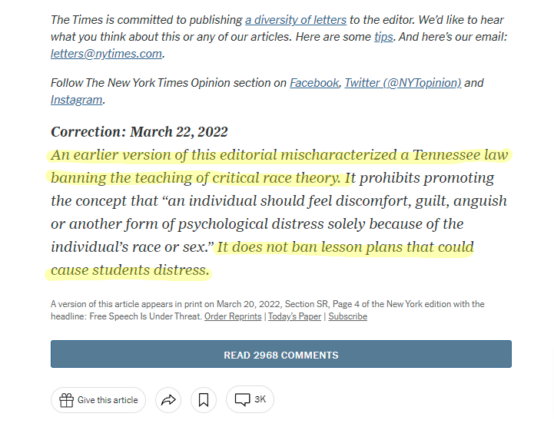
A major New York Times editorial on threats to free speech included the error until it was corrected several days after publication, apparently in response to a call for a correction by myself (and perhaps others):
“Correction: March 22, 2022: An earlier version of this editorial mischaracterized a Tennessee law banning the teaching of critical race theory. It prohibits promoting the concept that ‘an individual should feel discomfort, guilt, anguish or another form of psychological distress solely because of the individual’s race or sex.’ It does not ban lesson plans that could cause students distress.”
The Tennessee law “prohibits promoting the concept that ‘an individual should feel discomfort…’ It does not ban lesson plans that could cause students distress.”
To be fair, it can be confusing to pin down the final statutory language, which sometimes differs from previous versions.
And the language in some new stories has also been ambiguous. ABC, for example, reported that, according to the Florida bill, “an individual shouldn’t be made to” feel discomfort, etc. Some might interpret that as banning a deliberate effort to cause discomfort, but others would read it as covering teaching material that might simply have that effect.
And some documents — like a letter from a Texas legislator seeking to ban books from school libraries and classrooms and an “analysis” of the Florida bill by state legislative staffers — have used the broader “might make students feel discomfort” language.
But I have yet to find an enacted piece of legislation that says that.
Even when a news story describes the statutory language accurately, teachers’ inaccurate interpretations have been repeated without comment.
In one Education Week story, for example, the “should” language was quoted near the top, but farther down, one teacher was quoted as saying, “If a kid comes home and says they’re uncomfortable, now you’re breaking the law.”
Another teacher said he would no longer teach about the 1921 Tulsa Race Massacre, even though Oklahoma standards require it. “If I teach that,” he said, “am I going to cause a student to feel discomfort, guilt, or anguish?”
Those quotes could have been used to make the point that teachers are misinterpreting the statute, but they weren’t presented that way.
At a recent EWA webinar titled “Whose ‘Discomfort?’: Covering Efforts to Limit Teaching About Racism,” one of the panelists repeated a frequently heard accusation against the “discomfort” provisions: that they’re vague.
While that may be true of other provisions in these laws, it’s hard to see what’s vague about prohibiting teachers from instructing children that they “should” feel uncomfortable because of their race or sex.
Restrictions on speech that have been struck down as unconstitutionally vague generally fail to define terms like “offensive” or “indecent.”
True, it’s hard to imagine many teachers are actually instructing kids they “should” feel uncomfortable for these reasons — and that may lead observers to conclude that legislators are actually aiming at something else, like teaching about topics that could cause discomfort.
But that’s not what the laws say.
Even when a news story describes the statutory language accurately, teachers’ inaccurate interpretations have been repeated without comment.
During the EWA webinar, I asked panelists whether they thought the widespread inaccurate reporting of the “discomfort” provisions was a problem.
Eesha Pendharkar of Education Week responded that reporting should be accurate, but “it almost doesn’t matter if there’s a law,” because the climate of fear is such that teachers can be suspended or reprimanded even in states without laws in place.
I don’t entirely agree.
Yes, teachers and administrators will continue to self-censor — and some parents will continue to complain — whether or not these laws are in place or reported accurately.
But if educators understand what the law actually prohibits, I would hope that at least some will push back and even test the statutory language in court, if necessary.
Should educators have to do that? Absolutely not.
But if teachers avoid teaching any content that could conceivably make one hypothetical child uncomfortable, the education of all students will suffer — and so will our democracy, which depends on an educated citizenry.
These laws are a bad idea, but there’s no need to make a bad situation even worse. And that’s what the widespread misreporting of the “discomfort” provision in these laws is doing.
Related from The Grade
Covering the debate on teaching race in schools
‘Squid Game’ school board coverage isn’t helping
Previously from this author
The media blind spot hiding a big problem in American classrooms
ABOUT THE AUTHOR

Natalie Wexler
Natalie Wexler is a senior contributor on education at forbes.com and has published two books, one as a co-author, on education.