School boards set the curriculum for schools, and they have the legal right to decide what materials and speech are appropriate for the classroom.
Teachers face particular challenges when they are teaching political or controversial topics in classrooms. They must navigate a narrow passage between delivering the curriculum as required by their local board of education and sharing their own personal views and other information, while also abiding by board regulations regarding content and delivery. In addition, they must deliver the curriculum without attempting to indoctrinate students with their own personal beliefs, particularly on religious, political, and controversial topics.
In K-12 public schools, the local school board has the authority to set the curriculum, and teachers must adhere to it, as well as following all state and school board regulations. Simply put, K-12 teachers do not have the broad academic freedom that is usually afforded to their counterparts in higher education. Courts have made a distinction between university faculty and K-12 teachers in the area of free speech, noting “a special concern of the First Amendment” in higher education because of the university’s unique role in participating in and fostering a marketplace of ideas. E.g., Demers v. Austin, 746 F.3d 402 (9th Cir. 2014).
Additionally, in Garcetti v. Ceballos, 547 U.S. 410 (2006), the U.S. Supreme Court limited public employees’ rights to free speech within the confines of their employment. There the court held that when public employees make statements pursuant to their official duties, the employees are not speaking as citizens for First Amendment purposes; as such, the Constitution does not protect them from employer discipline. For example, when talking to students during classroom instruction, teachers cannot assume their speech is protected.
Teachers’ personal views
Teachers cannot let their personal beliefs interfere with their obligation to deliver the school’s curriculum, and they may not hijack the curriculum or use their position as teacher as an opportunity to inculcate students to their personal beliefs.
For example, in Mayer v. Monroe County Community School, 474 F.3d 477 (7th Cir. 2007), the Seventh Circuit held that the First Amendment does not entitle public school teachers to cover topics or advocate viewpoints that depart from the curriculum adopted by the school board. In the case, the teacher claimed she was dismissed because she expressed her disapproval of the Iraq war to students during a current events session in her elementary classroom. Administrators told her she could teach about the controversy but had to keep her opinions on the subject to herself. The Seventh Circuit Court of Appeals upheld her dismissal, finding that teachers do not have a constitutional right of expression within their classrooms. The court stated:
[T]he school system does not “regulate” teachers’ speech as much as it hires that speech. Expression is a teacher’s stock in trade, the commodity she sells to her employer in exchange for a salary. A teacher hired to lead a social studies class can’t use it as a platform for a revisionist perspective that Benedict Arnold wasn’t really a traitor, when the approved program calls him one; a high school teacher hired to explicate Moby Dick in a literature class can’t use Cry, The Beloved Country instead, even if Paton’s book better suits the instructor’s style and point of view; a math teacher can’t decide that calculus is more important than trigonometry and decide to let Hipparchus and Ptolemy slide in favor of Newton and Leibniz.
Simply put, the court held that the “First Amendment does not entitle primary and secondary teachers . . . to cover topics or advocate viewpoints that depart from the curriculum adopted by the school system.”
In Johnson v. Poway Unified Sch. Dist. of San Diego County, 658 F.3d 954, the Ninth Circuit Court of Appeals held similarly. There, administrators told a math teacher to remove large banners that displayed religious beliefs from his classroom. The teacher removed the banners and then challenged the district in court, asserting a violation of Free Speech and Establishment of Religion under the First Amendment. The court ruled against the teacher, finding that inserting his religious views into the curriculum was not protected speech. The court said:
Just as the Constitution would not protect Johnson were he to decide that he no longer wished to teach math at all, preferring to discuss Shakespeare rather than Newton, it does not permit him to speak as freely at work in his role as a teacher about his views on God, our nation’s history, or God’s role in our nation’s history as he might on a sidewalk, in a park, at his dinner table, or in countless other locations.
Again, the school district has the right and responsibility to set the curriculum and, within the delivery of that curriculum, teacher speech can be regulated.
Limiting materials
In addition, the school district may restrict curricular speech by setting forth what teachers must or may not use as part of delivering the curriculum. While many districts give teachers the latitude to select instructional materials, others require them to abide by rules prescribing or prohibiting certain texts, materials, and instructional techniques. If teachers violate these rules, they may be subject to discipline.
It is quite common for districts to have general rules regarding use of controversial materials in the curriculum, and teachers have been dismissed for failure to comply with these rules. In Board of Education of Jefferson County School District R-1 v. Wilder, 960 P.2d 695 (Colo. 1998), the Colorado Supreme Court upheld the dismissal of a high school teacher for showing an R-rated movie without first obtaining the principal’s approval as required by the district policy on controversial learning resources. The court held that the district had the right to control instructional materials and that the teacher should have sought prior approval, given the nature of the film (which included representations of violence, drug use, nudity, and sex acts).
In Brown v. Chicago Board of Education, 824 F.3d 713 (7th Cir. 2016), a teacher was disciplined for using a racial slur in a classroom, in violation of a Chicago Public Schools policy that forbids teachers from using racial epithets in front of students. Brown, a 6th-grade teacher, intercepted a note between two students that included music lyrics using the word n**ger. He used this as an opportunity for a lesson on why the use of this word was harmful and hurtful. But in providing this lesson, he used the word himself. He was suspended, and the Seventh Circuit Court of Appeals sided with the district, stating that, “The board may have acted in a shortsighted way when it suspended him for his effort to educate the students about a sensitive and socially important issue, but it did not trample on his First Amendment rights.”
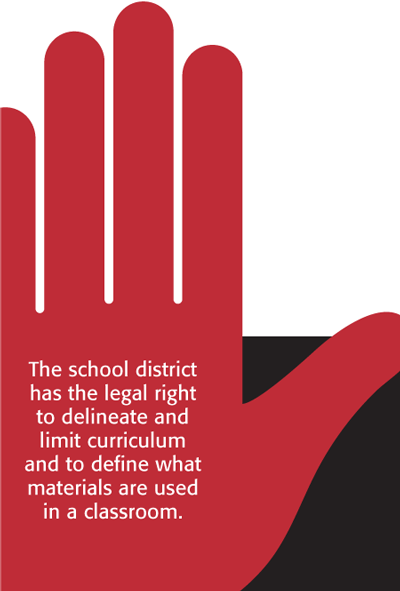
The takeaway message here is that as much as teachers should be respected for their expertise and experience in providing curriculum in the classroom, the school district has the legal right to delineate and limit that curriculum, and as employees, teachers must adhere to those policy decisions. As stated by the Sixth Circuit Court of Appeals in a decision upholding a teacher’s dismissal for not doing so, “Only the school board has ultimate responsibility for what goes on in the classroom, legitimately giving it a say over what teachers may (or may not) teach in the classroom.” Evans-Marshall v. Board of Ed. of Tipp City (624 F. 3d 332; 6th Cir. 2010).
Citation: Underwood, J. (2017/2018). School districts control teachers’ classroom speech. Phi Delta Kappan, 99 (4), 76-77.
ABOUT THE AUTHOR

Julie Underwood
Julie Underwood is the Susan Engeleiter Professor of Education Law, Policy, and Practice at the University of Wisconsin-Madison.