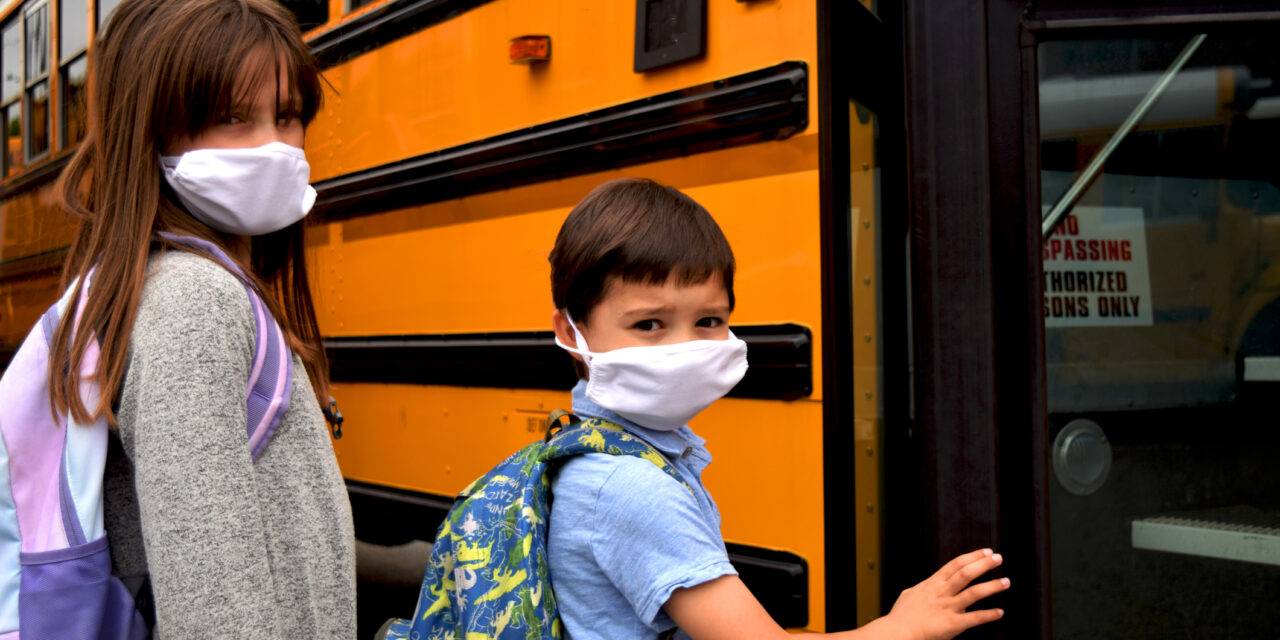
In August, the Centers for Disease Control and Prevention (CDC) recommended universal indoor masking in K-12 schools for all students, staff, teachers, and visitors, regardless of their COVID-19 vaccination status. By September, 18 states and Washington, DC, had responded by issuing mask mandates for some or all K-12 schools. Most of the remaining states have decided to allow school districts to set their own policies. But eight states — including Arizona, Florida, Iowa, Oklahoma, South Carolina, Tennessee, Texas, and Utah — have gone in the opposite direction, opting to ban local mask mandates, including in K-12 schools. That is, they prohibit school districts from requiring K-12 students to wear masks. They’ve issued a mandate against a mandate, if you will.
The divergence in policies among states reflects the stark polarization in attitudes toward the pandemic within school communities. It also invites a number of questions about the legality of mask mandates (and bans on those mandates).
Are mask mandates legal?
It’s fairly clear that the government, including public schools, can require mask wearing as a response to the COVID-19 pandemic. Legally speaking, mask requirements are not unlike vaccination requirements, which states and districts have the authority to impose for the general welfare of their residents (see Underwood, 2020). School districts, most notably Los Angeles, are beginning to require COVID-19 vaccinations of students ages 12 and above. This was inevitable, particularly after postsecondary institutions began to impose (and courts began to uphold) vaccination requirements for students and staff.
Yet, just like opponents of vaccination requirements, mask opponents are heading to court, alleging that mask requirements violate their constitutional rights, including their rights of free speech and free exercise of religion. For example, in Zinman v. Nova Southeastern Univ. (N.D. Fla. 2021), a Florida law student argued that his school’s mask requirement violated his First Amendment free speech rights by compelling him to engage in “expressive conduct conveying a message of subservience to authority” — and that the “refusal to wear a mask is inherently expressive of his disapproval of that message and [of] mask mandates themselves.”
It’s fairly clear that the government, including public schools, can require mask wearing as a response to the COVID-19 pandemic.
The court in Zinman disagreed, stating that mask wearing/non-wearing was not “inherently expressive conduct within the ambit of First Amendment protection” and that “[i]n the context of COVID-19 wearing a mask does not evince . . . subservience to authority — or any message at all. Rather, [it is] a means of limiting the spread of COVID-19.” The court reasoned that “[s]imply framing defiance of a law or regulation as a means of communicating disagreement with that law or regulation” was insufficient to receive free speech protection; otherwise, people could, for example, “refus[e] to wear a seatbelt or a motorcycle helmet, despite laws requiring such safety measures, in protest of being told to do so.” It also observed that the “plaintiff is free to express his opinion about mask requirements in virtually every way other than not wearing a mask — including, say, wearing a mask with an explicit message of protest written on it.” (“I Hate Masks” masks, anyone?)
Freedom-of-religion arguments against mask mandates have also been unsuccessful — so far. In Resurrection Sch. v. Hertel (6th Cir. 2021), a Catholic elementary school, and two parents with children enrolled at the school, challenged Michigan’s requirement that all persons five years of age and older wear a mask indoors, including in public and private K–12 schools. Although the law offered numerous exceptions, plaintiffs alleged that the mask requirement violated multiple constitutional rights, including the right to free exercise of religion under the First Amendment.
More specifically, the Catholic school in Hertel alleged that the mask requirement interfered with its “religiously oriented disciplinary policies and prevent[ed] younger students from partaking fully in a Catholic education.” In turn, parents complained that “their children find masks uncomfortable and distracting from their religious education.” One parent alleged that she was forced to homeschool her son, who she claimed was unable to wear a mask due to his health condition (although his own pediatrician determined that he did not qualify for a medical exemption from the mask requirement).
The Sixth Circuit swatted away these religion-based arguments, citing longstanding Supreme Court precedent upholding the validity of laws of “neutral and general applicability” that have an “incidental effect” on religion (see Emp. Div. v. Smith, U.S. Supreme Ct., 1990). The court concluded that Michigan’s indoor masking law applied “neutrally and generally” to students at both religious and non-religious schools and that the state had a legitimate interest in controlling the spread of COVID-19.
Despite Hertel, religious free-exercise claims in the era of COVID-19 warrant close attention in light of the Supreme Court’s recent willingness to view free-exercise claims expansively in other contexts, including employment discrimination cases (Kim, 2020) and some COVID-19-related situations. For example, in Tandon v. Newsom (U.S. Supreme Ct., 2021) the Court put the kibosh on a COVID-era California rule limiting all home gatherings, whether religious or secular, to three households because, in the Court’s view, the rule treated home religious gatherings less favorably than “comparable secular activities” outside the home.
What about mask mandate “bans”?
In states that oppose mandatory mask requirements, courts have begun to side with mask proponents seeking to delay or stop enforcement of state laws that ban or allow students to “opt out” of local mask mandates (e.g., ARC of Iowa v. Reynolds, S.D. Iowa, 2021, and G.S. v. Lee, W.D. Tenn., 2021). And, in a significant move by the Biden Administration, in September 2021, the U.S. Department of Education Office for Civil Rights (OCR) launched civil rights investigations against seven states for prohibiting indoor mask mandates in schools.
An Iowa case illustrates the legal challenges against mask mandate bans. In ARC of Iowa v. Reynolds (S.D. Iowa, 2021), parents of children with various disabilities — including asthma, cerebral palsy, Down syndrome, and several other congenital conditions — sued to invalidate a statewide prohibition of mask requirements on school district grounds. Plaintiffs claimed the prohibition violated their children’s rights under Title II of the Americans with Disabilities Act and Section 504 of the Rehabilitation Act by causing the “exclusion, denial of equal access, or unnecessary segregation of students with disabilities.”
The court agreed, stating that “Iowa’s mask mandate ban makes it not only dangerous for disabled or immunocompromised children to attend school, but . . . also dangerous for healthy siblings to attend school in person because they risk carrying the virus back to their disabled or immunocompromised siblings.” It concluded that Iowa’s mask mandate ban likely violated federal disability law because, instead of making school programs, services, and activities “readily accessible” to disabled students in the “most integrated setting” possible, it made them available only “under [in-person] conditions that are dangerous to children with disabilities” or through an “inferior” remote learning option that “unnecessarily segregated” them from non-disabled students.
In some states, the legal situation is unclear or in flux.
In contrast to the Iowa ruling, however, some courts have refused to interfere with statewide mask mandate bans. In Wilson ex rel. State v. City of Columbia (S.C., 2021), the state supreme court both upheld South Carolina’s mask mandate ban and voided local ordinances seeking to impose mask mandates in K-12 public schools. That ruling, however, was later overturned in federal court.
The parents of disabled children have so far failed to make headway in Hayes v. DeSantis (S.D. Fla., 2021), in which a federal judge — faulting the parents for not first seeking relief through administrative channels — refused to rule against an executive order that gives Florida parents the “freedom to choose” to opt out of local mask requirements. Similar litigation is pending in the Florida state courts. (And in case you think there aren’t any more novel ways that the school vouchers issue can suddenly rear its head: Florida regulations also provide for scholarships to enable a K-12 public school student who has been subjected to “COVID-19 harassment” for not wearing a mask to transfer to a private school or to another district in the state.)
In some states, the legal situation is unclear or in flux. For example, the litigation landscape in Texas appears to be a mess, with the state and multiple municipalities and districts suing each other in state and federal courts to evade or enforce Governor Greg Abbott’s mask mandate ban. Both sides have achieved at least partial or temporary victories.
Coming soon? Testing the limits of local discretion
It’s worth noting that, so far, “pro-mask” courts don’t appear to be requiring local mask mandates; rather, they are restoring local discretion to impose one or not. For example, in the Reynolds case, in siding with disabled students and halting the statewide masking ban, the Iowa judge stated “there is little harm to Defendants in . . . leaving a universal mask mandate to [local districts’] discretion.”
Similarly, the federal OCR is not investigating whether districts must impose a mask requirement, but whether states are “preventing schools from making individualized assessments about mask use” (Goldberg, 2021). Perhaps this is as it should be. After all, disability law largely invites actions and accommodations based on the facts surrounding particular students and particular schools.
But in case after case, students are reporting, as they did in Florida’s DeSantis case, health-related concerns that make “attending school without a universal mask mandate difficult or impossible.” Given that every public school likely has at least one student with similar concerns, as the pandemic persists, it’s not difficult to imagine hundreds of districts eventually being mired in legal disputes over whether they have “correctly” exercised their discretion. Further federal and state guidance and technical assistance for districts might reduce these districts’ future legal bills — especially if they help to delineate not only when districts must exempt students from mask requirements (as in OCR’s May 2021 guidance), but also under what conditions universal masking may be necessary to preserve students’ rights.
References
Goldberg, S. (2021, August 30). Directed investigation letter: Iowa Department of Education. U.S. Department of Education, Office of Civil Rights.
Kim, R. (2020). The historic Bostock opinion and LGBTQ rights in schools. Phi Delta Kappan, 102 (2), 64-65.
Office of Civil Rights. (2021, May 13). Questions and answers on civil rights and school reopening in the COVID-19 environment. U.S. Department of Education.
Underwood, J. (2020). Measles outbreaks motivate change. Phi Delta Kappan, 101 (7), 64-66.
This article appears in the November 2021 issue of Kappan, Vol. 103, No. 3, pp. 64-65.

ABOUT THE AUTHOR

Robert Kim
Robert Kim is the executive director of the Education Law Center, based in Newark, NJ. His most recent book is Education and the Law, 6th ed.