In this week’s newsletter: The school ICE raid that never happened. The stunning failure of DC’s middle school anti-truancy program. A professor who found “everyday racism” in classrooms picks a school for her own child. Reflections on school reform from The New York Times’ Dana Goldstein. And: Is it time to return to Twitter? (Yes.)
THE ICE RAID THAT NEVER HAPPENED
The big education story of the week
The big education story of the week is the ICE raid on a LAUSD elementary school that never happened.
Fears and speculation about an ICE raid at Gratts Elementary school were originally spread on social media through a highly emotional reaction from an LAUSD staffer whose video has nearly 8 million views on Twitter alone. However, there was no such raid.
According to Snopes, “A TikTok user claimed parents ran out of a ceremony at Gratts Learning Academy when federal immigration agents showed up.” Asked about the rumored raid, LAUSD superintendent Alberto Carvalho told the LA Times that “no such event happened.”
The good news is that no major outlets appear to have reported the rumor as news. A few quickly knocked it down (LA Daily News, The19th ). Some outlets reported community fears (LA Times, USA Today). Others described district efforts to protect kids and parents (The 74, EdSource).
However, the incident illustrates the corrosive combination of advocacy-fueled fears of ICE raids and of an immigrant “invasion,” unchecked social media — and the need for coverage to emphasize when fears are unfounded. Kids and parents are not being rounded up at schools. Suggesting that they are — or speculating that they might be — adds unnecessary terror and interrupts kids’ lives.
In fact, Denver schools recently withdrew its lawsuit against DHS because a judge found that there was little practical difference between the Biden-era “protected spaces” policy and the Trump administration’s changes. (Denverite, KDVR).
Other big education stories of the week include the Supreme Court’s accommodations decision (Washington Post, NPR, AP, EdWeek) and the ‘No Kings’ protests this weekend (The Guardian). Follow @thegrade_ for daily education news headlines.

FAILED ANTI-TRUANCY, DEMOCRATIC INFIGHTING, & LOWELL’S LOTTERY KIDS
The best education journalism of the week
🏆Empty desks: How the District’s failure to curb truancy in middle schools fueled the biggest youth crime surge in a generation (Washington Post).
🏆Democratic Debate Over Private School Choice Reveals Post-Election Tensions (The 74)
🏆How Washington is stressing out American schools (Washington Post)
🏆Florida schools face alarming rise in absences since pandemic (Sun Sentinel)
🏆These graduating Lowell students were called ‘lottery kids.’ The stigma never went away. (SF Chronicle)
EMPTY DESKS. REFORM’S DEMISE, & CLASSROOM RACISM
Our latest columns and commentary
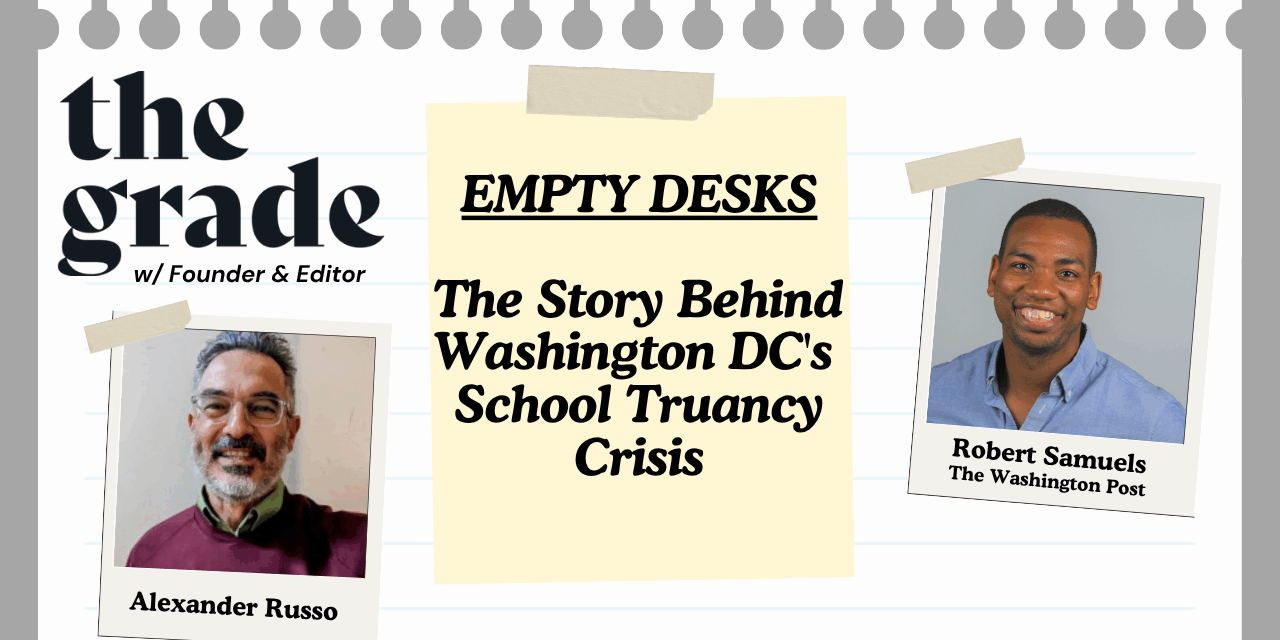
On Thursday, I had the chance to talk with Pulitzer Prize-winning Washington Post reporter Robert Samuels about Empty Desks, the investigative piece he wrote with Lauren Lumpkin and others.
“At the beginning, we were told that truancy became this huge problem for middle schoolers after the pandemic,” Samuels told me about reporting the story. “But when we did the research, what we had found was that that problem had started long before the pandemic.”
Asked about the Post’s spotty record covering DCPS, Samuels notes that this story has generated enormous attention. “I’d hope that [reader response] would help remind those in management about the importance of doing local investigations.”
You can watch our half-hour video interview or read the uncorrected transcript.
ALSO:
In her recent interview with AEI’s Rick Hess, the NYT’s Dana Goldstein blamed the demise of bipartisan reform on its focus on standardized testing: “There was no natural constituency among parents for a heavily standardized test-based education system, and it fell apart,” says Goldstein. Standardized testing “was really the downfall of the bipartisan education reform of the early 2000s,” according to the national education reporter, whose remarks generated a lengthy discussion on X.
This week we also published a new piece by sociologist and forthcoming book author Ranita Ray about how her experience observing everyday classroom racism informed her efforts to pick a school for her child. Ray’s book SLOW VIOLENCE comes out in August.

PEOPLE, JOBS, & EVENTS
Who’s going where and what’s happening?
Above: “It was an honor to speak at the National Press Foundation earlier this week,” noted the Hechinger Report’s Jill Barshay (pictured). “But now see that 1) I need one of those warm-toned ring lights and 2) I need to tidy up my home office!”
📰 Broadcast: In an On Point segment, the NYT’s Stephanie Saul talked about what the loss of international students could mean for the U.S. A new episode from NPR’s Through Line tells the fascinating story of The First Department of Education (i.e., the one that came before the current one).
📰 New follows: Quintessa Williams (Word In Black), Katie Jane Fernelius (Verite New Orleans), Julie O’Donoghue (Illuminator LA), Candice Wilder (Mississippi Today), Phillip W.d. Martin ( GBH Boston) Gintautas Dumcius (Commonwealth Beacon), Sonia A. Rao (New York Times), Krystal Knapp (Planet Princeton), & Savannah Newhouse (USDOE).
📰 Nontraditional voices, alternative approaches, and emerging platforms: Until this week I didn’t know about Verite News New Orleans, which features an education page. This week’s collection includes Michael Shoemaker, a high school history teacher who has 190,000 TikTok followers and provides attitude-heavy millennial takes including how we should stop complaining about the American education system since there are actually 50 separate state systems. Then there’s Mary Pat Campbell, an actuary, “math geek” and indefatigable newsletter writer who covers topics as varied as the Chicago School Board and public pensions. Last but not least, check out Dissident Teacher, a former district educator whose recent posts include five ideas to save K-12 education and Your Kids Are Nothing More Than a Revenue Stream.
At least one observer wasn’t impressed with the HISD Facebook page we featured in last week’s roundup of nontraditional information sources, calling it an example of “how teachers (usually retired and former) corral parents into fighting against better outcomes for kids and safer, calmer schools.” I recommend you read the whole thing. Speaking of last week, I’m generally a fan of The Free Press, but knee-jerk stories about critical race theory don’t seem particularly helpful or interesting in 2025.
📰 Quotable:
“It’s up to journalists to take action to avoid accidentally amplifying champions of illiberalism.”
“High school graduation rate is the biggest BS metric in education.”
“This explains why Josh [Cowen] would offer such a one-sided take on school choice.”
THE KICKER
We saved the best for last!

That’s Des Moines Register state education reporter Samantha Hernandez responding to #tellEWA no longer being a thing on Twitter/X.
That’s all, folks. Thanks for reading!
Reply to this email to send us questions, comments or tips. Know someone else who should be reading Best of the Week? Send them this link to sign up.
Using Feedly or FlipBoard or any other kind of news reader? You can subscribe to The Grade’s “feed” by plugging in this web address: http://www.kappanonline.org/category/the-grade/feed/.
Read more about The Grade here. You can read all the back issues of The Grade’s newsletter, Best of the Week, here.
By Alexander Russo