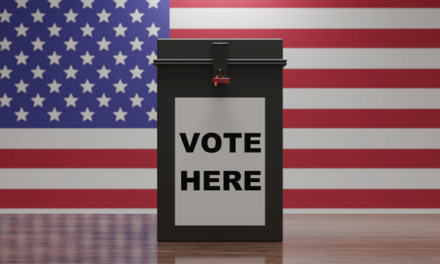
They set up a polling booth in the hallway. I remember small curtains draped to cover the entrance into a square foot of space filled only by a table and a child-friendly facsimile of a ballot box. This was the first time that I ever “voted” in a presidential election. I was in the 1st grade.
I find myself revisiting this moment in pursuit of an answer to much larger question: What should we demand from 21st-century civics education? For me, I imagine it to be something that makes me feel the way I felt that day as a politically engaged six-year-old. I remember the sense of pride in my voice as I told my mother about what I had done at school that day. The 1st-grade teachers all conspired to promote the importance of civic duty. It felt as if I had experienced a rite of passage into adulthood. I wish we could bottle this feeling.
Unfortunately, a less than desirable experience came after. As much as I swelled with pride after casting a ballot for the first time, I experienced a massive deflation in the days that followed. What happens now? In my six-year-old life nothing immediately changed. A president. A governor. Congress. Who are these people? What does all this mean? Suddenly, politics felt distant.
We need a civics education kids can feel. We need that educational experience to be enduring. I enjoy reading because words give me sensory access to all corners of the world. I appreciate math because, if nothing else, it comes in handy. We need a modernized version of civics education that satisfies these conditions as well.
Why don’t we have this already?
The modern form of civics education in the U.S. has two problems. First, its original purpose is not educational. It was designed to execute a national assimilation project (Crittenden & Levine, 2007).
Throughout the 20th century, the reach of the common school expanded. That model sought to teach students how to be moral citizens who can adeptly participate in a liberal democracy. Yet, through the efforts of nativists with xenophobic fears and corporate interests angling to exploit immigrants as cheap labor, civics education morphed into a process for “Americanizing” those not born on U.S. soil (Love, 2019).
This assimilation project included the passage and implementation of nationalist state and federal laws (Prinzing, 2004). Legislatures in states with a measurable foreign-born population passed laws to create programs that would educate these immigrants in the English language and American history. Federally, we saw laws promoting ceremonies that celebrate naturalization and patriotism. In an effort to quell “radical” threats to nationalism, Congress voted in 1921 to convert what was known as International Workers’ Day into Loyalty Day, a federal holiday that still technically exists but is no longer observed. Civics education was literal indoctrination.
The second reason civics underperforms is due to a lack of widescale reform. A growing list of organizations like Generation Citizen, Facing History and Ourselves, and iCivics offer cutting-edge civics curricula. At the Center for Educational Equity, we have been at the forefront of advancing these ideas toward changes in legislation. Now, in New York state, districts and schools can opt into the Seal of Civic Readiness Initiative, which formally recognizes students for demonstrating a high proficiency in civic knowledge (Kissinger, 2022). These models privilege either experiential learning or the integration of technology.
Efforts at major civics reform have not penetrated the national political agenda. Since 2020, federal lawmakers have put forward bills looking to add teeth to the jaws of civics education. None of them have even made it out of committee and onto the House or Senate floor for a vote.
At the state level, there has been progress. Most states (30) require high school students to complete a standalone civics course. A slight majority of states (26) have embedded constitutional knowledge, understanding of democracy, and political participation as primary curricular standards. Even more states (33) emphasize digital media literacy as a core principle for civics curricula. The states adopting these standards span the partisan spectrum, representing a small, bipartisan surge of useful reform.
Yet, the rest of what we know about state-level policy feels underwhelming. While most states require a high school civics course, only seven require that students receive a full year of civics instruction. Twenty states have no civics requirement at all for middle school students. There is a lack of support for the more sensory-based experiential curricula. Maryland is the only state that requires community service for high school graduation; less than half of states offer students course credit for community service work. In practice, civics is all about active engagement in communities. Yet, civics education is largely sterile knowledge accumulation, at best.
Where do we go from here?
We, as a society, need to see the true urgency of civics education. We take it for granted that students will gain this knowledge somehow, but when it comes to making it part of the curriculum, we treat it as an outdated luxury feature. If reading and STEM are the vehicles that carry students into the future, civics is the 12-disc CD changer collecting dust in a dark corner of the trunk.
When kids don’t learn math and show low proficiency in science, we shift into crisis mode. In 2021, the federal government spent almost $4 billion on STEM education programs. Over four years, the Gates Foundation spent $1.1 billion on supporting efforts to improve math education. Much of this investment has gone into developing and testing new curricula that include problem-solving, real-world application, and cultural relevance. Researchers argue that we can solve the math and science crises by making the content something that kids can see and feel.
Civics education requires the same urgent attention. We need uniformly adopted curricula that prepare kids not just for political participation but for genuine real-world problem solving. Our kids should leave schools equipped with what Harvard political scientist Danielle Allen eloquently calls a “participatory readiness” (2016). The new civics education is not an education of knowledge; it’s an education of action.
To fix what’s broken in America, we need to make civics education part of our infrastructure. Individual wealth, even collective wealth, won’t save us. It will take an engaged, coordinated citizenry that is knowledgeable about the inner workings of government to address, for instance, the complexity of housing affordability and helping the unhoused remain off the streets. Climate change, food deserts, access to quality medical care — these issues require civic solutions. Civics education needs to be a training ground where students are learning, through simulation, how to respond to these major dilemmas at the community level and up. This is the vision for what civics education must be.
What happens now?
I think back to that election day in 1st grade. I can’t help but lament the excitement that waned over time. I wish I understood then that I was practicing something that truly mattered. Not because it was my civic duty, although that is important, but because I was learning to use a tool from a larger toolbox. It will take elite skill with everything in that toolbox to save America.
References
Allen, D. (2016). What is education for? Boston Review, 41 (3).
Crittenden, J. & Levine, P. (2007). Civic Education. In E.N. Zalta & U. Nodelman (eds.), The Stanford encyclopedia of philosophy (Summer 2024 edition). Stanford University.
Kissinger, L. (2022). Civics diploma seals: Energizing civic education for students. Social Education, 86 (3), 209-215.
Love, B.L. (2019). We want to do more than survive: Abolitionist teaching and the pursuit of educational freedom. Beacon Press.
Prinzing, D. (2004, September). Americanization, immigration, and civic education: The education of the “ignorant and free” [Paper]. German/American Conference, San Diego, CA.
This article appears in the November 2024 issue of Kappan, Vol. 106, No. 3, p. 50-51.

ABOUT THE AUTHOR

Jonathan E. Collins
Jonathan E. Collins is an assistant professor of political science and education at Teachers College, Columbia University, New York, the associate director of the Teachers College, Columbia University Center for Educational Equity, and the founder and director of the School Board and Youth Engagement (S-BYE) Lab.