In this week’s newsletter: Grading Biden. Anticipating Trump. Burned-out schools in Los Angeles — and insights from the reporters covering them. Questioning the long-held belief in special ed inclusion. Surprising praise for immigrant education and deportation coverage from an immigration expert. School secrecy, Part 2: What happened in Massachusetts? The j-school professor behind so many education journalists’ books.
GRADING CARDONA & ANTICIPATING McMAHON
The big education story of the week
The big education story of the week is the sharp transition from the Biden administration to the second Trump administration, with all the shocks that may bring.
In his final week as U.S. Education Secretary Miguel Cardona sat for generally softball interviews with several major outlets (AP, NPR, Washington Times) and at least one trade pub (K-12 Dive).
Two outlets settled for a dispatch from a two-hour “celebration” that the USDE held to commemorate their four-year reign (EdWeek, Inside Higher Ed).
NPR’s Cory Turner took perhaps the most original approach, asking various edu-big-shots to grade Cardona’s tenure (NPR). The Washington Post ran the AP story. I didn’t see anything from the Times.
Come on, folks. You’re trying to rebuild credibility.
A few others dug into Cardona’s likely successor, Trump nominee Linda McMahon, who won’t face confirmation until after Monday’s inauguration (ABC News, WBUR, Politico). The big Trump transition stories continue to be schools gearing up to protect undocumented kids in a second Trump term (NYT, USAT) and the potential spread of private school choice (Christian Science Monitor, EdWeek, ProPublica).
Other big education stories of the week include the LA wildfires’ effects on schools and students (see below), Chicago’s newly elected school board, and a data breach of the student information system PowerSchool that we missed last week. Check out @thegrade_ for each day’s most important education news.
BURNED-OUT SCHOOLS & DISPLACED STUDENTS
The best education journalism of the week
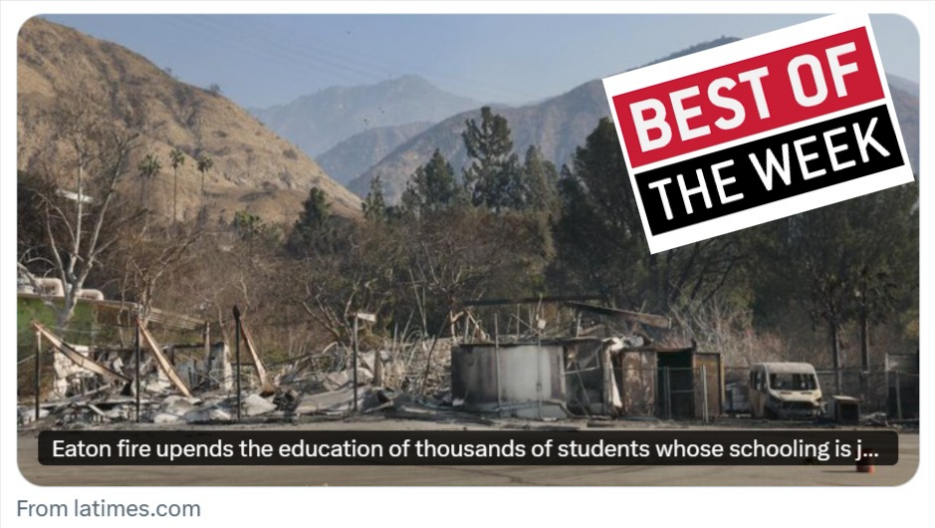
The best education journalism of the week is Eaton fire upends the education of thousands of students whose schooling is jolted again by Teresa Watanabe and Daniel Miller of the Los Angeles Times.
The magnitude of loss for schools is huge — roughly a dozen public, charter and private schools burned to the ground along with another 12,300 structures. At one school, 40% of families who answered a survey said their homes had been destroyed. One estimate puts the number of students out of school at more than half a million during the height of the disaster.
Watanabe, a longtime education reporter, and Miller, an enterprise reporter, focus mostly on the human toll in the foothill community of Altadena and the coastal enclave of Pacific Palisades. Educators in these places are now scrambling for classroom space to re-open, even as students, teachers and families reel from personal loss.
The piece comes alive when it simply lets students react to the horror. One high school senior who couldn’t get home watches videos of the gutted space where his house once stood — it’s now just “piles of black and gray ash.” He “did not cry. But he lay on the floor for an hour, dazed.” He later tells the reporters that he can’t really comprehend the magnitude of loss. “Like, I feel like I could wake up in my bed at any moment and this is just all a dream.”
This is a valuable piece of deadline storytelling that brings home the scope of the devastating fires.
Americans experienced 27 weather-related disasters costing $1 billion or more in damage last year — the 2nd-highest number ever, according to Vox. We’re all climate reporters now, argues Hechinger’s Caroline Preston in a new piece for The Grade.
Other education stories we liked include more great schools-focused wildfire reporting from a national education reporter based in LA (Wall Street Journal), how Philly high school students built a library from scratch (Philadelphia Inquirer), and how a handful of billionaire donors focused on religious schools expanded vouchers for all students into a dozen states (ProPublica).
SILENCE & SECRECY, PART 2: WHAT HAPPENED IN MA?
Our latest columns and commentary
The second installment in our January series on school secrecy and sexual assault is from Marina Villeneuve, now at the Hechinger Report: How I penetrated a wall of silence to document sexual abuse of Massachusetts students.
The first installment, an interview with Louisville Courier-Journal investigative reporter Stephanie Kuzydym, focused on unreported sexual abuse by middle and high school sports coaches.
Coming soon: Interviews with Charol Shakeshaft, the researcher who wrote an influential book on sexual abuse in schools, and Newsday’s Jim Baumbach, who with colleague Joie Tyrrell has reported on widespread sexual abuse and secrecy in Long Island, NY school districts. Any other journalists, experts, or practitioners we should talk to about school secrecy and sexual abuse of students by adults?

Above: Clockwise from the top left: Education reporters covering the LA wildfires up close include Teresa Watanabe (LA Times), Jonaki Mehta (NPR), Sara Randazzo (Wall Street Journal), Gabrielle Birkner (Chalkbeat), Jillian Jorgensen (NY1), and Dan Rosenzweig-Ziff (Washington Post).
PEOPLE, JOBS, & EVENTS
Who’s going where and what’s happening
📰 Kudos to all the local and national ed reporters who produced powerful firsthand coverage of the LA wildfires, including the Wall Street Journal’s Sara Randazzo, the LA Times’ Teresa Watanabe, the Washington Post’s Dan Rosenzweig-Ziff, NPR’s Jonaki Mehta, the San Gabriel Valley Tribune’s Teresa Liu, Chalkbeat’s Gabrielle Birkner, and NY1’s Jill Jorgensen.
Reflections from two of them about the experience:
“When a massive natural disaster like fire strikes in your city, it doesn’t matter what your beat is,” writes the WSJ’s Sara Randazzo, who jumped in to help with the coverage while her husband and two kids found safety at a family member’s house further from the fires. Back on the education beat, she wrote about a school that had burned down and the challenges of trying to keep a school community together in the aftermath. “Natural disasters almost always have an education angle, even if it’s helping keep readers apprised of school closures. The longer-term impact on student learning — and what it means to teach a population of students who have lost their homes — comes later and is equally important.”
“I grew up in Los Angeles, and wildfires have always been a reality of living here. But the scope of the devastation this past week has been unlike anything most Angelenos have ever seen,” writes Chalkbeat’s Gabrielle Birkner. Her reporting zoomed in on a school community in Altadena “where the campus was almost totally destroyed, and scores of school families — and a handful of staff members — lost their homes. Chalkbeat wanted to understand what this acute period looked like for this tight-knit school community and what it would take for it to move forward.”
📰 Congrats also to Hechinger’s Jill Barshay, who got out in front of everyone talking to a top scholar who says the evidence for mainstreaming disabled students is “fundamentally flawed.” Her thread explaining what she found.
📰 Commentary: “I think that the coverage has been pretty good,” says Migration Policy Institute’s Julie Sugarman (who wrote a piece for The Grade on covering immigrant students last summer). “I don’t think it’s helpful to pretend that challenges don’t exist, because that frustrates practitioners and keeps us from finding solutions.” On deportation, insiders worry about coverage creating undue panic. “But again I think the fear is real and worth documenting, at a minimum, and could help potential allies in the general population see what the impacts of potential policies are.”
📰 Research and reports: At least eight states have enacted cell phone bans over the past two years, and proposals are being considered in several more states this year, according to AP. School culture wars cooled considerably in 2024, according to Cato. ProPublica’s private school demographics database is up, allowing comparisons between private schools and nearby public schools. (Join a 1/31 webinar to learn more.)
📰 Comings and goings: Ed reporter Kati Kocal is leaving the Palm Beach Post to start next month at Milwaukee public radio station WUWM. Former education reporter Priska Neely is in her second week as Training Manager for Report for America. The 74 has hired longtime contributor (and previous Omaha World-Herald reporter) Lauren Wagner as a staff writer. Longtime education reporter Kate McGee Balagia is moving off the beat to become a Texas Tribune investigative reporter. Jessica Priest is the Tribune’s new higher ed reporter. (ICYMI, Jaden Edison is the K-12 reporter). Anyone else changing jobs (or beats)? Let us know!
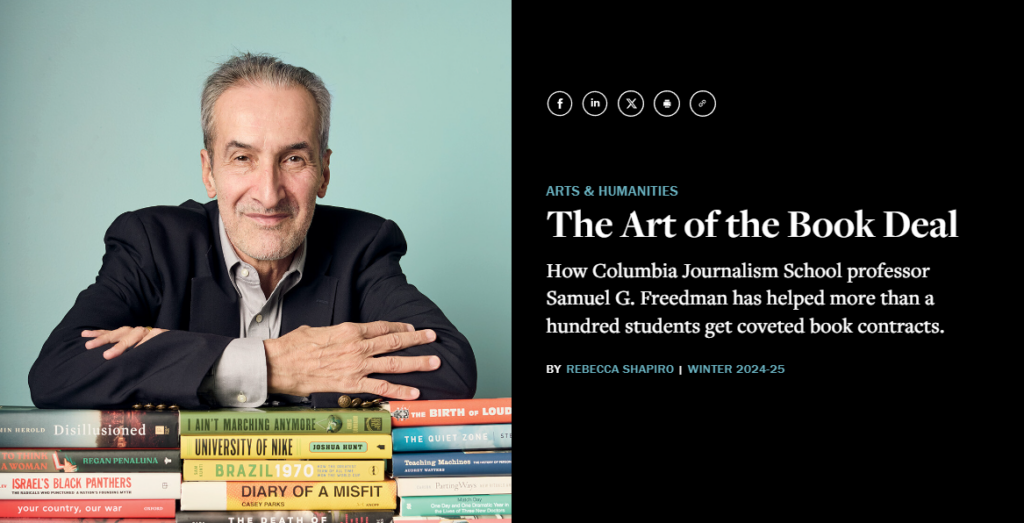
Above: Columbia Journalism School prof. Samuel Freedman
THE KICKER
We saved the best for last.
I count at least three education titles on the pile below longtime Columbia Journalism School professor Samuel Freedman (above), who’s retiring after a career spent helping Spencer Fellow education journalists (like me) and many others turn their story ideas into books.
That’s all, folks. Thanks for reading!
Reply to this email to send us questions, comments or tips. Know someone else who should be reading Best of the Week? Send them this link to sign up.
Using Feedly or FlipBoard or any other kind of news reader? You can subscribe to The Grade’s “feed” by plugging in this web address: http://www.kappanonline.org/category/the-grade/feed/.
Read more about The Grade here. You can read all the back issues of The Grade’s newsletter, Best of the Week, here.
By Alexander Russo