As a PDK Distinguished Educator Fellow nearing the culmination of his career in teacher preparation and a high school graduate just starting his journey, we are at different points on the same path. Despite the generational gap, we share a common vision: to ensure broader access to teacher preparation programs like Educators Rising, allowing all students to explore the teaching profession, regardless of whether they are enrolled in career and technical education (CTE) pathways.
A multigenerational perspective on teacher preparation
While teaching in Texas public schools from 1984 to 1990 and preparing new teachers in higher education programs from 1990 to today, I’ve witnessed how our education system has evolved. Teacher shortages, which were an issue during my early years in the classroom, remain a significant challenge today. However, the strategies to combat this problem must evolve. This is where the next generation, including Calvin Plante, brings invaluable perspective. As a recent graduate from Pinkerton Academy High School in New Hampshire and a PDK Educators Rising Ambassador, Calvin represents the future of the profession, and his insights offer fresh urgency to the call for policy reform.
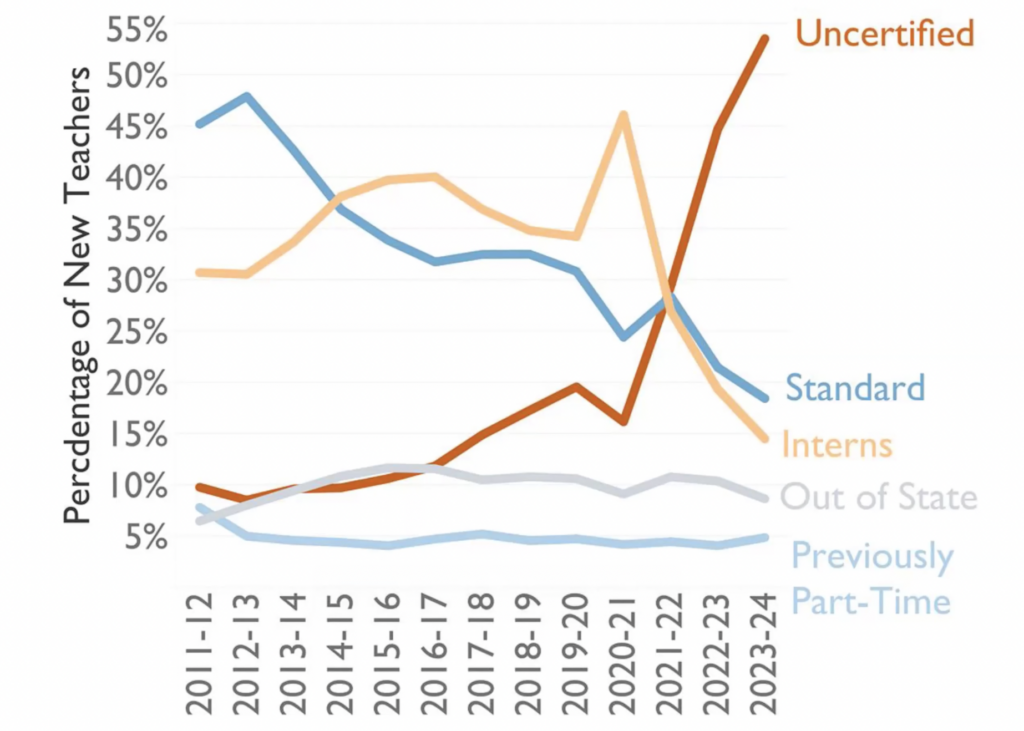
Citation:
Marder, M. (2024). The rise of uncertified teachers in Texas: Bad for kids, bad for business. UTeach Institute, University of Texas at Austin.
Calvin’s enthusiasm for teaching is palpable, yet his journey might never have begun if not for his involvement in Educators Rising. Unfortunately, in New Hampshire and several other states, access to Educators Rising is limited to students who are already enrolled in the education CTE pathway. This restriction means countless students who might otherwise consider teaching as a career never have the opportunity to explore the profession.
What is Educators Rising?
Educators Rising is a career and technical student organization (CTSO) dedicated to cultivating a new generation of highly skilled educators. With chapters in high schools across the U.S., the program provides students with the tools, resources, and practical experiences they need to develop a passion for teaching.
Students in Educators Rising engage in hands-on experiences in classrooms, leadership development, and competitions that allow them to showcase their skills. The program also offers access to scholarships, professional development, and mentorship from experienced educators, all of which help shape a future workforce dedicated to improving education.
Placing limitations on who can participate in Educators Rising prevents the program from reaching its full potential. Making the program available only to students enrolled in the CTE education pathway in certain states is shortsighted.
Broadening access to address the teacher shortage
The teaching profession is facing a significant shortage of qualified candidates, particularly in rural and underserved areas. According to recent reports, many states, including New Hampshire, are struggling to fill teacher vacancies in critical subjects like math, science, and special education. This shortage will only worsen unless we take bold steps to broaden the recruitment pipeline.
One way to address this challenge is to expand access to teacher preparation programs like Educators Rising. Expanding access to all interested students, not just those on the CTE track, can significantly increase the pool of future teachers.
The benefits of early exposure
High school is a critical time for career exploration. Allowing students to engage in programs like Educators Rising, even if they aren’t on the traditional education track, opens doors for those who may have never considered teaching as a viable career. Calvin’s own experience speaks to this: “I didn’t know I wanted to be a teacher until I had the chance to work with younger students through Educators Rising,” he says. “It wasn’t until I had that exposure that I realized the impact I could have on future generations.”
This kind of early exposure is invaluable, not just for students like Calvin but for the entire profession. Allowing more students to participate in Educators Rising can spark interest in teaching earlier, giving them a chance to build a commitment to the profession before they reach college. In addition, students who may be undecided about their career paths can use this program to explore teaching, potentially drawing in those who might not have otherwise considered education as a career.
Building a more diverse teaching workforce
Another critical aspect of expanding access to Educators Rising is the potential to increase diversity in the teaching workforce. Currently, the U.S. teaching population does not reflect the diversity of the student body, and research consistently shows that students benefit from being taught by educators from diverse backgrounds. By allowing broader participation in Educators Rising, we can recruit future teachers from a wider range of racial, cultural, and socioeconomic backgrounds.
Educators Rising programs are uniquely positioned to foster this diversity by creating an inclusive environment where students from all walks of life can see teaching as a career option. As more students are exposed to the program, the diversity of the teaching workforce will naturally increase, providing students with role models who better reflect their experiences and communities.
Expanding Educators Rising
Our message is clear: If we are to address the teacher shortage effectively, we must expand access to Educators Rising to all students, not just those in a CTE pathway. This policy change will not only grow the pool of future teachers but also allow students to make more informed career choices and contribute to a more diverse and inclusive educational system.
To expand access beyond the traditional CTE pathway, schools could offer Educators Rising as an elective course available to all students. Alternatively, districts might establish after-school clubs or extracurricular programs to reach students who are unable to fit an additional course into their schedules. Hybrid models combining elective coursework with extracurricular components could also provide flexibility and broader participation opportunities. These approaches ensure that all students with an interest in teaching, regardless of their academic track, have a pathway to explore and prepare for a career in education.
We encourage those who make decisions about how to structure their schools’ CTE programs to look at successful models in other states and take immediate steps to make Educators Rising available to more students. As both a seasoned educator and a young aspiring teacher, we urge state officials to recognize the importance of making Educators Rising available to every high school student with an interest in teaching.
This article was written as part of PDK’s 2024 Emerging Leader and Distinguished Educator programs.
ABOUT THE AUTHORS

Michael Odell
Michael Odell is a professor of STEM Education at the University of Texas at Tyler. He has been an educator since 1984 in both the K-12 system and higher education. Odell has held several administrative positions at the university and cofounded the UT Tyler University Academy charter Laboratory Schools.

Calvin Plante
Calvin Plante is a recent graduate of Pinkerton Academy High School in New Hampshire. He is now in his first year at American University in Washington, D.C., majoring in secondary education and history. He is in his second term as an Educator Rising National Ambassador and currently serves as the president of the Educators Rising chapter at American University.