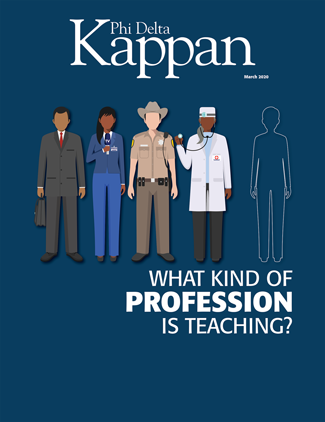
This month’s Kappan focuses on an especially timely question: “What kind of profession is teaching?” As I write this column, thousands of Florida’s teachers have just concluded a one-day rally in Tallahassee to press legislators to boost education spending. Recent months have seen similar rallies and strikes in several other states and in dozens of cities and towns, focusing not just on funding and salary increases but also on a number of other professional concerns, having to do with school resources, standardized testing, class sizes, course loads, teacher evaluation systems, and more. It’s far too soon to tell whether this flurry of teacher activism will evolve and endure. However, it hardly comes as a shock that after two decades of having education reforms thrust upon them, rather than being treated as partners in efforts to improve schools, many teachers would want to assert greater influence over their professional status and working conditions.
But while this month’s issue gives special attention to the teaching profession, one could make the case that every issue of Kappan, for 101 years and counting, has been dedicated to strengthening the professional identity of teachers and other educators.
From the start, this magazine has aimed not just to share research findings and commentary about teaching, learning, and school leadership, but also to provide a window into the profession itself. In fact, the very first research study the magazine published, in 1921, was a member survey meant to determine “why more of the most capable young men” — as all PDK members were at the time — “who graduate from high schools do not prepare for a life career in education.” (The leading responses, by far, were “inadequate salaries” and “lack of respect for education as a profession.” The latter, respondents said, was due mainly to the prevailing view of teaching as “a woman’s job.”)
Further, Kappan’s founders saw the publication of this magazine as, in itself, an essential means of building and sustaining their profession. As one early contributor explained, in 1926, “Progress in all the professions has been due to the fact that the professions themselves have determined what their standards shall be,” and Kappan was to be the place where PDK members would hash out those standards. By reading, writing for, and discussing the magazine, schoolteachers and administrators would determine their shared values, beliefs, principles, practices, and norms.
In the decades since, many movements to professionalize teaching have come and gone, including efforts to toughen the field’s entry requirements, require university degrees, build career ladders, offer advanced certification, involve teachers in evaluating their peers, and so on.
Strikingly, however, the contributors to this month’s Kappan — especially Pam Grossman, Susan Moore Johnson, and Edit Khachatryan and Emma Parkerson — propose something similar to what this magazine’s founders had in mind in 1915. As they see it, the surest way to define and strengthen educators’ professional identity is to provide opportunities for them to engage in serious and ongoing conversation about their work and how to improve it.
Public school teaching in the U.S. has never met all the formal criteria that define professions like medicine, law, and architecture. Perhaps, as many have argued, it’s better described as a “semi-profession,” like nursing and social work. Or maybe teaching requires its own unique conception of what it means to be a professional. But whatever teaching is, it tends to thrive when educators come together — in their workplaces, networks, and the pages of Kappan — to discuss teaching and learning, identify their most pressing problems, and find solutions.
ABOUT THE AUTHOR

Rafael Heller
Rafael Heller is the former editor-in-chief of Kappan magazine.