Teachers’ beliefs about their students may affect their willingness to change their practices. Changing those beliefs may be a key step toward spreading effective teaching practices to all classrooms.

Getty Images
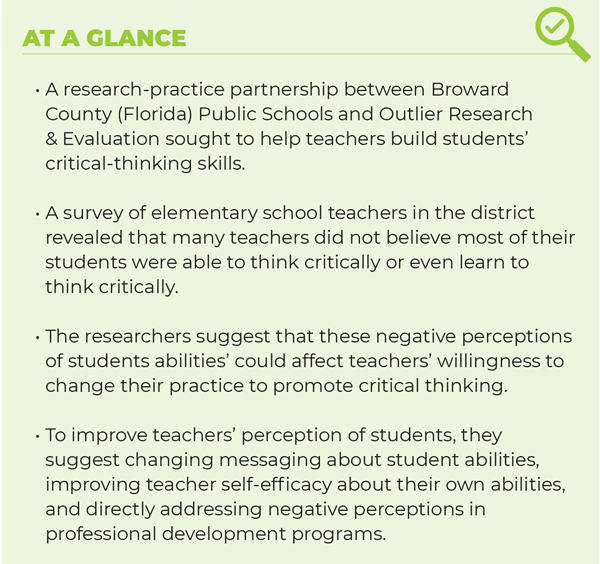
How do teachers perceive their students’ abilities? We would like to believe that all teachers recognize the greatest potential in all students. But what if they don’t? How does that affect their desire to change their practice to reach particular students? As part of a research-practice partnership (RPP) between Broward County (Florida) Public Schools (BCPS) and Outlier Research & Evaluation, a research group at the University of Chicago, we asked these questions of approximately 6,000 elementary teachers. The surprising answers we received suggest an important alternative focus for teacher professional learning and educational improvement.
With the support of the William and Flora Hewlett Foundation, Outlier partnered with BCPS to spread what the Hewlett Foundation refers to as “Deeper Learning” practices in the district. We focused in particular on teaching practices that supported students’ critical thinking. Our team provided capacity-building support for teachers to implement these practices, while also considering possible barriers to spreading the practices. As we engaged in the work, we began to speculate about the teachers’ motivation and commitment to change their own practices to support their students’ critical thinking. We wondered, “Might teachers’ perceptions of their students’ abilities to engage in critical thinking affect their willingness to change their teaching?” We administered questionnaires to BCPS elementary teachers to find out.
Teacher expectations and student outcomes
While there is very little literature on the relationship between teachers’ perceptions of their students and those teachers’ willingness to engage in new teaching practices, there is a great deal of research on the relationship between teachers’ expectations and student outcomes (Rubie-Davies et al., 2015; Tenenbaum & Ruck, 2007). Essentially, students are more likely to succeed with teachers who have high expectations than they are with teachers who have low expectations (Good & Nichols, 2001; Rubie-Davies et al., 2015). Furthermore, research shows that teachers’ expectations sometimes are associated with students’ race, gender, socioeconomic status, and other characteristics (Gershenson, Holt & Papageorge, 2015; Jamil, Larsen, & Hamre, 2018). This leads to varied and inequitable teaching practices. These relationships are more acute for students in the early grades (Kuklinski & Weinstein, 2001), and the effects persist over years for some students, especially those from marginalized groups (Hinnant, O’Brien, & Ghazarian, 2009).
The relationship between students’ race and ethnicity and teachers’ expectations appears at multiple school levels. For example, studies have shown that teachers have lower expectations for low-income and Black students (Diamond, Randolph, & Spillane, 2004), and these expectations can move beyond a single student to a whole class. For example, one study found that class-level teacher expectations were significantly associated with students’ academic outcomes as well as students’ perceptions of their own academic competence (Rubie-Davis, Flint, & McDonald, 2012). And finally, research has shown that teachers feel less responsibility for student learning in schools with a large makeup of Black students than they do in schools with a higher percentage of white and Asian students (Diamond, Randolph, & Spillane, 2004).
To state it plainly, teachers modify their instruction according to their expectations of whether they will have an impact on student learning (Burgess & Greaves, 2013; Mechtenberg, 2009). Teachers with high expectations for all students believe that their instruction can promote learning for all (Rubie-Davis et. al, 2015). Furthermore, they believe that developing unbiased expectations based on students’ actual performance, rather than prior performance or stereotypes, can promote student learning and success (Rubie-Davis et. al, 2015).
For our RPP, this research raises an important question: How might teachers’ perceptions of their students’ abilities be potential barriers to our efforts to promote teaching practices that support critical thinking?
Studying teacher beliefs
In the long-standing partnership between Outlier and Broward County Public Schools (the sixth largest school district in the country), researchers work arm in arm with teachers. Together, we developed a strategy that focused on teaching critical thinking, with a focus on the skills of argumentation, using evidence, and communication. The evolving strategy included demonstration schools, teacher webinars on specific classroom strategies, garnering support from the central office, and clear messaging to teachers about expectations and practices. Our work started before the COVID-19 pandemic and before the increased visibility of the Black Lives Matter movement in 2020, both of which subsequently caused us to reflect on and revise our approaches and messaging.
Concurrent with the capacity-building efforts, we administered teacher questionnaires in 2019, 2021, and 2022 that, among other things, asked teachers to share their perceptions of their students’ abilities to engage in critical thinking. In our fall 2019 administration, we found that a strong majority of teachers perceived that 50% or fewer of their students were not able to think critically (see Table 1).

In our spring 2021 administration, the results were similarly disappointing. Specifically, we asked teachers, “What percentage of your students ARE ABLE to think critically right now?” Nearly 72% of the responding elementary teachers reported that 50% or fewer of their students were able to think critically. Similarly, when asked, “Right now, what percentage of your students are able to LEARN to think critically?” more than a third (34%) of teachers reported that 50% or fewer of their students were able to LEARN to think critically right now. This suggests that they believed at least half of their students could not learn to think critically. Why did teachers perceive that so few of their students were able to think critically or even able to learn to think critically?
Sources of low expectations
Our RPP team steadfastly believes that all students can think critically and that appropriate instruction can help them build their thinking skills. We had made that explicit in our communication, but it appeared that teachers weren’t hearing our message. Thus, we set out to understand why teachers perceived their students this way and determine what we could do about it.
We decided to interview teachers to explore what was behind their perceptions. In spring 2021, we interviewed 16 teachers and two administrators. During the interviews, we shared the 2019 questionnaire results and asked, “Why do you think so many teachers reported that so many of their students were not able to think critically?” When we analyzed our transcripts, eight main reasons emerged, six of which pertain to students and two of which pertain to teachers (see Table 2).

To determine whether these reasons applied to the broader BCPS elementary teacher population, we incorporated them into our fall 2021 questionnaire. Teachers who indicated that fewer than all of their students could think critically were directed to select up to three of the reasons we’d identified and rank them in order of importance. Table 2 shows the ranking, in order. We also had an “other” option, but no new reasons emerged.
There was much to process here, but given our focus on equity, we were particularly interested in the last two reasons pertaining to students: “students don’t want to think critically” and “students are not capable of thinking critically.” We were surprised to see these reasons come out in the interviews, and even though they rank 5th and 6th in frequency, almost one in five of the teachers surveyed selected one of those reasons in their top three. This amounted to more than 500 teachers. Why would so many teachers perceive that students didn’t want to think critically or simply weren’t capable of thinking critically? Would these views stand in the way of teachers’ willingness to facilitate critical thinking in their classrooms? We thought so.
Why did teachers perceive that so few of their students were able to think critically or even able to learn to think critically?
We wondered if there was something that distinguished these teachers from the other teacher respondents. Why did these teachers choose these two reasons while others didn’t? When we compared these teachers to the remaining respondents, we found that, in fact, they were different. First, these teachers were more likely to report higher percentages of students who are not able to think critically now, or able to learn to think critically in the future. In other words, they had lower expectations of their students than the other teachers.
We also found that these teachers were more likely to report lower self-efficacy when it came to facilitating critical thinking in their classrooms and less will to prioritize facilitating critical thinking in their classrooms. These findings weren’t as surprising as they might otherwise have been because, in our interviews, some educators had speculated that teachers said their students were unable to think critically because the teachers doubted their own understanding of critical thinking and ability to facilitate it. In other words, teachers may have managed their own lack of confidence by reasoning that the students weren’t able to think critically (or learn to do so) anyway.
Improving teacher perceptions
These findings left us asking what we could do to improve teachers’ perceptions of their students’ abilities and, by extension, their willingness to change their practices to promote more critical thinking.
Change our messaging
First, we took the relatively easy step of shifting our messaging, which we began doing when we first saw the 2019 data showing that teachers believed their students were not able to think critically. We had been using the phrase “DIG Deeper” to remind teachers to create opportunities for students to use evidence and engage in argumentation and communication. We changed this message to a phrase: “Every Student Can DIG Deeper to Learn” and set out to communicate this message to everyone we could.
We distributed stickers districtwide, added the hashtags #EveryStudentCan and #DigDeeper2Learn to social media communications, and infused the messaging into professional development wherever possible. The district’s chief academic officer, the director of elementary learning, the STEM+CS supervisor, and others used the hashtags in communications to ensure teachers saw and heard the message from multiple sources. Our findings show that teachers’ awareness of this message increased from 15% in fall 2019 to 49% in fall 2021 and 57% in spring 2022.
Increase teacher self-efficacy
We also focused on teachers’ perceptions of their self-efficacy. While we knew that providing professional learning opportunities about critical thinking was helpful, our data indicated that this was not sufficient.
One step we have taken to increase self-efficacy is to identify where teachers already are facilitating critical thinking among their students without realizing it. We accomplished this partly through webinars in which teachers communicated directly to other teachers about how they had facilitated critical thinking in their classrooms. Teachers were able to recognize some of their own practices in their colleagues’ examples. Participants in the webinars also shared actionable, job-embedded approaches that teachers could use immediately.
Our spring 2022 questionnaire administration showed a positive trend in overall perceptions of students (see Table 1). We couldn’t say how much of our efforts contributed to that, but we were pleased. However, higher percentages of teachers chose reasons focused on students’ capability and will as explanations for their lack of critical thinking (Table 2), showing the persistence of these perceptions.
Information and training to build teacher capacity is important, but teachers’ perceptions may affect teachers’ will to engage in new practices even when they have the capacity to do so.
Explicitly and directly address perceptions
We are also looking ahead to other steps we might take. One option is creating professional learning experiences explicitly focused on helping teachers recognize their perceptions of students. There are existing tools and processes designed to help teachers consider their student populations and their relationships to those populations. These include working with teachers through coaching, mentoring, and self-assessments to reduce deficit discourse about students, examine their questioning, and facilitate peer observations (Singer, 2015; The Education Hub, 2018). We plan to use these tools to create learning opportunities where teachers can recognize the powerful messages they might be delivering to their students, intentionally and unintentionally, and alter those messages as needed.
Start with teacher perceptions
We expect that what we learned in BCPS is not unique. When working to bring new practices to your schools, we suggest an early step of gathering data on your teachers’ perceptions of their students. Had we not had this information, we likely would never have identified teacher perceptions as a possible barrier to our work on bringing critical thinking to classrooms. It is clear to us now that information and training to build teacher capacity is important, but teachers’ perceptions may affect teachers’ will to engage in new practices even when they have the capacity to do so.
References
Burgess, S. & Greaves, E. (2013). Test scores, subjective assessment, and stereotyping of ethnic minorities. Journal of Labor Economics, 31, 535-576.
Diamond, J.B., Randolph, A., & Spillane, J.P. (2004). Teachers’ expectations and sense of responsibility for student learning: The importance of race, class, and organizational habitus. Anthropology & Education Quarterly, 35, 75-98.
Gershenson, S., Holt, S.B., & Papageorge, N.W. (2016). Who believes in me? The effect of student-teacher demographic match on teacher expectations. Economics of Education Review, 52, 209-224.
Good, T.L. & Nichols, S.L. (2001). Expectancy effects in the classroom: A special focus on improving the reading performance of minority students in first-grade classrooms. Educational Psychologist, 36, 113-126.
Hinnant, J.B., O’Brien, M., & Ghazarian, S.R. (2009). The longitudinal relations of teacher expectations to achievement in the early school years. Journal of Educational Psychology, 101 (3), 662-670.
Jamil, F.M., Larsen, R.A., & Hamre, B.K. (2018). Exploring longitudinal changes in teacher expectancy effects on children’s mathematics achievement. Journal for Research in Mathematics Education, 49 (1), 57-90.
Kuklinski, M.R. & Weinstein, R.S. (2001). Classroom and developmental differences in a path model of teacher expectancy effects. Child Development, 72 (5), 1554-1578.
Mechtenberg, L. (2009). Cheap talk in the classroom: How biased grading at school explains gender differences in achievements, career choices and wages. The Review of Economic Studies, 76, 1431-1459.
Rubie-Davies, C.M., Flint, A., & McDonald, L.G. (2012). Teacher beliefs, teacher characteristics and school contextual factors: What are the relationships? British Journal of Educational Psychology, 82, 270-288.
Rubie-Davies, C.M., Peterson, E.R., Sibley, C.G., & Rosenthal, R. (2015). A teacher expectation intervention: Modeling the practices of high expectation teachers. Contemporary Educational Psychology, 40, 72-85.
Singer, T.W. (2015, October 1). Seven ways to raise expectations for all students. Courageous Literacy.
Tenenbaum, H.R. & Ruck, M.D. (2007). Are teachers’ expectations different for racial minority than for European American students? A meta-analysis. Journal of Educational Psychology, 99, 253–273.
The Education Hub. (2018, June) How to develop high expectations teaching.
This article appears in the March 2023 issue of Kappan, Vol. 104, No. 6, pp. 44-49.

ABOUT THE AUTHOR

Jeanne Century
JEANNE CENTURY is the director of Outlier Research & Evaluation and a research associate professor at the University of Chicago, Chicago, IL.