
It’s hard to get assessment right when you only teach some of the standards. Focusing on some, but not all, of the standards has a negative effect on students, especially those most at risk of school failure.
At a Glance
- The difficulty of teaching all the grade-level standards has led some educators to identify a small number of priority standards to focus on.
- This approach creates an iceberg effect in which more and more untaught content accumulates below the surface.
- Students deserve the opportunity to learn all the content and skills required of them.
- When teachers have high expectations of students, they are more likely to perform well and meet more of the standards.
- Teachers will have more time to teach all the standards if they limit time spent reviewing past content, engaging in administrative tasks, and explaining processes.
- Interventions should focus on what students need so they can access the required content.
Once upon a time in American education, standards did not exist. Teachers, and sometimes school districts, decided what students needed to learn and how to ensure they learned it. Curriculum, instruction, and assessment were locally controlled. Large-scale formal assessments concentrated on basic skills and aptitudes rather than academic standards for a grade level. For example, the dominant test for many years was the Iowa Test of Basic Skills, developed in the 1930s. It measured skills such as word analysis, reading comprehension, and data interpretation. Although these assessments indicated what grade level students performed at, they did not provide specific guidance about what students should be taught at each grade level.
The publication of A Nation at Risk, a 1983 report critical of U.S. education, increased pressure to determine which schools were and were not “good.” To make comparison easier, students needed to learn the same thing at the same time. As part of this movement, the 2000 No Child Left Behind Act mandated standardized tests aligned to academic standards. Every state in the U.S. now has academic standards that direct teachers about what to teach and formal assessments that align with those standards.
Critics have said that these standards are “a mile wide but an inch deep,” a phrase attributed to American journalist Edgar Nye who in 1889 used it to describe the Platte River in the midwestern U.S. The concern is that the standards cover a large range of topics but only scratch the surface of each one, potentially leading to shallow understanding. The Common Core State Standards, first released in 2010, promised to reduce the number of standards overall. But the concern that there are simply too many standards remains.
Enter priority standards
One solution to the problem of too many standards has been a focus on priority or essential standards. Larry Ainsworth (2013) defines these as:
a carefully selected subset of the total list of the grade-specific and course-specific standards within each content area that students must know and be able to do by the end of the school year in order to be prepared for the standards at the next grade level or course. (p. vx)
The remaining standards are called supporting standards. They enhance priority standards but do not receive the same amount of focused instruction and assessment.
According to some authorities (e.g., Kramer 2015), priority standards should meet the following selection criteria:
- Endurance. The knowledge and skills have value beyond a single test date and represent how things are done outside school.
- Leverage. The knowledge and skills can be applied to access skills and content in multiple disciplines.
- Readiness. The knowledge and skills act as a building block for success with standards in the next grade level, the next instruction level, or the next state test.
For example, these have been considered priority standards:
- Grade 3 mathematics: Understanding and applying strategies for addition and subtraction within 20 and representing and solving addition and subtraction word problems.
- Middle school science: Understanding the structure and function of cells and tissues.
- High school English: Analyzing the development of themes in complex works.
The essential standards protocol (Kramer, 2015) recommends that teachers work with their colleagues to identify “seven to twelve or approximately one-third of state standards” to teach. If teachers at each school select their own standards to build their curriculum, the experiences in one school could be widely different from those in another school, and the impact on learners could be profoundly negative.
The reality of untaught content
Students deserve to learn all the standards expected of them. If they do not, performance gaps will persist and may worsen. Adopting priority standards can create an iceberg problem with masses of content not taught or learned accumulating deeper and deeper below the surface.
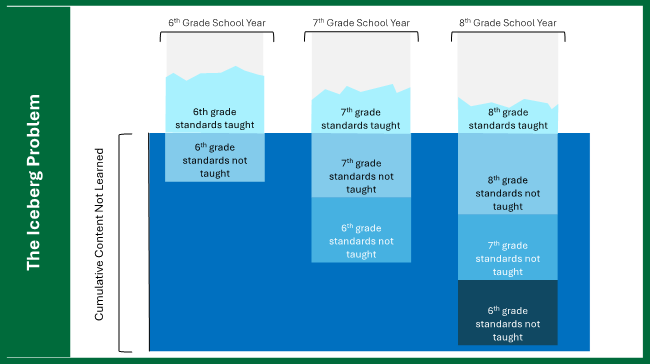
In the example in Figure 1, the sixth-grade team has followed the process of identifying priority standards or used priority standards the district gave them. Their instruction and assessment efforts focus on those standards, and they do not teach or assess the remaining standards. Naturally, student learning varies, and some students perform at higher levels than others. The state assessment indicates that students did not learn at appropriate levels.
The students move up to seventh grade, and their teachers also prioritize standards. They may try to address some of the unfinished learning from sixth grade but are more likely told to focus on the priority standards for their grade level. The amount of content below the surface grows because the unlearned sixth-grade standards add to the unlearned seventh-grade standards. Again, student proficiency on the priority standard varies, and the state assessments continue to show students’ lack of proficiency. This is repeated in eighth grade. A growing number of concepts and skills remain below the surface. And once again, the students’ performance on the state assessment continues to be far below what is acceptable.
What high-performing schools do differently
High-performing schools teach all the standards. Their teachers expect students to learn all the content and allocate instructional time for learning that content. They do not focus on priority standards. Instead, they focus on teacher expectations, the allocation of time, the value of learning, and aligned interventions.
Teacher expectations
The research on teacher expectations is robust and powerful. When we expect students to perform poorly, they do so in remarkable ways. And when we expect students to perform at high levels — and provide high-level content and support — the achievement gains are stunning. Reviews of the research on teacher expectations reveal not only the profound differences in learning outcomes when teachers have high expectations for students but also the specific actions and behaviors of those teachers (Rubie-Davies & Hattie, 2024). Table 1 shows some of the differences between low- and high-expectations teachers.
| Factor | Low-expectations teachers | High-expectations teachers |
|---|---|---|
| Performance orientation | Expect low performance and seek evidence to confirm these views. | Expect improvement and seek evidence to enact improvement. |
| Views on differentiation | Define differentiation as different activities for different groups of students. | Define differentiation as allowing students to take varying amounts of time and different paths to meet success criteria. |
| Focus on academic diversity in the classroom | See greater differences between students in class. | See fewer differences between students in class. |
| Grouping patterns | Use ability groups and design different activities for each group. | Work with all students in mixed and flexible groups. |
| Classroom tasks | Have students work alone, discourage interaction, and focus on compliance. | Have students work alone and with others and encourage student dialogue about learning. |
| Alignment with grade-level standards | Provide lots of repetition and lower-level activities for lower achievers and high-level activities for high-achieving students. | Engage all students in advanced, challenging activities aligned with grade-level expectations. |
The actions teachers take, the decisions they make, and the language they use communicate to students what their teachers expect of them. Expecting students to achieve the required learning, providing them access to all the standards and learning activities, and assessing learning to determine where lessons can be accelerated are hallmarks of schools that make a difference.
Allocating time
Teachers commonly report that they do not have time to teach all the standards, which has contributed to the focus on priority standards. In reality, instructional time is not used well, and the pace of many lessons does not allow teachers to ensure all students master the standards.
Time gets wasted in classrooms in multiple ways. In addition to the time lost for intercom announcements, staff visits, and students entering (or reentering) class in disruptive ways (Hess, 2023), time is spent as follows:
- Repeated learning. On average, 40% of instructional time focuses on content students have already mastered (Nuthall, 2007). This not only causes boredom, but also prevents teachers from introducing new ideas and skills.
- Downtime. Students spend 9-13% of instructional minutes waiting for something to happen (Fisher, 2009). This is why Madeline Hunter advocated for sponge activities that allow students to continue to learn and practice when lessons run short or teachers are occupied with administrative tasks (Hunter, 2004).
- Process explanations. Approximately 15% of instructional minutes are spent on procedural explanations that let students know what will happen in the next part of a lesson (Fisher & Frey, 2020). Using common and predictable instructional routines allows teachers to spend less time on procedural explanations.
Added together, about two-thirds of our instructional minutes are not focused on new learning, and only one-third are focused on concepts and skills students need to learn. No wonder teachers complain that there isn’t enough time to teach the standards. They are trying to do so in 33% of the allocated instructional minutes.
Aligning interventions
The education nonprofit TNTP (2024) studied 28,000 public elementary and middle schools in which the average student performed below grade level on the first year of state testing. Of those 28,000 schools, 5% (1,345) consistently delivered 1.3 to 1.7 years of learning for each year students were in school, and they did it year after year. These schools accelerated students’ learning and changed their learning lives.
In their study of these trajectory-changing schools, TNTP found the schools shared three characteristics:
- Belonging: They create an environment in which students felt valued, respected, and supported to do hard things.
- Consistency: They deliver consistently good teaching using grade-level content for all students.
- Coherence: They build a unified instructional program and set priorities that are clear to all, aligning interventions with the core academic standards and classroom instruction.
One of TNTP’s key findings is that any response to intervention (RTI) or multi-tiered system of supports (MTSS) must not replace the core curriculum but should instead give students access to the concepts and skills needed in their core classrooms to meet grade-level standards. For example, one intervention in the study involved preteaching concepts and vocabulary for an upcoming lesson so students could better understand the material when it was taught in the core classroom. Of course, some students will have unfinished learning that needs to be retaught, but focusing too much instructional time on the past prevents students from accelerating their understanding so they can meet grade-level standards.
The evidence suggests that effective supplemental interventions vary in terms of amount, duration, frequency, group size, and types of assessments. What they have in common is the removal of barriers, opportunities to learn, and enhanced delivery.
- Removing barriers. Barriers might include how often students are called on, which communicates what their teachers expect. Or they might be systemic, involving course schedules and progressions that keep certain students on a certain path.
- Opportunities to learn. The opportunity to learn is “the degree to which a student experiences classroom instruction, including a variety of approaches that address a range of cognitive processes, teaching practices, and grouping formats” (Heafner & Fitchett, 2015). For example, the ways teachers group students can impact the opportunities they have.
- Enhanced delivery. There are times when some students need additional support through systematic and intentional interventions. This is where differentiation comes in, as teachers change their approach or offer additional interventions to enable students to reach the learning goal.
Taken together, these three elements provide students with a system that responds to what students need to perform at their grade level. And system is the important word. Too often, these three elements are disconnected from one another, which lessens their potential. By creating a network of responses, rather than just one, we unleash the potential of RTI/MTSS as a crucial part of school improvement and student success.
Teach all the standards
The well-intended advice to focus on some, but not all, of the standards has had a negative effect on students, especially those most at risk of school failure. In our discussions with teachers who work in affluent schools, we found that those schools do not focus on priority standards. Some argue that they can teach more standards because their students already have extensive background knowledge and skills. That may be true, but removing blocks of standards would then put already-disadvantaged students at an even greater disadvantage.
If certain standards truly were not necessary for learning, they would — or should — be eliminated as part of the process to revise the standards. However, until and unless that happens, students deserve to be taught all the standards and have their teachers expect greatness, use time wisely, and align interventions to address unfinished learning.
References
Ainsworth, L. (2013). Prioritizing the Common Core: Identifying specific standards to emphasize the most. Corwin.
Fisher, D. (2009). The use of instructional time in the typical high school classroom. The Educational Forum, 73, 168-176.
Fisher, D. & Frey, N. (2020). No instructional minute wasted. Educational Leadership, 77 (9), 56-60.
Heafner, T.T. & Fitchett, P.P. (2015). An opportunity to learn U.S. history: What NAEP data suggest regarding the opportunity gap. High School Journal, 98 (3), 226-249.
Hess, F.M. (2023). Rethinking school time. Kappan, 104 (7), 36-41.
Hunter, R. (2004). Madeline Hunter’s mastery teaching: Increasing instructional effectiveness in elementary and secondary schools. Corwin.
Nuthall, G. (2007). The hidden lives of learners. NZCER Press.
Rubie-Davies, C.M. & Hattie, J.A. (2024). The powerful impact of teacher expectations: A narrative review. Journal of the Royal Society of New Zealand, 55 (2), 343-371.
TNTP. (2024). The opportunity makers: How a diverse group of public schools helps students catch-up and how far more can.
This article appears in the Summer 2025 issue of Kappan, Vol. 106, No. 7-8, pp. 8-12.

ABOUT THE AUTHORS

Douglas Fisher
Douglas Fisher is a professor of educational leadership at San Diego State University and a teacher leader at Health Sciences High & Middle College, San Diego, California. His most recent book, co-authored with Nancy Frey, John Almarode, and Kierstan Barbee, is Teacher Clarity: Four Necessary Components for High-Impact Student Learning (Corwin, 2025).

Nancy Frey
Nancy Frey is a professor of educational leadership at San Diego State University and teacher leader at Health Sciences High in California. Her most recent book, co-authored with Douglas Fisher, John Almarode, and Kierstan Barbee, is Teacher Clarity: Four Necessary Components for High-Impact Student Learning (Corwin, 2025).